Sixty years ago, at Christmas 1964, Britain was swept by Dalekmania. Toy shops were flooded with merchandise, the Go-Go’s released their (non-hit) single ‘I’m Gonna Spend My Christmas with a Dalek’, and the creatures turned up in political cartoons in the Daily Mirror, the Daily Express and the Daily Mail (by Franklin, Giles and Leslie Illingworth respectively). All of this was spurred by the screening of ‘Dalek Invasion of Earth’, Terry Nation’s second Dalek story for Doctor Who.
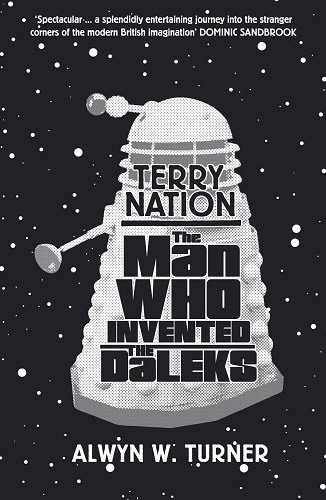
The following is extracted from Alwyn Turner’s book The Man Who Invented the Daleks…

The story opens under a semi-derelict bridge, on which there is a poster bearing the enigmatic and sinister message: ‘Emergency Regulations: It Is Forbidden To Dump Bodies Into The River’. A man appears, tearing away in anguish at the helmet encasing his head.
It transpires that we are in London in the year 2164, exactly two hundred years into the future, and that Earth has been taken over by the Daleks. Some humans have been brainwashed to act as the occupying force’s henchmen, the Robomen, while others have formed a determined, if largely ineffective, resistance. Despite the future setting, it was difficult to escape the past, to see this as being anything other than a development of the Nazi associations of the Daleks, an extension of that theme into an invasion of Britain (despite the title, we don’t leave south-east England).
The serial’s director, Richard Martin, was more than aware of the connections: ‘Terry and all of us who were making it were very influenced by the Second World War, because those images and those wrecks were still abundant. There were still bits of London where you could find the weeds growing, that they hadn’t rebuilt. So when I was looking for locations, and when he was describing locations, he was describing the stuff that we had intimately known during the Second World War.’
It was an impression reinforced by key scenes over the course of the six episodes. Daleks swagger – inasmuch as Daleks can swagger – around London landmarks like Trafalgar Square and the Albert Memorial; human beings are used as slave labour in a mine, under the direction of uniformed Robomen; and there is a genuinely shocking scene when Barbara and Jenny, a member of the resistance, having escaped from London into the country and found refuge in a cottage, are betrayed to the Daleks by the two elderly women who live there. ‘We’re old, child,’ one of the women tells Barbara in a deleted passage from the original script. ‘Times are difficult. There’s only one law now – survive.’
And just in case there might be any mistake, in the last episode the commander of the Daleks issues the ultimate orders: ‘Arrange for the extermination of all human beings – the final solution.’
Terry Nation was not the only person pursuing such imagery. A coincidence of timing had seen the release a month earlier of Kevin Brownlow and Andrew Mollo’s film It Happened Here, which had been eight years in the making. The movie’s portrayal of what Britain would have looked like in the aftermath of a Nazi invasion in 1940 bore some striking, if accidental, parallels with ‘Invasion’, not only in broad terms – both are set some years after the invasion has actually taken place – but in particular scenes: the shots, for example, of German troops around key London landmarks, including the same two sites of Trafalgar Square and the Albert Memorial.
The central figure in It Happened Here is a nurse named Pauline Murray, who a doctor friend tries to recruit into the resistance, using arguments not dissimilar to those employed in ‘The Daleks’: ‘The appalling thing about fascism is that you’ve got to use fascist methods to get rid of it.’ But Pauline is worn out by standing up for her principles, and has no appetite for a prolonged struggle: ‘My point is we’ve fought a war and lost it. There’s been a terrible lot of suffering on both sides, so why prolong that suffering?’

‘Invasion’ was very grim indeed, especially in the context of a teatime children’s show. The fratricidal reality of a society under military occupation achieves literal expression when a resistance fighter named Larry discovers that his brother has become a Roboman; in an ensuing fight between the two, they slay each other. As David, another member of the resistance, warns Susan: ‘Not all human beings are automatically allies. There are people who will kill for a few scraps of food.’
Meanwhile the debate about pacifism in the first serial has a successor in the shape of an argument, spread over two episodes, about how best to respond to the Dalek occupation. ‘What’s the point in running away all the time?’ asks the history teacher Barbara, and Jenny replies: ‘I’m not running. I’m surviving, that’s all.’ She later spells out what she sees as Barbara’s illusions: ‘You’ve got this romantic idea about resistance. There is nothing heroic about dying. There’s no point in throwing lives away just to prove a principle.’
The idea of surviving, of simply living in the face of overwhelming odds, was a concept to which Nation was repeatedly to return, and in his original script for ‘Invasion’ there was an explicit statement of the theme. ‘The world you have come into is one where friendships mean very little,’ David was to have told Susan. ‘There’s been no place for sentiment in society. Just staying alive is the most anybody has time for.’ Susan reflects on her own experience of extreme situations, the positive element of how they can build stronger ties between people: ‘The four of us faced dangers together and it seemed to give us a greater understanding of one another.’
So it was to prove here, for the story ends, after the defeat of the Daleks, with Susan staying behind on the future Earth to help David in the reconstruction of society, a prospect they have already contemplated. ‘One day this will be all over,’ says David. ‘It’ll mean a new start.’ Susan is enthused by the challenge: ‘A new start? Rebuilding a planet from the very beginning. It’s a wonderful idea.’ One might see here the germ of the idea that would become Survivors.
There were other elements that would recur in Nation’s work, including the central conflict between a totalitarian state and a scattered resistance movement. And the resistance is painted in the same, extravagantly idealist colours that would become a feature of Nation’s writing.

None of which is allowed to get in the way of what is at its heart a thundering good tale about terrifying aliens invading our world and being seen off. As a piece of television, it also benefited hugely from a move to a more spacious studio and from the extensive location shoots used for the first time in a Doctor Who story. Much more than the first story, this felt like a major piece of work, a modern myth in the making. In particular, the scenes of resistance leader Dortmun being hurriedly pushed in his wheelchair through deserted London streets, with the knowledge that Daleks might be lurking around any and every corner, were disturbing in a way not previously seen on British television.
Much of the plot is gleeful nonsense – the Daleks are trying to extract the molten core of Earth so that they can use the planet as an intergalactic spaceship – and the denouement that sees their evil plan thwarted is confused at best, but Nation is clearly enjoying himself, and the absurdities are less intrusive than might be expected.
The one exception is perhaps the Slyther, an alien creature kept as a pet by the Black Dalek, who is heading the mining operation. (The idea of a hierarchy within Dalek society was beginning to emerge.) As it appears on screen, the Slyther is patently a man in a monster suit, looking like a homemade approximation of a deep sea sloth. It should, however, have been more impressive than that. Drawing on his radio experience, Nation was keen to convey the creature essentially by sound – ‘this awful panting, gasping sound’ – and his original conception of ‘a huge, black jellyfish’ that we never quite see, just ‘the hint of a shapeless, pulsating mass’, had a hint of Lovecraftian menace that was never realised. Even so, the creature prompted a number of complaints to the BBC about it being too horrific for children’s television.
As was already characteristic of Nation’s writing, there are echoes of other stories. There is, for example, a hint of John Wyndham’s The Day of the Triffids in the account of how the Dalek invasion was preceded by a cosmic storm of meteorites, and by a plague that killed off a large part of the population: ‘The Daleks were up in the sky, just waiting for Earth to get weaker. Whole continents of people were wiped out: Asia, Africa, South America. They used to say the Earth had a smell of death about it.’ Likewise the Daleks’ plan to burrow to the Earth’s core is reminiscent of Arthur Conan Doyle’s When the World Screamed (1928), in which Professor Challenger drills through the Earth’s crust to prove his theory that the planet is actually a living organism in its own right. The result of his experiment is a series of explosions and volcanic eruptions all over the world, just as at the end of ‘Invasion’, and the Doctor’s comment could well have come from the mouth of Challenger himself: ‘The Earth rebelled and destroyed the invaders.’
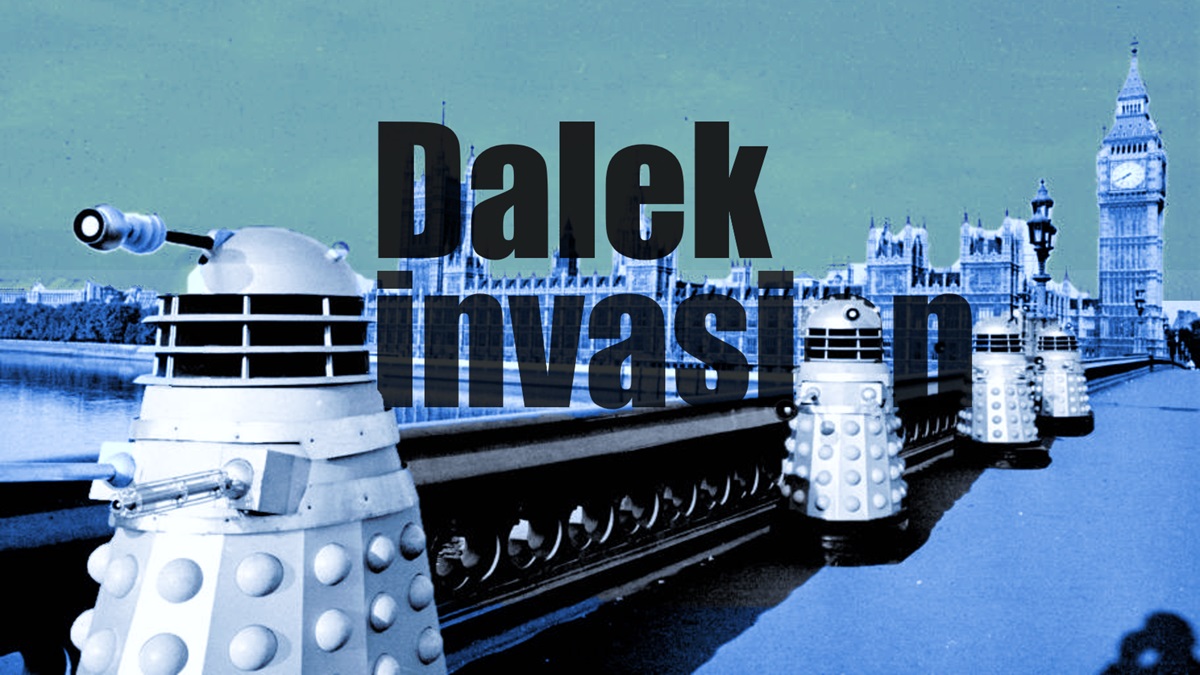
‘The Dalek Invasion of Earth’ was a major triumph, bigger even than ‘The Daleks’ had been. For the first time Doctor Who broke into the weekly top ten of the most watched programmes, and its position as the country’s favourite science fiction show was assured. That second story broke new ground for the series: the first monsters to return, the first invasion of Earth, the first attempt to establish continuity between two different serials. There was no guarantee that it would work, for much of this was without precedent in science fiction on British television. Quatermass may have enjoyed periodic revivals, but it was the humans not the aliens who were the common factor.
But the extraordinary wave of Dalekmania made the triumph seem like a foregone conclusion, and it was clear at the end of ‘Invasion’ that this was not the end of the story; the Doctor had encountered them twice now in their history and we knew that he would do so again.
Nation was on a roll, but then he never admitted to harbouring any doubts. Even before the serial was broadcast, he was positive and confident of its success. ‘I met Terry after we’d shot about three of them,’ Richard Martin remembered. ‘We had a showing, and he was over the moon. He was a lovely, ebullient, rounded sort of Welshman, and he clasped his hand around my back and said: “Well, boy, we had to come back big, and by golly we did!”’
now available…
Discover more from Lion & Unicorn
Subscribe to get the latest posts sent to your email.
