
SIMON MATTHEWS watches J. Lee Thompson’s 1957 movie Woman in a Dressing Gown.
Ted Willis is best remembered now for Dixon of Dock Green, the 1955 BBC TV series with the strapline ‘Stories of a London Policeman’. Based on PC (later Sergeant) George Dixon, one of the principal characters in his 1950 film The Blue Lamp, it proved astonishingly popular, running until 1976. Episodes began with Dixon, played by Jack Warner, emerging from Dock Green Police Station, saluting the audience and pronouncing ‘Evening all’. Initially his appearance was accompanied with a whistled rendition of ‘Maybe it’s Because I’m a Londoner’; once the series was established, the famous, wispy, harmonica theme took over.
Dixon tended toward ponderous, almost folksy, moral certainties, with his avuncular style giving him in later years an uncanny resemblance to prime minister Jim Callaghan. But there was more to Willis’s writing than that. He did comedy, scripting a couple of Norman Wisdom films, and had an interest in social realism. His 1947 play No Trees in the Street, set in the ‘30’s, was filmed in 1958. In his pre-war youth he had been secretary of the Young Communist League and drama critic of The Daily Worker, before shifting toward the Labour Party, who gave him a peerage in 1963, one of the few writers to be so awarded.
He also wrote prolifically for television, producing a great many series and stand-alone plays, one of which Woman in a Dressing Gown was broadcast on ITV Television Playhouse on 28 June 1956. Directed by Peter Cotes, who did the original stage run of The Mousetrap, it was a well observed study of infidelity from a woman’s perspective, and rated so highly that a film version was quickly put in train. Funding came from Associated British, and J. Lee Thompson was assigned to direct, probably because of his work on a couple of crime dramas, The Weak and the Wicked (1954) and Yield to the Night (1956), both of which featured strong female characters.
Filmed in late 1956, the action opens one morning in a council flat in London. In Wiltshire Close SW3, to be precise, on an estate not that long built. The central character is a housewife, chaotically preparing breakfast, rather badly, for her husband and son. She has the radio on – all the time – the blaring music accentuating a general feeling of disruption and disorganization. She also spends most of her day in a dressing gown.
Yvonne Mitchell, a 41-year-old actress, was cast as the woman, and was probably best known at that point for having played Julia in the 1954 television adaptation of George Orwell’s Nineteen Eighty-Four. She also wrote and directed plays, notably The Same Sky, a reworking of Romeo and Juliet set in an Orthodox Jewish household during the Blitz. It had a West End run, was performed on radio, filmed three times for TV and performed regularly in repertory.
Anthony Quayle is her husband. He extricates himself from the noisy fracas that commences the plot by walking – supposedly to work, to do some overtime on a Sunday – straight to a young woman’s flat in the then dowdy London W11.
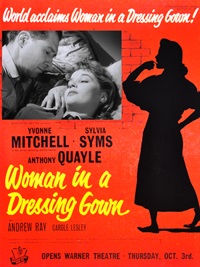
It is quickly apparent that she is his mistress, and that they’ve been having an affair for five years, having met at work. The sudden plunge that the film takes into open infidelity, rather than being something hinted at, must have been quite bracing for audiences in the mid-1950s. Sylvia Syms plays the young woman. (In the TV play the part was taken by Andrée Melly, sister of jazz-singer George.)
And so, it continues, gradually getting grimmer by the minute. This is pre-reform of divorce laws, when the agonies of adultery, were at their extreme, marital cases being reported, with descriptions of sex, in detail in local papers. Quayle’s and Syms’s characters work in an office somewhere in London’s docks (which gives the exterior scenes of this vanished landscape an additional piquancy). There are continual subterfuges about answering the phone, excuses for working late, not being seen to be too close etc. Events duly come to a head with a faltering request for a divorce by Quayle after which the dialogue, and situations, become harrowing, and very realistic, as anyone who has been through a relationship breakdown will testify.
It gets resolved in the end. Not happily, in the sense of a bow being tied, but in a recognisably pragmatic fashion, that still leaves viewers exhaling with something akin to relief.
It premiered at the July 1957 Berlin International Film Festival, where, despite an absurd review from Jean-Luc Godard (‘…from beginning to end, the film is an incredible debauch of camera movements as complex as they are silly and meaningless… May the English lose the Middle East soon if the loss of their political power could restore their sense of beauty…’), it won four awards, including, deservedly, Silver Bear for Mitchell as Best Actress.
Domestic critics differed widely, but it was a big hit with audiences, particularly women. Today, more than half a century later, some think it should be regarded as part of the ‘kitchen-sink’ genre. Certainly, the setting is similar: a council flat + woman in a state of undress doing housework + adultery. There is also a youth interest, with Andrew Ray (son of comedian Ted) as the son, whose girlfriend refers to a record they’ve bought as ‘groovy’, possibly the first use of this slang in a UK film. But they aren’t central characters.
Willis did have a habit of picking up on contemporary events, though. His 1958 play Hot Summer Night (filmed 1960 as Flame in the Streets) was written and staged a month after race riots in Notting Hill, Bristol and Nottingham. In some ways Woman in a Dressing Gown reminds one of Look Back in Anger, where Alison, Jimmy Porter’s wife, spends much of her time ironing in a dingy flat in her underwear and dealing with his adultery. This premiered on 8 May 1956, so the possibility of Willis seeing it early on and then writing Woman in a Dressing Gown doesn’t seem particularly far-fetched.
We don’t know, and in any case, most kitchen-sink dramas are aggressively male. This is from a woman’s point of view, showing how much damage they suffer when male testosterone gets out of control. Willis had explored this subject earlier, in a 1953 BBC TV series The Pattern of Marriage, starring Billie Whitelaw (who also played Dixon’s daughter in the first series of Dixon of Dock Green). What decisively excludes Woman in a Dressing Gown from ‘the kitchen sink’ is the age of the protagonists. At forty-three, Quayle is clearly too old to be an ‘Angry Young Man’. He was at RADA in 1931, and joined the Old Vic company a year later.

Like Quayle, director J. Lee Thompson was also a pre-war man, a precociously talented young playwright in the ‘30s. So was Willis. In 1963 he wrote the script for Bitter Harvest, an adaption of the 1935 Patrick Hamilton novel 20,000 Streets Under the Sky. Of late this too has been rediscovered and proclaimed a typical example of ‘British kitchen sink drama’, despite its situations and characters being at odds with those popularised by Osborne, Braine and co. It would be more accurate to say that ‘30’s style ‘social realism’ prepared the way for ‘kitchen sink drama’ whilst having a slightly different set of characters and situations.
Yvonne Mitchell’s tour-de-force in Woman in a Dressing Gown was her only starring role in cinema. Her distinguished career included appearing on Broadway in The Wall, a harrowing account of the Warsaw ghetto uprising, playing Virginia Wolff on stage in Bloomsbury and writing a biography of French writer Colette. It is slightly surprising to note that she was the cousin of Sir Keith Joseph MP. (Born Yvonne Joseph, she changed her name by deed poll). Considered a cold and unsympathetic character, he should perhaps have made more of this family connection when seeking high office in the 1970s.
see also:



Discover more from Lion & Unicorn
Subscribe to get the latest posts sent to your email.
