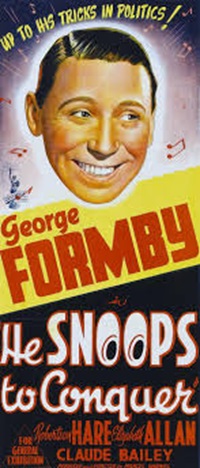
SIMON MATTHEWS on Marcel Varnel’s 1944 comedy He Snoops to Conquer.
George Formby died in 1961. He was fifty-six and had spent most of his time since the end of the war in seaside revues and touring the old white Commonwealth, where he continued to draw big crowds. His health wasn’t good and his involvement in a 1951 stage success Zip Goes a Million, playing a window cleaner (of course) who inherits a fortune, was curtailed after six months when he suffered a heart attack. Nor did his recording career prosper. Unlike other pre-war entertainers, such as Gracie Fields, he didn’t enjoy much success in the pre-rock and roll hit parade.
The truth was that for most people in Britain – excepting a loyal following north of the Wash – he seemed comically dated, forever resonant of the 1930’s, seaside holidays during ‘wakes week’, walks along wet and windy promenades and evenings sheltering at the cinema or local variety theatre. The big comedians of the post-war years – Tony Hancock, Peter Sellers – were decidedly cerebral by comparison, and Formby’s simpleton persona an increasing anachronism.
None of which detracts at all from his immense, national popularity in the earlier stages of his career. Particularly in cinema, where he appeared in twenty feature films between 1934 and 1946. The first couple were low-cost efforts hastily put together by Mancunian Films, but their receipts were sufficient for Associated Talking Pictures (based at Ealing Studios) to take an interest and sign him to a rolling contract.
Here he hit his stride in a series of modestly budgeted black and white capers that were typically about 70-80 minutes long and rattled along quite cheerfully, even if The Times noted ‘the structure of Mr George Formby’s films do not alter very much.’ They didn’t win awards, but with plots that ended with Formby triumphant, winning the girl and outsmarting his snooty adversaries, they made money. Lots of it.
Because of this, Formby moved to US studio Columbia Pictures in early 1941, after playing an employee in an underwear factory in Turned Out Nice Again. They made him an offer he couldn’t really refuse: a seven-picture deal guaranteeing him £500,000, a major step up from the £30,000 a film that he’d been on previously. (The average manual worker’s wage was around £250 a year.) Appropriately, his output here kicked off with South American George, surrounded by Latin rhythms and dancing girls. Not that any of it was filmed down Argentine way; production took place at Gainsborough Studios, Hoxton.
He Snoops to Conquer was his fifth outing for Columbia and was shot immediately after he returned from a visit to the D-Day landings, floating about offshore, entertaining the soldiers and sailors. It starts documentary style, in a newspaper office where the journalists are drafting a piece about post-war planning (strap-line ‘Decent Homes for Decent People’) which involves them visiting a typical UK town, complete with a coal mine, to assess the impact of this policy on the public.
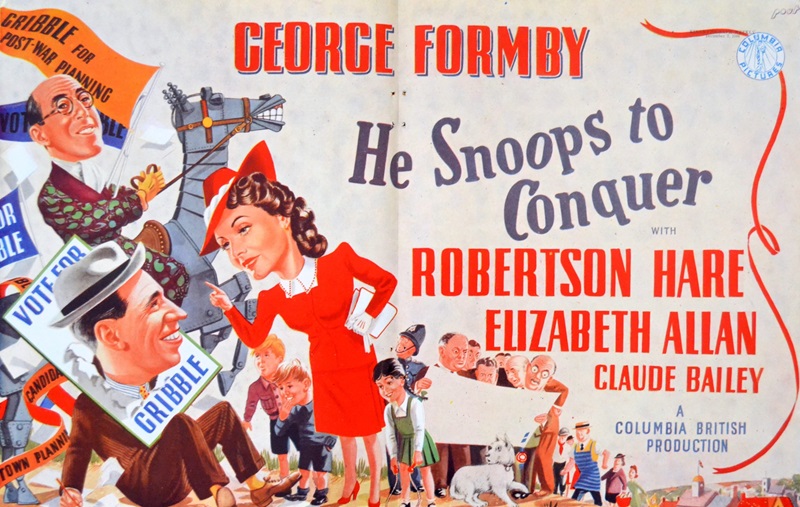
Here we meet Formby, as Gribble, a council employee, and by the look of it almost the only one. Smartly turned out in a double-breasted suit with a broad grin and his hair plastered flat, he soon has his uke out, busking through the topically titled ‘Unconditional Surrender’, a pleasing little number that was released on the flip side of ‘Our Fanny’s Gone All-Yankee’.
The town-hall politicians are a petty bunch of self-interested men, much put out by the interest taken in their fiefdom by the journalists. Formby – whose qualifications remain unclear, so simple is his character – is dragooned into doing a door-to-door survey of public opinion about local housing conditions. (It is interesting to note that such work is regarded as ‘snooping’, a very un-English intrusion into personal privacy.) Whilst carrying this out he comes across his co-star, Robertson Hare, playing a wealthy benefactor and mad inventor with more than a hint of Heath Robinson. Hare, a skilled farceur whose career stretched from Edwardian repertory theatre to early 1970’s television, is underused by a script that puts Formby continually centre-stage.
Hare’s character also provides the love interest at one remove via a daughter who is conveniently studying town planning. Having connected with the authentic voice of the people, with her assistance, Gribble outwits the smart businessmen running the town hall, and stands for election to the council on a ticket of introducing proper planning. After a ridiculous public meeting and an obligatory chase sequence, Marcel Varnel steers the film to its conclusion.
Lasting an hour and forty minutes, this is longer than Formby’s classic hits and contains an awful lot of talk about post-war reconstruction. More to the point, he is decidedly middle-aged, tubby, flat-footed and no longer able to get away with playing a gormless ‘lad’. He Snoops to Conquer failed to match his earlier successes and after Formby’s contract with Columbia expired in 1946 with George in Civvy Street, there were no further films.
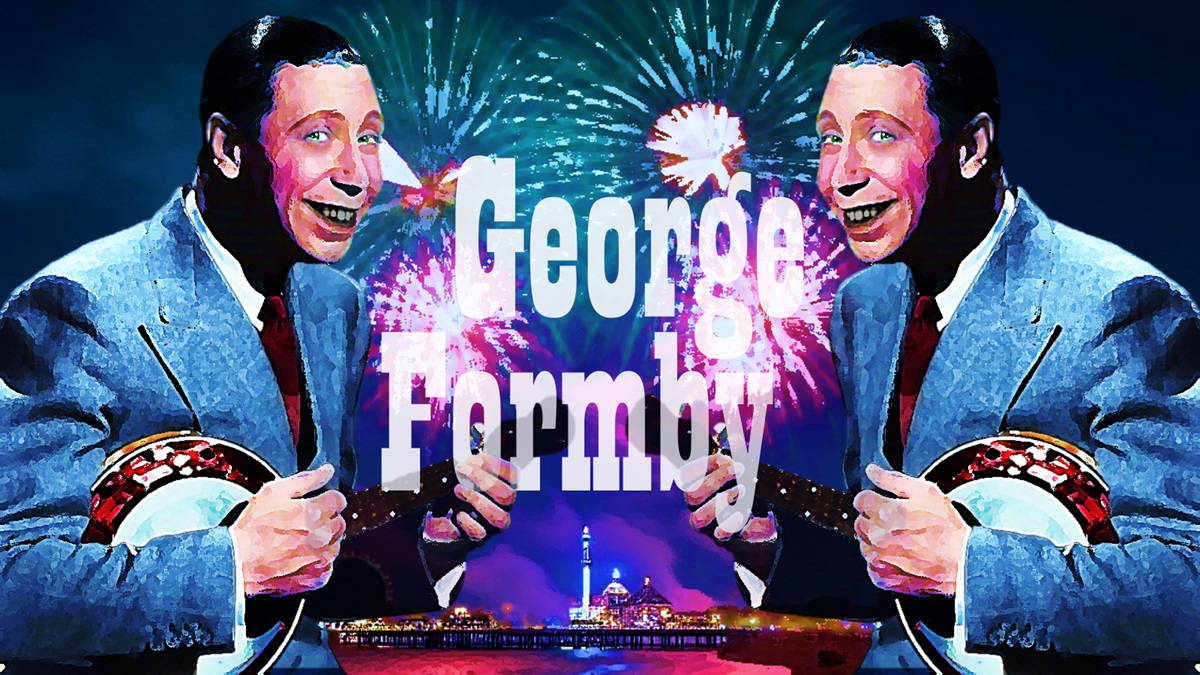
His obvious successor was Norman Wisdom who clowned and sang his way through films, stage reviews and TV series from the early 1950s to the mid-70s. And, for those wanting a solid-gold tribute act, there was Alan Randall whose vocal similarities to Formby were uncanny. The survival of this type of persona – a ‘northern’, unsophisticated, good-humoured, loyal character who outwits ‘smarter’ (usually ‘southern’ and middle-class) rivals – into the late twentieth century says much about the on-going north-south (and industry-financial services) divide in the UK.
For that reason, it remains possible that future Formbys (or Wisdoms) are yet to ambush us. Until he went serious, ukelele-playing Lee Evans looked a likely candidate. But if they do, none will project the innocence that Formby managed in his films, a quality that keeps them watchable despite their failings in other areas.
see also:


Discover more from Lion & Unicorn
Subscribe to get the latest posts sent to your email.
