When I was young, my dad’s parents lived on Victoria Street, built at the turn of the twentieth century in Willenhall, Staffordshire, a small industrial town with several lock factories. The only thing that marked out this perfectly normal road of terraced houses was that it could boast the 35-strong Victoria Street Girl Pipers. Of an evening, the back alley would be filled with the not-always-pleasing sound of a new recruit brushing up on her bagpipes.
They weren’t the only ones. There were girl pipe-bands across the country, all of them inspired by the world-famous Dagenham Girl Pipers, who have – very sadly – just announced that they are closing down after nearly a century, due to a lack of new recruits.
The original Dagenham Girl Pipers were a group of children, all under the age of thirteen, recruited by a Congregationalist minister, the Reverend Joseph W. Graves of Osborne Hall, Five Elms from his Sunday School. He also funded the band, borrowing against his insurance policies to kit them out not only with instruments but uniforms: velvet jackets, tam o’ shanters, kilts and sporrans. He employed Pipe-Major Douglas Taylor of the King’s Own Scottish Borderers to put them through eighteen months of practice before they made their first public appearance in May 1932. The aim was to raise funds to pay for the new church buildings, explained Graves, and he dreamed that the girls might one day participate in the Lord Mayor’s Show
That ambition was achieved in October of the same year. A week later Graves resigned from Osborne Hall, though he remained as manager of the band, which soon became professional, playing ever more lucrative and prestigious events, including the Royal Command Performance, and releasing gramophone records that sold very well.
In later years, they played for an impressive range of guests from the Queen to Elvis Presley. Perhaps most notable was their 1937 visit to Germany, as guests of the Hitler Youth, when the Fuhrer himself went to see them at the Winter Gardens in Berlin. ‘I wish I had a band like that,’ he said to Graves afterwards. But he didn’t, and was never likely to. They were far too British, part of the great tradition of this country’s working-class music: eccentric, nonconformist, autonomous.
I mourn their demise, another link broken in the chains that bind us to our history. Even the names of the founding members speak of a lost world: Margaret Batty, Gladys Cooper, Gladys Cross, Brenda Graves, Peggy Iris, Edna Jordan, Violet Nash, Doris Patterson, Phyllis Seabrook, Maisie Thompson, Edith Turnbull. Among those who joined soon after was mace-bearer Ada Clatworthy, born in Pratt Street, Camden Town – now there’s a name to conjure with.
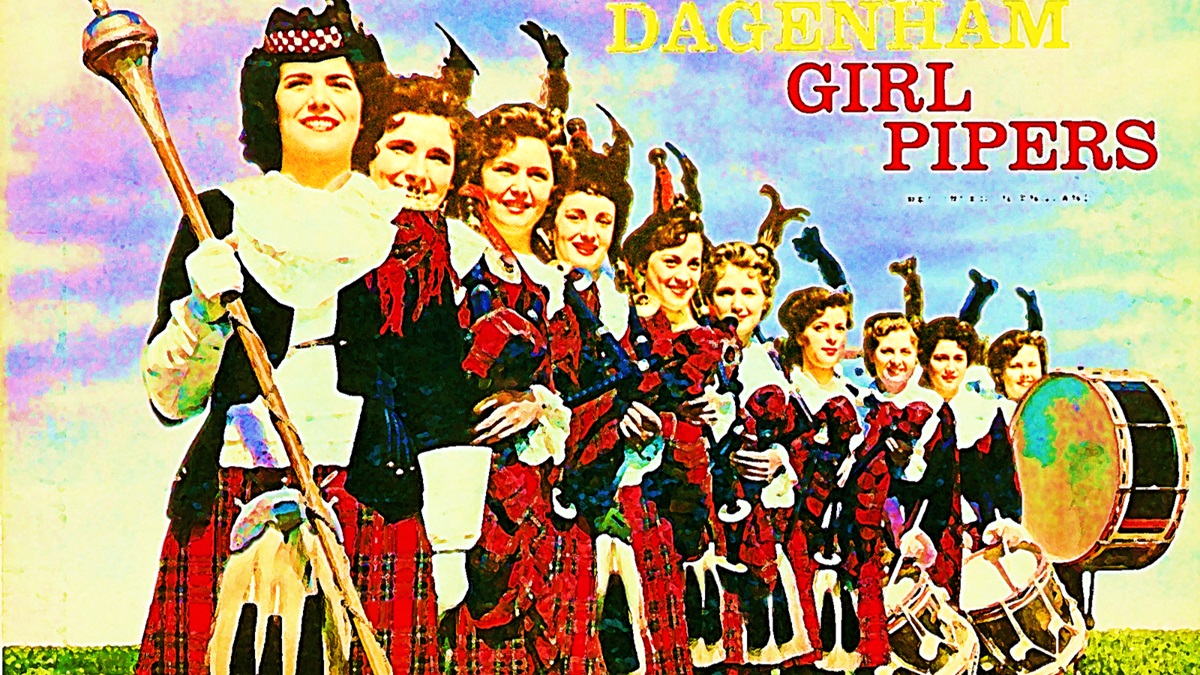
Not that one should get too sentimental and nostalgic. Part of the point of Rev. Graves’s initiative was to help the girls fight the impact of poor housing and hygiene conditions in the 1930s. ‘The bagpipes practice has developed their lungs and improved their general health,’ he said.
I went back to Willenhall about a decade ago. The Victoria Street Girl Pipers had disappeared, as well. On the other hand, my grandparents’ old house had – at some point since their deaths in the mid-1980s – acquired a bathroom and an indoor toilet. Change: it’s not all bad
Discover more from Lion & Unicorn
Subscribe to get the latest posts sent to your email.
