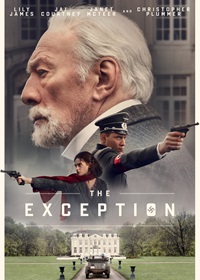
SIMON MATTHEWS on David Leveaux’s 2016 film The Exception.
This is a 2016 film. And one resting on the premise – first floated in Look and Learn No. 472 (30 January 1971) – that Winston Churchill offered the former Kaiser, Wilhelm II, exile in the UK in May 1941. We know the Kaiser never came, but despite such vague foundations, it provides a sufficient thread to spin an entertaining yarn.
Its source is The Kaiser’s Last Kiss, a 2003 novel by Alan Judd. Judd, real name Alan Petty, writes comment pieces for The Daily Telegraph and a motoring column for The Spectator. Before becoming a full-time writer, he served in the Army and the Foreign Office. His debut novel, A Breed of Heroes, set amongst the British Army in Northern Ireland (where he served) was much liked on publication in 1981 and was later adapted into a 1994 BBC TV play.
Things were clearly a bit more straightforward then, as the first thing one notices at the start of The Exception is the massive array of producers, distributors and financiers listed in the opening credits. You would also receive, if viewing this on TV, numerous warnings about ‘scenes of a sexual nature’ and, sure enough, the first of these happens ten minutes in, between a (Jewish) housemaid in the former Kaiser’s residence and the ‘good’ German officer sent to command the guard there after the occupation of Holland. It isn’t terribly plausible, not least because we learn soon afterwards that the girl is really a British agent.
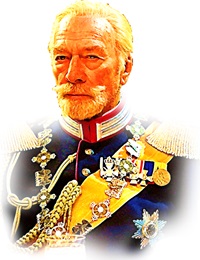
Dead centre in the plot, as one would expect him to be, is Christopher Plummer as Wilhelm II. It is a truthful portrait, produced by good, even brilliant, acting. Plummer, at 86, still had six films and a TV series to go before his death five years later. Watching him in action, surrounded by German military uniforms and intrigue, it is hard not to recollect his famous turn in The Sound of Music. Playing Princess Hermine of Greiz, Empress in exile (and wife #2), Janet McAteer is equally effective. One of the underrated actors of our time, she provided a linking narration in the otherwise flawed Velvet Goldmine, and received an Academy Award nomination for her role in Albert Nobbs (2011).
Beating them both in the thespian stakes (which are high here) is Eddie Marsan as an understated, unassuming and deeply chilling Heinrich Himmler. Inserted into the plot by Judd – Himmler and the ex-Kaiser never met – he engages in murderous, matter of fact table-talk, whilst proposing a restoration of the German monarchy. Relaxing with his own kind afterwards, he confides it is all a deception, ‘to flush out’ remaining Royalists in the armed forces and eliminate them. Marsan’s performance is so well-observed it really ought to have won an award, if Hollywood (or anyone else) were minded to give one to an actor portraying the head of the SS.
At its best (which is very good), the film succeeds when it portrays the moral choices faced by German conservatives after the emergence of Hitler. Brought up in the refined pre-1914 world, where antisemitic attitudes were common, and democracy merely tolerated, they proved incapable of seeing the NSDAP regime for what it was (or initially, were indifferent to seeing it as it really was), and lacked the ruthlessness to overthrow it once the scale of its crimes and transgressions were apparent.
A couple of scenes at the dinner table display this. The Kaiser (and his wife) indulge, as they always have, in light-hearted banter about ‘the Jews’ and their iniquity, in much the same way that they and most of the upper classes did in the late nineteenth and early twentieth centuries when ideas about the dominance of the Anglo-Saxon race were being propounded by Joseph Chamberlain and Theodore Roosevelt. Today, one bristles on hearing this, and it is immensely distasteful. But it is certainly not the same as the monstrous industrial-scale annihilation carefully explained to them by Himmler. (From which they recoil.) Nor, it has to be said, is their vision of the state brutally dictatorial, involving the operation of a party-political police force beyond the rule of law.
Thus, the film has an interesting feel when it approaches these issues. Alas, the remainder of the plot – scenes of a sexual nature excepted – is somewhat routine. The Gestapo are in town, inclined to torture, as ever, and the action eventually goes down market. After a Dick Barton-type chase, the serving girl (Lily James, later Lady Rose in Downton Abbey) escapes to the UK, and the ‘good’ German offer (Jai Courtney) ends up at a desk job in Berlin, corresponding with her via the Red Cross.

The film concludes with a twinkling-eyed Kaiser, attending to his paperwork at his desk in Holland. It is interesting to look on this as an exercise in his rehabilitation. Pre-1914, Wilhelm II was a semi-comic figure, always pictured in a pickelhaube, making stilted Teutonic comments with his withered arm carefully tucked away in a military jacket. Within a few years he was a barbaric war criminal whose soldiers (allegedly) skewered babies on bayonets. James Brockman (later co-author of that perennial hit ‘I’m Forever Blowing Bubbles’) wrote ‘We’re Going to Hang the Kaiser Under the Linden Tree’ and by late 1918 there were serious discussions between Clemenceau, Lloyd George and George Curzon about his being put on trial and hung, hence his exile in the Netherlands. Here, the best part of a century later, he is a genial old gent… and really, not that bad when compared with Himmler et al.
Is there a message of some kind for our own times here? Attempts to research whether the Kaiser was offered exile in the UK in May 1940 (and at whose request) don’t produce much. Perhaps Judd came across a couple of yet-to-be released files delineating this. For the moment, this remains one of a substantial number of UK WW2 counterfactuals, a bit like Len Deighton’s SS-GB. But the acting is great.
see also:



Discover more from Lion & Unicorn
Subscribe to get the latest posts sent to your email.
