Mark Lawson
Bloody Margaret: Three political fantasies
Pan, 1991
It is an intriguing feature of this fine collection, comprising one short novel and two short stories, that the further these tales move from their inspiration, Margaret Thatcher, British Prime Minister from 1979 to 1990, the more engaging they become.

By contrast, when they drift into the powerful orbit of Baroness Kesteven (as she was to become) the pace and engagement seem to flag.
In part this is the result of time passing. The great passions excited by the lady are mostly gone, as is she herself. But in part, I fear, it is that she was never as interesting as members of the intelligentsia, both opponents and supporters, believed at the time.
More on that in a moment.
The short novel, ‘The Nice Man Cometh’, is quite clearly the best of the three, and not just by virtue of being the longest. Its central character, Graham Sterling, is a medical journalist, a polite way of saying he toils for Dentists and Dentistry, a trade mag for tooth doctors. His brusque but loving and supportive wife Eliza tells friends and acquaintances: ‘Well, it’s a smart move to have a specialism under your belt, if you’re looking to get into Fleet Street.’
The story opens at the dawn of the 1980s, with Graham, Eliza and some, although not all, of their fellow middle-class London friends enraptured by the return of Roy Jenkins from Brussels and the subsequent launch of the ‘nice people’s party’, the SDP.
‘Graham has come out of the closet,’ Durry explained, ‘and joined the SDP.’
‘Well, bugger me!,’ laughed Ben Waddle. ‘So have we!’
The new recruits are sometimes a little vague about what the SDP stands for.
‘You’re comfortable about the new party supporting nuclear weapons, are you?’
‘Does it?’ asked the Waddles simultaneously. They were pacifists.
‘I don’t think the policies are fully worked out,’ said Ben.
Graham suffers from a quite severe inferiority complex. He often begins his sentences with: ‘Er…’ He seems a half-decent cook and, much to his own surprise, proves adept at navigating the internal politics of Oral, as the magazine has been renamed by its new publisher Garry McKenzie, a pornographer. But when he is summoned for an interview with McKenzie, he has to have his lines written out for him by Eliza.
The narrative canters through the decade – the Falklands, Tory election victories in 1983 and 1987 – and thus to the ultimately underwhelming performance of the SDP-Liberal Alliance. Disillusionment sets in as Graham studies the 1987 manifesto:
It was not that he disagreed with any of it … but that, in a commendable efforts to avoid the rhetoric of division, the party seemed to have been drawn to pettiness – the state of Britain’s phone boxes was treated as a cause celebre – or self-cancelling sops to two sides: ‘We will strengthen the police BUT increase their accountability.’
As the two wings of the Alliance stumble towards a full merger, Graham and Eliza are pushed apart, the result of an adulterous affair on his part with Anne, a female colleague.
Graham and Eliza’s marriage was concluded, as it had been conducted, with minimal emotion or even discussion. In fact the mechanics of the separation were a parody of their relationship … It was Eliza who took control. ‘OK,’ she said back in their flat on the Sunday evening, ‘I think there’s someone else and I think it’s probably that little girl from your office. I’ve never seen the point of melodrama. So I wouldn’t waste my breath fighting for your affections.’
Anne and Graham go on to marry.
‘But she’s confused, Gray. Hurt. She says she doesn’t know what happened. Frankly, it surprised us all. I mean it never occurred to us that you of all people would run off for a bit of bonking on the side … She was barmy about you. Actually, sometimes I think she was just barmy.’
A theory doing the rounds among this set is that Graham was so frightened that Eliza would hurt him that he hurt her first. If so, it was all a terrible waste. She would have stayed with him whatever the weather.
The tale concludes with the couple plus some friends from the old days holidaying in a Tuscan farmhouse in July 1990, as it turned out just days ahead of the Iraqi invasion of Kuwait. One woman of their party buttonholes Graham on the subject of Eliza.
‘And – I can say this to you because I’m your friend – you might not always, all the time, be quite as nice and decent as you think you are…’
A desperately sad story, beautifully told.
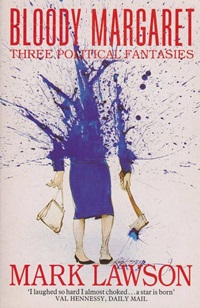
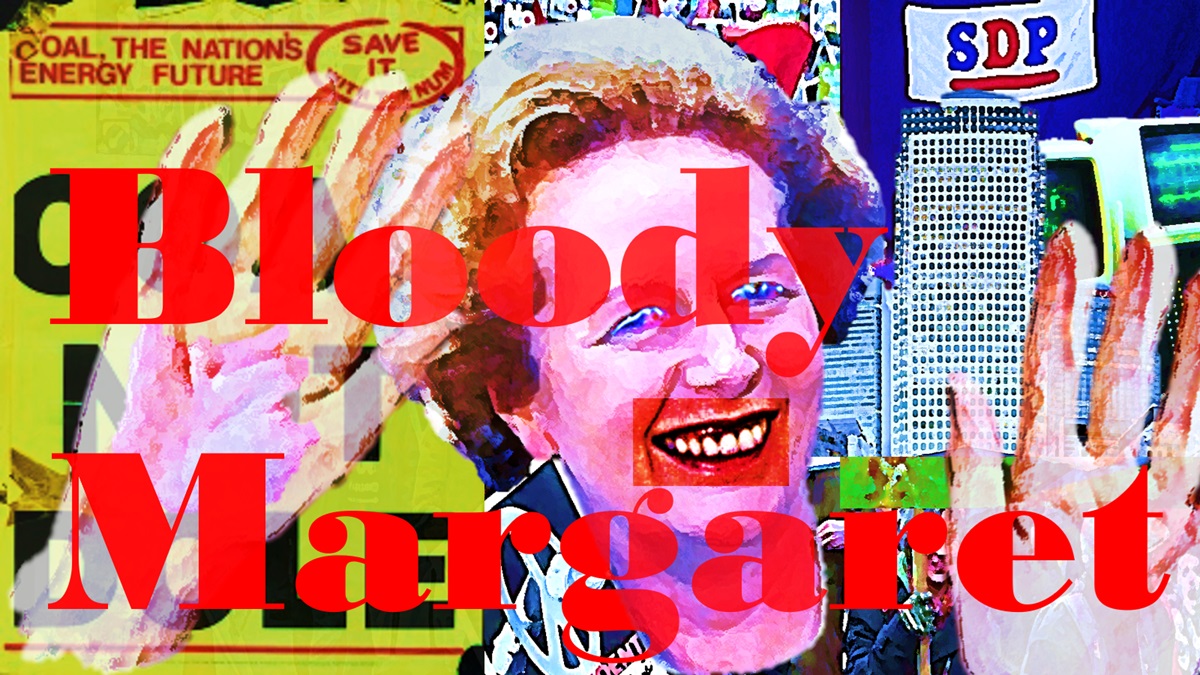
From the strongest piece in the collection to, in my view, the weakest, the ‘title track’, as it were, ‘Bloody Margaret’. In keeping with my earlier argument, the weakness here stems from its being the tale most closely bound up with the doings of Margaret Thatcher, divided into four sections, each taking its name from the venue of a key event in the then Prime Minister’s life.
There is the 1987 party conference in Blackpool, the Group of Seven summit in Toronto in 1988, the St James’s Park photo-opportunity that same year, in which Mrs Thatcher picked up litter to set an example and, later in 1988, preparations were made for her to address the General Assembly of the Church of Scotland. Finally there is London in 1990, with occasional glimpses of an international summit in Paris as her premiership comes to an end.
A rotating crew of narrators (how very 1990s) provides the commentary: her bodyguard, her clergyman, press secretary, old school mate, image consultant, soldier, cleaner, a journalist, an ex-Minister, and ‘ultra-loyal’ backbencher and her Ayurveda teacher (nor I).
There are some piquant reminders of the three years in question. The bodyguard notes:
[T]here has been a lot of gossip in the press about, I may have got the numbers wrong, the Guildford Four, the Birmingham Six, the Magnificent Seven and very probably, I wouldn’t wonder, the Famous Five. There is talk of forensic errors, of members of Her Majesty’s Constabulary falsifying confessions.
He points out that the public cannot be given all the facts for security reasons and that overworked coppers and forensic analysts can occasionally make mistakes.
As things turn sour for Mrs Thatcher in the late summer and autumn of 1990, her deputy, Sir Geoffrey Howe, resigns. Her press secretary is nonchalant.
Talk about ‘is resignation won’t be steaming up the windows of the Plough and Whistle. Nah. His differences with the Prime Minister are over tone and style, not policies. Anyway deputy Prime Minister. Deputy schmeputy, This resignation, it reminds me of when you read in the papers that someone – a film star, mebbe – has died and you think: ‘I thought they were dead already.’ You know what I mean?
There is much amusement at the supposedly erratic behaviour of the Prime Minister at the summit in the French capital, at which she heard she had failed to see off her challenger in the first round of voting, but no mention of the fact that she was there to sign the Peace of Paris, which ended the Cold War.
Finally, to ‘Teach Yourself American in Seven Days’, the tiddler of the collection. In the late 1980s, I was due to meet someone in the Corney & Barrow wine bar on Cannon Street. Arriving early, I ordered a drink and gazed idly at the television behind the counter, showing footage of some heavy blizzard in the United States,
After a moment, it dawned on me that these images were not being relayed via Auntie or ITV – I was actually watching American TV news.
It wouldn’t cause a flicker today.
Robert Oscott is a Brit who has not so much embraced what he thinks of as the American way of life as been swallowed whole by it.
For this was the thing which Robert Oscott liked most about London in 1990, that, with network television coming by cable and satellite, the sleek City sandwich joints which sold greasy pastrami piled on rye, the underground restaurants where Californian and Brooklyn girls served you fat and haemorrhaging hamburgers, you could pretend to be in America.
Oscott manages the remarkable feat of ordering none of the great burgers, ribs, hot-dogs or Tex-Mex dishes offered by our American cousins instead, going for a ‘Pacific Heights’, which sounds quite extraordinarily revolting: ‘In this design, the beef was topped with blue cheese, chilli and fried banana.’
He invests in a the ‘Teach yourself…’ course, which yields some hilarious results. But, although he works for an American-owned stockbroker, he has never visited the United States, until invited to do so by his firm, along with some colleagues. This coincides with the Iraqi invasion of Kuwait and the subsequent Allied response. Oscott takes what he imagines is a suitably robust, American line.
He had restricted himself to contributing short, loud assessments of Iraqi military capability, usually ending with an exclamation like; ‘And then it’s Goodnight, Mustafa.’
I like this story enormously, not least because of its Thatcher-light structure. In this, it is in sharp contrast to the second tale, whose fascination with the Iron Lady sometimes veers towards the sort of unhinged venom that once marked the effusions of the likes of Red Wedge and Class War, The clergyman takes up the tale:
Has any modern politician unleashed hatred, a word I dislike but feel constrained to employ, on the scale that she did? Cartoons and television spoofs have become nastier and more furious during her decade.
I am not sure that was entirely the then Prime Minister’s fault.
The contrary view, mentioned earlier, is that Margaret Thatcher really wasn’t as interesting as all sides made out. Her achievements, love them or loathe them, were largely in the areas of suppressing inflation (although it was rising again by the time she left office), curbing the trade unions, downsizing the industrial or commercial parts of the public sector (coal, gas, steel, water and the rest) and beefing up the armed forces (before reducing them again).
Elsewhere, nothing happened. The schools were at least as bad at the end of her time in office as at the beginning. The same was true of the health service. Crime soared during her premiership and the first seeds of ‘woke’, two-tier policing were planted.
Don’t take my word for it. As Lawson reminds us in the middle tale, during the Blackpool conference Mrs Thatcher ripped into the failings on schools and crime, as if someone else had been in charge for the previous eight years.
All said, this is a wonderful book, rich in detail and, for some of us, in memories.
A final word to one of the Brits in ‘Teach yourself…’
‘What I find amazing, looking back, is that moment, only last summer. I’m serious. When Eastern Europe was electing governments, Russia was seriously reforming, or so we thought, and we were all – weren’t we? – worrying about what to do with all the money we wouldn’t need to spend on guns. I suppose, when we’re old and boring, tapping past the war memorials with our sticks, we’ll always remember that summer of 1990 as a kind of mirage.’
Ain’t that the truth?
also see:


Discover more from Lion & Unicorn
Subscribe to get the latest posts sent to your email.
