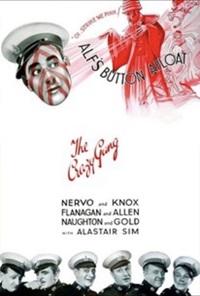
SIMON MATTHEWS on the Crazy Gang in Marcel Varnel’s 1938 comedy Alf’s Button Afloat.
Nine decades on from their peak, who remembers the Crazy Gang? More to the point, looking back from the first quarter of the twenty-first century, what does anyone remember now about UK cinema in the 1930s? Possibly the early Hitchcocks and, for the more historically minded, selected documentaries. (Take a bow, Night Mail).
As suggested by their name, the Crazy Gang were a group of comedians, more specifically three double acts: Flanagan and Allen, both of whom were quite tall, Nervo and Knox, who were noticeably shorter and Naughton and Gold who were even smaller, barely five-foot. The latter were also older, having emerged from music hall pre-1914, – the other duos only became widely known during the 1920s on the somewhat different variety circuit.
Individually or collectively, there was nothing inherently ‘crazy’ about them. Allen was a bit gentlemanly, Flanagan, who was Jewish, was an over-confident wide-boy, Knox specialised in speaking gibberish in a diffident middle-call accent and Naughton and Gold did a lot of physical comedy. But this is to miss the context of when they came to prominence. They first performed together during the depths of the inter-war depression, playing men adrift from their families, living off their wits and eking out a living as simple street entertainers. (Of which a great many could be seen on the streets then).
Assembled as a ‘Gang’, their style became manic, involving a great deal of falling over, funny voices and imbecilic, machine-gun speed banter. They provided simple entertainment for the masses. It was immensely popular. In 1932 they wowed the Royal Variety Performance, on a bill that included music hall legends Harry Champion and Vesta Victoria. Times were hard and nostalgia was at a premium. During 1935 they appeared in three separate revues at the London Palladium and thereafter settled down to a routine of an annual stage show interspersed with films and summer seasons.
Their big screen debut came in 1937 with OK for Sound, adapted from a play by song-writers Bert Lee and R. P. Weston and with a plot described in one reference work as ‘After falling on hard times, the members of the Crazy Gang are busking on the streets of London.’ The Band of the Royal Marines also featured. With significant box-office success, the Gang sought to repeat the formula.
Thus was born Alf’s Button Afloat, a remake of Alf’s Button, a World War I escapist fantasy written by William Aubrey Darlington, drama critic of the Daily Telegraph. About a soldier who polishes one of the buttons on his tunic and discovers that it summons up a genie who can grant him any wish he wants, it had already been successfully staged and filmed twice. The plot was switched from the army (and the trenches) to the peacetime Royal Navy, allowing the Band of the Royal Marines a return appearance. Not that any of it was shot at sea. Whilst including a few stock footage clips of battleships etc, it was filmed on sets at Gainsborough Studios, a cavernous former electricity generating station in Shoreditch originally built to power the Moorgate-Finsbury Park branch of the Northern Line.
Directed by Marcel Varnel, the go-to man for UK film comedies at that time (he did them all: Will Hay, George Formby, Arthur Askey) it opens with a fine exposition of the back story, done documentary style and with virtually no dialogue, showing a magic lamp being buried, dug up, bought by a sailor, sold in Bow Road, tossed away as scrap, smelted and made into buttons, one of which is duly sewed onto a new Royal Marine tunic. From this cinematic high we descend to the Crazy Gang, busking on a street corner, presumably in a naval town. The Band marches past, and in chaotic scenes all six are swept into the Royal Marine depot, where despite their age, and diminutive size, they are put into uniform.
Eventually ‘Alf’ (Bud Flanagan, though he doesn’t really play any character other than himself) accidentally polishes his magic button and Alastair Sim appears as the genie, towering over them in a fantastic costume. An excellent actor who had learned his trade at the Old Vic, Sim enjoyed numerous West End successes during the 1930’s in staged adaptations of Ian Hay and Edgar Wallace. His terrific diction and beautiful voice are deployed to full effect even if his sole function here seems to be to act as a straight man to the six comics.
In fact, the entire cast do little more than perform as straight men (or women) to the Crazy Gang. There’s a grumpy admiral, whose daughter gets involved with a young Lieutenant and a Royal Marine sergeant-major driven to distraction, but none have any real function other than to give the comedians a break. Later, there is a concert on board where the Gang do their acts, including some in drag, and a bit of faux comic opera. After a few more wishes they end up fabulously rich in a harem. Sim turns into a US gangster and they disrupt a fox hunt at an enormous country house.
The latter episode illustrates the simple voyeurism that the film encouraged for working-class audiences: the Crazy Gang are harmless fun because they get accidentally mixed up with their social superiors. But there is never any satirical handling of this. Class divisions remain intact and are never challenged. Finally, with its running time complete, and all manner of twists having been introduced to the plot, they wish themselves out of the enveloping denouement and tumble back onto the street.
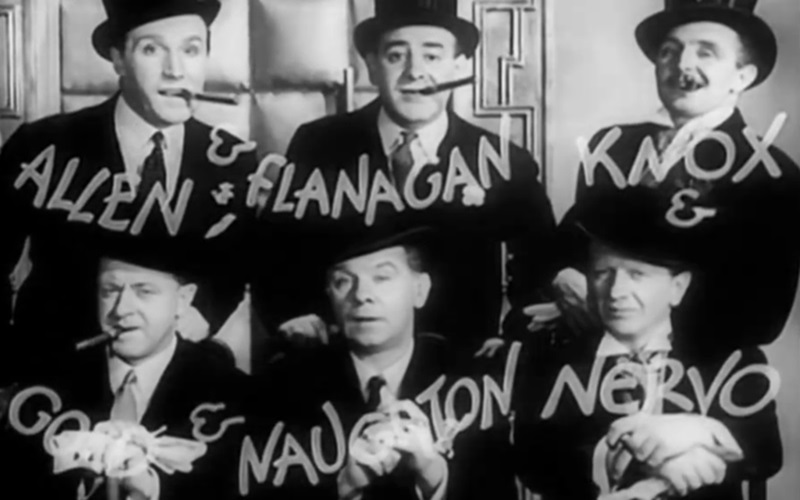
Released in July 1938, this would have been a big attraction, shown as part of an evening’s entertainment alongside cartoons, a newsreel and second feature. In larger cinemas the trappings of the variety circuit were also incorporated with comedians, magicians and so on performing between each item.
But at this distance, is Alf’s Button Afloat any good? Contemporary audiences might well find it tiresome. Whilst there are jokes in the dialogue that still raise a chuckle, everything is spoken so quickly that they flash by before one can digest them. Rather oddly, Flanagan and Allen, whose recordings in the 1930s retain a genuine period charm, are not required to do any singing.
The Crazy Gang’s style of manic comedy, which is hard to equate with anything today, remained popular for a long time. They appeared in seven further revues at the Victoria Palace between 1947 and 1960. After a stab at TV, with Peter Glaze in the mid-1950s, they made their last film Life is a Circus in 1958 (the plot of which also includes a magic lamp and genie) and finally disbanded after a slot at the 1961 Royal Command Performance, clowning for the Queen Mother, a great fan of variety.
Their longevity, from pre-1914 music hall to early 1960’s television, was astonishing. Nor did it end then: a tribute show, Underneath the Arches, with Roy Hudd as Bud Flanagan, and Glaze as one of the Gang, opened at the Chichester Festival Theatre and then ran at the Prince of Wales Theatre 1982-1983. Sensibly, it concentrated on the music.
see also:

Discover more from Lion & Unicorn
Subscribe to get the latest posts sent to your email.
