
The following is extracted from ALWYN TURNER’s Rejoice! Rejoice! Britain in the 1980s.
The late-1970s had seen sporadic conflict between the police and black youths, particularly at the annual Notting Hill Carnival, but it was not until the Thatcher years that the underlying hostilities really exploded. When they did, in April 1980, it was unexpectedly not in London, Liverpool or Birmingham – their time would come – but in Bristol.
Unnoticed by the rest of the country, tensions had been building in the city for some time: black unemployment had doubled over the last four years, at a time when it was in decline locally amongst white workers, and there had been a steady stream of complaints about a campaign of police harassment that had, amongst other things, closed down all but one of the black-owned cafés in the St Paul’s area, where prostitution, cannabis-smoking and unlicensed drinking were said to be rife. It was a mass raid by uniformed policemen and drug squad officers on that last remaining café that provoked a spontaneous fight back by some 2,000 youths, forcing the police off the streets for several hours. Buildings and police cars were burned, causing an estimated half-a-million pounds of damage, before order was restored.
This was not, despite the inevitable tone of much of the coverage, a race riot as such, a conflict between white and black; rather, in the words of one St Paul’s resident: ‘This is the start of a war between the police and the black community.’ Twelve people were later charged with riotous assembly, a serious offence that brought a potential sentence of life imprisonment, but none was convicted.
From the state’s perspective, the most worrying aspect of the events was the withdrawal of the police at the height of the disturbances; it was ‘unacceptable’, insisted home secretary William Whitelaw, and he set up an inquiry into the police response to the riot, though not into their prior behaviour, nor into what might lie at the root of the problem. Perhaps he felt there was little need, since the answer was relatively obvious and required government action that was unlikely to be forthcoming. ‘The causes, then, lie in the squalor and deprivation of decayed urban centres, in empty lives, and lack of work and opportunity,’ noted an editorial in the Sun. ‘These same conditions exist on a far greater scale in other cities: Liverpool, Manchester, Newcastle and London itself.’
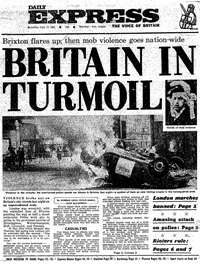
Indeed they did, as did heavy-handed policing, and a year later a police operation in Brixton, South London sparked an explosive two days of rioting, more serious than any comparable disorder thus far in the century. The estimated damage this time amounted to £6.5 million, while hundreds were injured, and police casualties outnumbered civilians by around three to one. Petrol bombs were used on a widespread scale for the first time on the British mainland, and several buildings were burnt down, though the arson was not indiscriminate: the local Law Centre and the branch of Marks & Spencer remained untouched, while a pub with a reputation ‘of having in the past discriminated against black people’ was attacked. So too was a newsagent that ‘was alleged to have refused to serve homosexuals’.
It was, said Whitelaw, ‘a shameful episode in our nation’s life.’ Amongst those arrested was the future comedian Mark Steel, who recorded his observations at the station: ‘“Black bastards,” said a copper as he smashed a truncheon into the face of a lad stood about ten yards from me. A line of black youth descended the stairs at the back of the station, each of them with their face covered in blood.’ Others provided similar stories of police action; John Clare, the BBC’s community affairs correspondent, witnessed three officers attack a photographer who was taking a picture of a man being arrested: ‘his camera was wrenched away, thrown into the gutter and stamped on,’ it was reported, and the photographer ‘was severely beaten up with the police aiming at his groin: the motorcycle he had been riding when he took the picture was dragged along the road and its petrol tank ripped open’.
Again this was not a race riot, but an attack on a seemingly indifferent society and on policing practices. ‘Fuck monetarism, fuck the free market, and more specifically fuck the police,’ as one sympathetic writer put it. ‘There is police violence,’ a retired detective, John Scott, told the Labour Party conference later that year, ‘and while there are many people in the police force who are not racially or politically prejudiced, the vast majority are.’
Other commentators were keen to explore a wider dimension; journalist John Cole, soon to become the BBC’s political editor, drew parallels with the American riots of the mid-1960s and concluded: ‘The casus belli of a youth war therefore lies in unemployment, bad housing, the breakdown of morality and of family/school discipline, a more rebellious attitude to authority in this generation, over-reaction by the police, the violence of youth culture, of some rock music . . . The list trails on to infinity.’

Political reaction was divided, even within the Labour group on Lambeth Council, within whose environs Brixton lay. The council leader, Ted Knight, complained about saturation policing not merely before but after the event: ‘Lambeth is now under an army of occupation’, he said, claiming that the police were using the ‘same apparatus of surveillance that one sees in concentration camps’. More publicly, an editorial in the magazine London Labour Briefing, a journal particularly associated with both Knight and Ken Livingstone, caused some controversy with an editorial that argued: ‘An alternative view would be that the street fighting was excellent, but could have been (and hopefully, in future, will be) better organized.’
The official government response again fell to Whitelaw. Less than a week before the Brixton riot, he had rejected Enoch Powell’s latest call for the repatriation of black Britons to their countries of racial origin, with an unequivocal endorsement of a multi-racial society that wasn’t shared by all members of his party: ‘Black people are part of this country and part of our future.’ Now, he managed to resist the press calls for immediate and draconian action and instead appointed Lord Scarman – said to be one of the more liberal members of the judiciary – to chair an inquiry into the riots.
Whitelaw’s statement to the Commons concluded that ‘we must develop policies designed to promote the mutual tolerance and understanding upon which the whole future of a free democratic society depends’, and he was later to claim, with some justification, that: ‘The thing I am proudest of is that I managed to handle the riots in 1981 without being forced to take more repressive measures.’
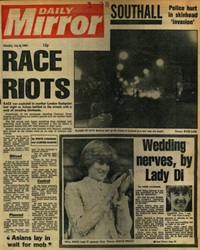
Even as Scarman was installing himself in Lambeth Town Hall to collect evidence for his inquiry, the first week of July 1981 saw another outbreak of rioting, first in Toxteth, Liverpool, followed swiftly by Southall in West London, Moss Side in Manchester and Handsworth in Birmingham. There were smaller disturbances too in a dozen other places, including Leeds, Preston, Wolverhampton, Hull and again in Brixton. The worst of these were in Toxteth, where the police used CS gas for the first time on the mainland and where the first fatality was recorded – a disabled man named David Moore was killed after being hit by a police van driving on a footpath.

When Scarman did deliver his report, it was critical of the police, even if some felt that it pulled its punches: ‘racial prejudice does manifest itself occasionally in the behaviour of a few officers on the street,’ he conceded, but ‘the direction and policies of the Metropolitan Police are not racist’. He recommended that greater efforts be made to recruit black officers, and that racist behaviour be made a disciplinary offence, with dismissal as the normal penalty.
What was most striking was the placing on official record for the first time of extremely hostile attitudes towards the police, and of so many anecdotal accounts that they could hardly be ignored. Even amongst many black people of an older generation, the Scarman Report came as a revelation.
The balanced and carefully weighted liberalism of Scarman’s words, however, was enough to infuriate some senior officers. James Anderton, the chief constable of Greater Manchester claimed that, if the report’s recommendations were implemented, ‘the character of the British police would never be the same again.’

Discover more from Lion & Unicorn
Subscribe to get the latest posts sent to your email.
