SIMON MATTHEWS on Pete Walker’s 1972 film Four Dimensions of Greta.

Film reference books usually avoid mentioning Pete Walker. From Salford, and the son of music hall comedian Syd Walker, he directed 15 feature length productions between 1968 and 1983, energetically bucking the decline that UK cinema experienced once the froth of swinging London subsided.
It was a grim, austere time. The combination of increased television ownership, development finance that couldn’t match Hollywood budgets, arts funding being appreciably lower than that enjoyed in Europe and some notable box office failures led to many cancelled projects and a steady reduction in the number of films made for the domestic market. And whilst the James Bond and Carry On franchises continued to do excellent business, for others the reality was how to turn a profit by making something the public would watch, and wasn’t available on TV.
Which was where Walker spotted an opportunity. Like his father, he started out as a comedian, albeit in less salubrious settings: entertaining disinterested punters in a Soho strip club circa 1957. From there, and careful initially to use a pseudonym, it was an easy step to making 8mm ‘glamour’ films of girls undressing, dressing and generally cavorting with no clothes on. Distributed privately, they made enough money for him to go legit in April 1968 with The Big Switch. The plot, which Walker claimed took all of seven hours to write, was about an Aston Martin driving playboy who gets framed for a murder and forced into posing for pornographic pictures.

Made in colour, mainly in Soho (though concluding on Brighton Pier), it set the parameters for his subsequent productions. The plot is embarrassing and reads like a tabloid expose, and is somewhat offset by a surprisingly decent lead actor (Sebastian Breaks, then with the Royal Shakespeare Company) and lots of music, including an appearance by pop-soul outfit Timebox in a discotheque scene much liked now by lovers of mod cinema, and an awful lot of smoochy, and very atmospheric, big-band jazz from Harry South.
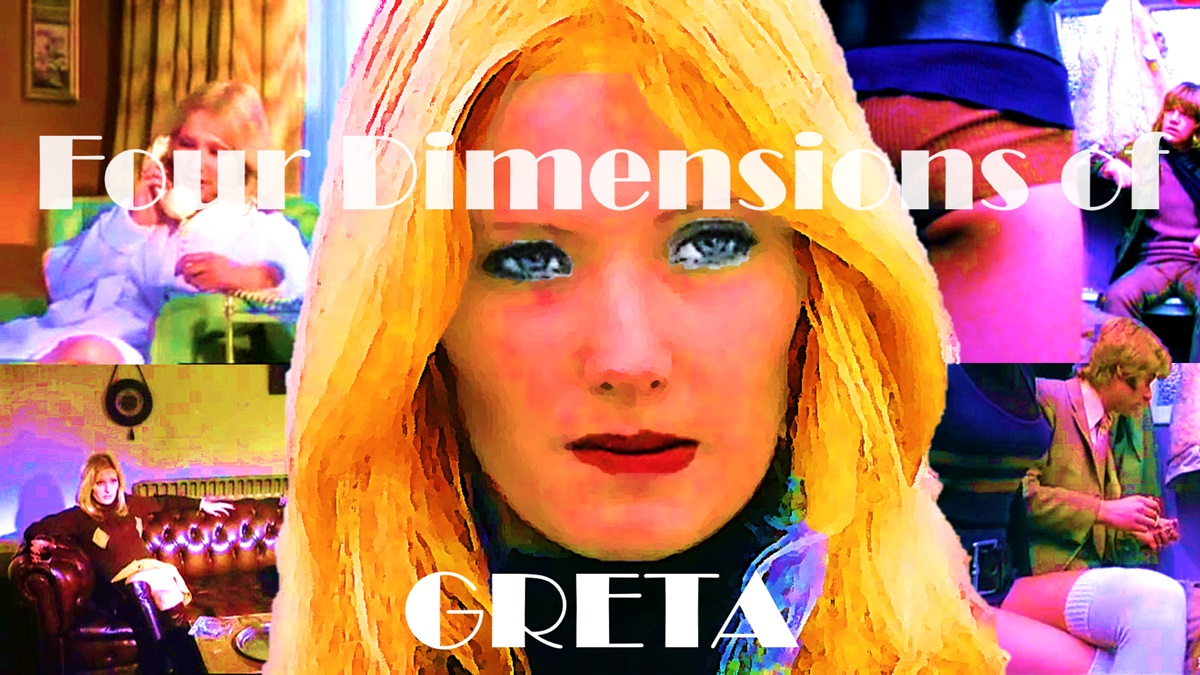
After Cool It Carol (1970), featuring Robin Askwith in his first starring role, and Die Screaming Marianne (1971), with Susan George, he brought Askwith back for The Four Dimensions of Greta, the plot of which begins in Berlin when a journalist is asked to travel to London to find a teenage girl, Greta, by her worried parents. He duly visits selected locations and in each of these encounters a character who recollects, in flashback, their involvement with Greta. There are four such episodes, hence: The Four Dimensions of Greta.
None of which should imply that this was a serious attempt at artistic credibility. Walker knew his target audience and was careful with the pennies as well. As Greta he selected Leena Skoog, who had twice revealed all for Mayfair magazine in between which she released a decidedly weird Swedish version of ‘Je t’Aime’ with Anders Naslund, an operatic baritone better known for his work interpreting Wagner. She had zero acting experience. Nor did co-star Karen Boyes, similarly known to readers of Mayfair and Reveille, whilst the German journalist, Hans, was played by Australian actor Tristan Rogers, with what can only be called a terrible accent.

Smaller parts were played by Alan Curtis, who also worked as a cricket announcer at Lords, and Richard O’Brien, appearing as ‘a degenerate’ in what appears to be a dummy run for his creepy manservant role in The Rocky Horror Show. Askwith plays Roger, ‘a footballer with a west London club’ (think Stan Bowles here) with his trademark Jack-the-Lad insouciance.
The first full-frontal occurs five minutes in, the script is would-be comedic (and dreadful now, if it wasn’t then) with slow motion and soft focus used to accentuate night club and strip club scenes. Oh, and there’s a corrupt policeman as well. As for the flashbacks, the first is a three-in-a-bed scene with O’Brien, the second features black fashion model Mynah Bird (who also appeared on magazine covers, in her case the November 1970 Oz, with a machine gun), the third gives us Askwith’s recollections and the fourth takes place in a posh gambling club.
True to form, and ensuring a moralising tone that counteracts the sexualised atmosphere, Walker also provides violence with fight scenes and a rape. Askwith and Skoog end up as an item, but the film ends with her returning to Berlin and him mournfully alone.
It seems clear that Walker spent the majority of his limited budget on two things: (1) Askwith, and (2) the music. The latter includes twenty bits of early 1970s big-band TV jazz by Harry South, much like his theme for The Sweeney. It’s quite good and should have had a formal release. There was also a syrupy title song, written by Hal Shaper, which wouldn’t have been cheap. Shaper was a major Tin Pan Alley figure who composed big hits for showbiz figures like Matt Monro and Shirley Bassey. Sinatra covered his stuff and he wrote scores for proper films too. But he was also, for a price, willing to slum it a bit, adding credibility to stuff that ought otherwise to have been beneath him. Which is how he fits in here.
Released in May 1972, it undoubtedly made money, which would have pleased many in the industry at that time. Askwith moved to the Confessions franchise (four films, 1974–77), which made even more. Walker moved on to his ‘best’ film, or rather the one the critics were least hostile about, House of Whipcord, a ghoulish horror made in 1974. Briefly considered in late 1977 as a possibility for directing Malcolm McLaren’s cherished Sex Pistols movie, he concentrated after he retired from directing on renovating classic cinemas. His screenwriter of choice, Murray Smith, subsequently wrote the 1980’s TV series Bulman and The Paradise Club.
Half a century later, The Four Dimensions of Greta is a reminder of the odd casts, and odder still assumptions, that characterised cheap feature-film productions as UK cinema entered its difficult years. Today it is mainly visited by Rocky Horror completists, 1970’s jazz enthusiasts and connoisseurs of its-so-bad-its-good kitsch. Like the News of the World, its combination of sermonizing respectability and salacious smut is now, thankfully, a thing of history.
see also:


Discover more from Lion & Unicorn
Subscribe to get the latest posts sent to your email.
