
This is a previously unpublished piece from late 2020.
In the beginning there was Talk Radio UK.
The Broadcasting Act 1990 allowed for three independent stations to be given a national licence for the first time and, following on from Classic FM and Virgin, Talk Radio won the rights to provide a speech-based service. Its chairman David Nicholas announced that ‘it will be a significant presence in the broadcasting community in Britain,’ and audiences of four million were predicted. No one really believed it would provide a rival to Radio 4, which got twice that audience, but there was a promise of ‘500 hours a year of high-quality entertainment, documentaries and drama’.

That lofty aspiration didn’t materialise, of course. Instead the station, which launched in 1995, was a conveyer belt of phone-in shows, mainly hosted by people who preferred their own voice to that of the listener: James Whale, Jeremy Beadle, Terry Christian.
Then there were the much vaunted US-style shock jocks (Caesar the Geezer, Wild Al Kelly), who didn’t live up to the hype, and a few big-name signings who never really got the hang of the format: Trevor McDonald, Jonathan King, David Starkey. There were some good presenters as well – Vanessa Feltz, Mike Dickin and, above all, the mighty Tommy Boyd – but for the most part it didn’t exactly stir the blood.
Nor did it attract the anticipated audience and, two years on from its launch, it was getting fewer than two million listeners. In desperation, the station’s bosses followed the model of satellite television and turned to football.
The Premier League was then housed exclusively at BBC Radio 5 Live, and anyway that was a bit pricey, but the Football League Division One (the Second Division as we used to call it, the Championship as it’s now known) was just about within Talk Radio’s budget. It was bought up for the 1997–98 season, and the emphasis of the station began to shift.
The first use of the Talksport name came shortly afterwards, an online incarnation, talksport.net, that no one much noticed; it was reported in 1999 that over a sample 24-hour period, just eleven people listened, none for more than ninety seconds.
Nonetheless, in 2000, the entire station was rebranded as Talksport, with most of the old presenters jettisoned in favour of football.
Given its new brief, it was regrettable that the station failed to secure the rights to broadcast the 2002 World Cup. Instead it offered ‘totally unofficial, totally unauthorized coverage’, by which it meant that the commentators weren’t actually at the matches, but were watching TV in the studio, with the sound turned down, their words accompanied by ‘synthetically generated crowd noise’. It was dreadful.
Things steadily improved from there, as the station used football to lure its target demographic, 25- to 44-year-old men, away from 5 Live. This should have been catnip for advertisers, though the commercials that were aired suggested Talksport wasn’t quite at the top end of the market; rather than ads for expensive cars and consumer luxuries, they were for vans, bookies and builders’ merchants.
The station’s new identity removed most of the non-sport content, and the half-hourly news bulletins only reluctantly allowed world events a mention. On the one hand, ‘America has begun the bombing of Afghanistan with air raids over the capital Kabul,’ but just as importantly: ‘Jim Smith has lost his job at Derby County.’
Nonetheless, there was a discernible political stance. And with former Sun-editor Kelvin MacKenzie as chief executive, the nature of that stance came as no surprise. ‘It is anti-liberal, anti-political correctness, anti-euro,’ wrote radio critic Gillian Reynolds in 2005. ‘Yet although it says it is the voice of the man in the street, it isn’t, and the listening figures show it.’
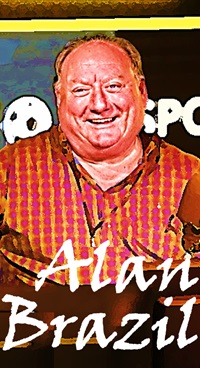
There were fewer phone-ins now (even football fans have a tolerance threshold when it comes to the opinions of other fans), which in turn ensured that the presenters had a lot of time to fill, and were often to be found blundering into current affairs. Breakfast-show presenter Alan Brazil, the former Ipswich Town and Scotland forward, was reprimanded by the Broadcasting Standards Commission twice in short order; first for saying that ‘regional accents were disappearing because of too many immigrants’, and then for suggesting that a ship full of asylum seekers approaching Australia ‘should be sunk’. On the day after 9/11, he mused: ‘I wonder how all those politically correct people are feeling this morning’.
His co-presenter at the time, the former Daily Express journalist Mike ‘Porky’ Parry, was equally forthright on subjects such as Saddam Hussein (‘who’s clearly mental by the way’) and his ‘mentally retarded sons’. Parry, in particular, became a minor cult figure, a licensed buffoon whose tongue and brain were in a perpetual state of civil war. ‘I think cathedrals are cathedrals,’ he’d declare, or he’d make reference to ‘Bordeaux – as in the tapestry’. Frequently he would favour the listeners with ideas that displayed an aptitude for lateral non-thinking, as when he suggested that racehorses be fitted with rear-view mirrors, or that the answer to Iraqi insurgents was for Britain to deploy its own suicide bombers.
Parry went on to form a late-night double-act with ‘Iron’ Mike Graham – another Daily Express veteran – the latter playing the role of the grumpy sceptic to Parry’s demented prophet. The Two Mikes were ‘Talksport’s answer to the Muppets’ Statler and Waldorf,’ according to the Daily Telegraph, though the paper wasn’t always that polite; it also called them ‘two grizzled, abdominous, perpetually half-pissed (“bladderated” in their own peculiar argot) hacks from the dying embers of Fleet Street’. Both verdicts were correct. They were very funny, greater than the sum of their parts.

This was all ‘light-hearted banter’, of course, not to be taken seriously. And banter was very much the station’s schtick. On 5 Live in those days you’d get an earnest argument; on Talksport you got mickey-taking and mockery, as well as all the absurdly opinionated tribalism you’d expect in the world of football.
But there was also a background hum of tabloid values. The station’s DNA still carried the shock-jock gene, and so, for example, its celebration of European football was never going to be matched by an enthusiasm for the European Union. Indeed, even within sport, foreign organizations were generally to be distrusted. In November 2011 FIFA banned England players from wearing poppies for a match against Spain, saying it would have contravened their ban on political messages, and Talksport was in its mouth-frothing element.
By that stage, it was all sport, all the time. A key turning-point had come in 2008 when Jon Gaunt, one of the few surviving non-sports presenters (he had a current affairs phone-in show on weekday mornings), was sacked after an on-air argument with a local councillor, during which he’d called the man a Nazi.
In 2010 the station got the rights to 64 Premier League games a season – at the expense of 5 Live, who retained 128 matches – and the audience began to build. By 2016 listening figures were up to 3.3 million (still a way off 5 Live’s 5.9 million), and were good enough to attract the attention of Rupert Murdoch’s company News UK, which acquired Talksport in its takeover of the Wireless Group that year.
The result was a rise in public profile, largely thanks to heavy cross-promotion in the News UK papers: the newspaper archives show 50 references to Talksport in the Sun in 2015, and 740 in 2018. It didn’t pay immediate dividends – apart from anything else, many football fans have never forgiven the Sun’s coverage of Hillsborough – and audience numbers and profits fell over the next couple of years. But Murdoch didn’t get where he is today without having an eye to the long game.
Serious money was spent and the station began outbidding 5 Live to get some proper broadcasting rights, including larger chunks of the Premier League, as well as the FA Cup and the Champions League. There was also a fair bit of international cricket, rugby – both union and league – and even darts, though most of this stuff was hived off onto Talksport 2, in order that the main station could focus on relentlessly plugging its forthcoming football coverage and, just as importantly, getting some bookies on to tempt us into betting.

And then came Covid, just as the station really was becoming ‘a significant presence in the broadcasting community in Britain’. Now what was it supposed to do?
To start with, advertising revenue suffered. Without live sport, bookies stopped shouting the odds. Happily, the government stepped in and every ad-break now contained a message repeating whatever tripartite slogan was being pushed that week to protect the NHS from the people. The station was suitably grateful, adding its own more targeted messages in on-air idents: ‘Follow the rules and show Covid the red card!’, that kind of thing. And the presenters were thunderous in their denunciations of any footballer who broke lockdown regulations.
More concerning was what a station built on talking about sport was supposed to do without any sport to talk about. And yet, paradoxically, perversely even, the first lockdown in the spring and early summer of 2020 was Talksport’s finest moment.
For much of the time, it turned itself into an oldies station, celebrating past sporting glories and providing nostalgic escapism for those bludgeoned by Covid’s domination of the talk-radio airwaves. Phone-in subjects became your favourite FA Cup finals, the best strikers of the 1980s, the worst kits of the 1990s. And the nostalgia was not just sport-based: Adrian Durham and his Drivetime sidekick Darren Gough worked their way through the James Bond back-catalogue (the movies, obviously, not the books), and devoted half-hours to their favourite songs by the Beatles, Queen and (may God have mercy on their souls) David Bowie.
Obviously, the cultural reminiscences worked best with those presenters who’d always had a hinterland beyond sport: the likes of Max Rushden, Paul Ross, Charlie Baker and, most impressively, the afternoon pairing of Paul Hawksbee and Andy Jacobs, who enjoyed an Indian summer.
Hawksbee and Jacobs had been with the station since 2000 and had become the best double-act on British radio. Both came from the back-rooms of TV comedy (they’d worked together on Fantasy Football League) and balanced their love of football with a gleeful revelling in the absurdities of celebrity, the tabloids and life generally. Their world of sport had always had room for cheese rolling, snail racing and porridge eating.
In their glory years, this was where you went for stupid phone-in competitions, for old recordings of Fred Trueman in his anecdotage, for throwaway references to dated pop culture (it was one of the few places where the likes of Victor Silvester and Old Mother Riley could get a mention, where Wilson, Keppel and Betty still meant something). And then there was the Clips of the Week feature, in which listeners nominated stupid comments and stumbles by other presenters, particularly by Mike Parry and Alan Brazil, that were replayed out of context.

This wasn’t laddish banter in the normal Talksport style; it was more like a self-aware version of the elderly rap DJs created by Harry Enfield and Paul Whitehouse.
By the time of Covid they had a million-strong audience, which was pretty good going for the 1–4 pm slot. But in recent years (since the Murdoch takeover coincidentally), they’d lost some of their sparkle. It felt as though they’d been given instructions to stay on more orthodox lines, so that there was more sport, fewer trivialities. They were still the best thing on the station – ‘the funniest show on radio,’ according to the Sun’s TV reviewer, Ally Ross (a regular guest) – but the impression was that they’d had their wings clipped.
The absence of live sport in lockdown saw a superb return to form. The Sun’s radio listings said that they would ‘debate the latest sporting issues and keep an eye on the afternoon’s events. Plus, the duo serve up the hottest sports news as well as big guests.’ But they did nothing of the kind.
Instead, splendidly, silliness was back in vogue. Old compilations of Clips of the Week were dusted down and rebroadcast. Andy Jacobs and his wife attempted to beat their record for the longest table-tennis rally, live from their home. And, taking audio-books to new depths, fellow presenter Ian Danter – a gifted mimic who could make a living from his impression of Stan Collymore, if only there were one to be made – was prevailed upon to read the whole of Steve Bruce’s 1999 murder mystery novel Striker, with the voice of Steve Bruce. It was magnificent.
Billing itself as ‘your lockdown station’, Talksport was on a roll. Sensitive to the isolation that many of its listeners would be feeling, the tone changed subtly, so that the banter was gentler, less abrasive. It was all rather sweet, even if we knew it couldn’t last.
And it didn’t. In due course, football returned, and it came not singly but in battalions. The schedules were filled with matches, but something odd had happened. Because, in the absence of live crowds at the lockdown games, Talksport’s commentaries sounded just like they had twenty years earlier, back in the days when the station didn’t have rights to live sport and was blagging – complete with that ‘synthetically generated crowd noise’ it had pioneered in the 2002 World Cup. This was, in the language of the day, ‘the new normal’.
see also:

Discover more from Lion & Unicorn
Subscribe to get the latest posts sent to your email.
