The possibility that the Telegraph Media Group might remain permanently in foreign hands – the Abu Dhabi-backed RedBird IMI – has triggered even more hand-wringing than is customary on the occasion of the sale of a British newspaper.
‘I would just be very concerned to see one of the papers of record in the UK come under the control of somebody in the Middle East,’ said Sir Iain Duncan Smith. HM Government is doing all it can to block it. And the Daily Telegraph itself is more than a little concerned.
The main objection is that RedBird is majority owned by a sovereign fund of a state not necessarily in the first rank when it comes to press freedom. The thought that those not British, and especially those not sharing what are imagined to be British Values, could take control of this nation’s larger media assets has always been a cause of unease in the Establishment.
Nothing quite underlined this suspicion of outsiders more than the battle to own a newspaper that declared itself ‘as British as roast beef and Yorkshire pudding’, namely the News of the World (NotW). The year was 1968 and the words were written in a leader by editor Stafford Somerfield in response to a potential takeover by that most dangerous and alien of threats, a war hero decorated with the Military Cross who now sat proudly in the House of Commons. Admittedly, the army captain turned MP was our old friend Robert Maxwell, whose distinguished record in the advance from Normandy Beach to Berlin – and subsequent feat of twice being returned to Parliament by the electors of Buckingham – hardly excused him being a Jew born in an obscure village in what was then Czechoslovakia.

Robert Maxwell had first been involved in newspapers in post-war Berlin as part of his role with the occupying forces, building contacts that helped him develop the publishing company that made him rich. He was an MP from 1964, a role which barely slowed his international business wheeler-dealing – and sometimes financial scandal – though the expectation that a member should dedicate every hour of the day to the job was not what it is today. (That said, with the help of secretary Judith Ennals, he was efficient at dealing with constituency business). However, he never looked likely to rise above the rank of high-profile backbencher, not least because he alienated many with some presumptuous behaviour not long after arriving in the House. Newspapers seemed more likely to make Maxwell the major man of affairs he felt he should be.
Just before becoming an MP, Maxwell had been rebuffed in a proposal that he would run the ailing Daily Herald on behalf of the TUC. But in September 1968 came the opportunity to buy 25 per cent of the shares in the NotW. That was due to a division within the Carr family that had long owned the newspaper. Sir William Carr, chairman since 1952, was much taken with playing the role of patrician lord of the manor, given to inviting staff to an annual garden party at his country house – where his butler would introduce guests as they arrived – treating employees to golf at Walton Heath every Monday, and investing company funds in racehorses.
This wasn’t the behaviour of a modern, go-ahead 1968 company executive, and despite a circulation of around six million profits were sluggish; the Carr family were, in a lower-key, suffering from the kind of disunity that, within the Barclays, has allowed the Telegraph to come up for grabs. Sir William’s cousin Derek Jackson was a physics professor, Grand National jockey, decorated RAF ace, committed horizontal gymnast and much else. But he was not close to the Carrs, and was putting his stake up for sale.
Since Sir William and his immediate family only controlled a further 27 per cent of the company, there was a good chance that Maxwell, if he owned a quarter of the shares, could then persuade those holding the remaining non-Carr 48 per cent to sell him enough to hold a majority stake.
Maxwell offered Jackson and also Sir William himself a price far above the market value of the shares, amid unsurprising publicity. He also surprised the Buckingham Labour Party by announcing that should his takeover succeed, he would step down as their candidate. Sir William’s feelings were made known the following Sunday in a front-page NotW editorial penned by veteran editor Somerfield.
Why do I think it would not be a good thing for Mr Maxwell, formerly Jan Ludwig Hoch, to gain control of this newspaper which, I know, has your respect, loyalty and affection – a newspaper which I know is as British as roast beef and Yorkshire pudding.
Aside from misspelling Maxwell’s former middle name Ludvik, even then this was pretty spicy stuff.
Bill Grundy – like Jackson, too extraordinary a figure to be restricted to just a single sentence in any appearance on the page – responded in a Spectator media column sympathetic to Maxwell:
I was deeply moved by this, and almost visibly disturbed when he threw Mr Maxwell’s original Czech name at him and his original Czech nationality. ‘This is a British paper, run by British people,’ he burbles on. ‘Let us keep it that way.’ And go home, blacks, while we’re at it. Mr Maxwell’s hackneyed remark that he’s more English than we are because he at least chose to be, whereas we were merely born that way, can serve as Mr Somerfield’s come-uppance.
Carr’s bankers Hambros, who had financed Maxwell in his early business days, took Somerfield’s view. Maxwell’s excoriating biographer Tom Bower quoted one Hambros banker as saying: ‘It was a dirty battle in which everyone played as hard as they could.’ This meant the Hambros putting up money to challenge the prospective owner by buying shares themselves, contrary to the City’s supposed ‘good chap’ code of practice. Now things were turning against Maxwell, who upped his own offer. But his real nemesis was materialising from the other side of the world.
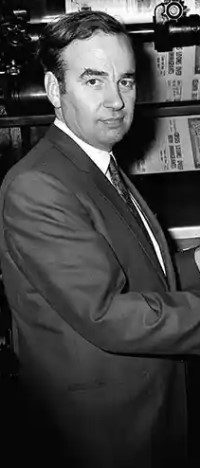
Rupert Murdoch, just over ten years Maxwell’s junior, was already a major media player in his native Australia, having taken over and transformed the relatively modest family business. Now Murdoch, briefly a Daily Express sub-editor after studying at Oxford, saw an opening to return to the British media at a slightly more senior level. As Murdoch himself put it in John Preston’s recent book about Maxwell: ‘I could smell that the establishment would not let him in.’
Thus aware that the Carrs felt Maxwell was not a suitable owner for their newspaper, Murdoch – Melbourne-born but of British, Presbyterian stock – flew in and, fortified by reading Somerfield’s screed, turned up for breakfast at Sir William’s London flat (any later meal would generally not find the heavy drinker nicknamed ‘Pissing Billy’ in prime shape for business negotiations).
Murdoch, despite offering less money than Maxwell, was quickly accepted by Carr (with whom he shared mutual friends), presumably as a more red-blooded British alternative to the former Mr Hoch. As Carr consulted with his bankers, Murdoch got on the phone to Australian prime minister John Gorton for permission to move millions of dollars to the UK.
However, when the Australian started buying shares, trading was swiftly suspended. Now all would be decided at a shareholder meeting to be held on 2 January 1969 at the Connaught Rooms. Murdoch’s offer was to put up some of his Australian assets in return for control of the NotW, keeping Sir William or another Carr as chairman, partly to appease the investigating Takeover Panel. Maxwell was desperately contacting individual shareholders, including other Carr relatives, to plead for support, but things were not going his way.
Carr employees were bussed in to ensure a hostile audience for Maxwell. Hambros director Harry Sporborg (quite a lot of war heroes in this story) briefed the morning papers that he already held enough proxies to ensure Murdoch’s victory. And Sir William opened the meeting with an attack on Maxwell’s business record.
The Australian kept his statement succinct, but Maxwell was never a man of few words, and laid into Sir William amid audience heckles. (‘Sitting just feet away, Murdoch ill-concealed his smile’, writes Bower.) The result of the vote was pre-ordained, and Maxwell congratulated Murdoch on ‘catching a big fish with a very small hook’, while reacting to having had some sympathy for his treatment at the hands of the City by saying: ‘I’m on the side of the angels, it’s amazing.’
Needless to say, Murdoch did not long keep Sir William as chairman; within months he’d forcibly removed him to the honorary post of president. The official end of decades of Carr control was not even mentioned in the NotW itself, Somerfield quoting Murdoch as saying: ‘The readers don’t bloody care’. Carr was soon seriously ill and died in 1977. Somerfield himself was out by early 1970, sacked in a three-minute interview, and became a judge at Crufts.

The consequences of Carr’s determination that the NotW not pass into Maxwell’s hands are well known, although it is quite possible that the newspaper would have disappeared far sooner with Captain Bob at the helm, or at least had a rockier future than it did under Murdoch.
The Australian soon found himself in what was to become his familiar role as public bogeyman, at least among what were once called the chattering classes. An early action at the NotW was to buy the rights to Christine Keeler’s memoirs. Murdoch was invited on to David Frost’s London Weekend show Frost on Friday and was given a hard time by the host for traducing the reformed John Profumo (‘There is a man doing a fantastic job of work and you are threatening that work by this story’). The audience also took a dim view, save for Murdoch’s own advisor (Frost spat: ‘Your PR man’s going mad again, you must give him a raise’). Pleading that the NotW was not a ‘dirty’ newspaper merely had the effect of earning Murdoch his Dirty Digger nickname from Private Eye.
It is alleged that this experience persuaded Murdoch not to base himself in the UK full time and also to attempt to buy London Weekend (swiftly ousting Frost, one of the company’s founders). Murdoch in the end was not allowed to retain control of the station, but by then he had already added another key asset to the NotW. The Sun, which had replaced Maxwell’s old target the Daily Herald, had been put up for sale in spring 1969 by publishers IPC. Maxwell offered to take the loss-making paper for nothing, keeping it Labour-supporting and not in competition with the Daily Mirror.
However, Maxwell also admitted that there would be redundancies, particularly among the printers, and Murdoch again saw his chance. Murdoch met with the print-union leader Richard Briginshaw, and promised fewer job losses, ensuring as vital a backer for a bid as Carr had given him at the NotW. Union pressure at IPC meant Maxwell’s offer was rejected and Murdoch bought the Sun for £800,000, which in retrospect, of course, seems a bargain. He shrank the paper into tabloid size and, with the help of editor Larry Lamb, turned it into the biggest-selling daily, ahead of the Mirror, paired with the NotW as a publishing powerhouse to which in the future would be added The Times and Sunday Times.
Maxwell, out of Parliament by 1970 – at the hands of the voters of Buckingham, rather than his own choice – had to overcome other business difficulties in the next few years. But the story of Robert Maxwell is one of a man who did not allow even very public humiliations to stay his ambitions. Once he got hold of the Mirror, he was to launch an attempt to challenge Murdoch’s media power that raged through the late 1980s. A battle, it is fair to say, that ended in a victory for the Australian (and defeat for the late Maxwell) even more final that those he tasted when taking over the NotW and then Sun.

Could Murdoch have achieved his global success had it not been for Carr’s (dare one say, prejudiced) distaste for Maxwell? What would have been the story of British newspapers from the 1970s onward? Much that actually happened might be put down to the competition between Murdoch and Maxwell, which forced the eventual confrontations with the print unions, and arguably worsened the circulation wars (especially for the public figures rightly or wrongly disgraced as a consequence). What would have been the story for television? (Sky and Fox, rather than LWT, became Murdoch’s vehicle, while Maxwell’s downfall was in part due to his failed attempts to become a similar broadcasting mogul.) What, even, of politics, as the support of certain newspapers under the Digger’s control became a not irrelevant concern for those seeking high office?
Those questions are unanswerable. In fact a timeline is perfectly conceivable in which Maxwell takes over both the NotW and Sun, but is eventually eclipsed when a wound-licking Murdoch finds a way to buy the Mirror (which, pre-Murdoch, was the circulation leader after all). But even in the extraordinary stories of both men, this was a pivotal episode, a story of splits within a colourful family and concern at foreign control of a proud British newspaper.
see also:
Discover more from Lion & Unicorn
Subscribe to get the latest posts sent to your email.
