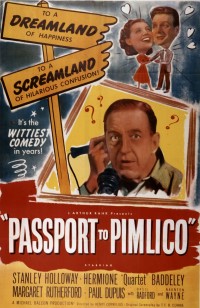
SIMON MATTHEWS watches Henry Cornelius’s 1949 film Passport to Pimlico.
London 1949. A bomb-damaged world. Down trodden people tramp the streets, restricted by petty local authority and government regulations. Life is basic and rationing has never been so severe.
During a heat wave an unexploded bomb is discovered. When it detonates the crater reveals the basement and cellars of a mediaeval building, dating back to 1477. It turns out to be the remains of a palace occupied by Charles the Bold, Duke of Burgundy, after his disastrous defeat at the Battle of Nancy. A chest is opened, and a treaty found, ceding the palace and its surroundings, in perpetuity, to Charles and his descendants. Telephone calls are made, the authenticity of the parchment is confirmed and an official expostulates: ‘Do you mean that these Londoners are technically Burgundians?’
The word quickly gets out that UK law doesn’t apply in Pimlico. Austerity is over! The locals are overjoyed and tear up their Identity Cards. Traders flock there and it becomes a huge unregulated market place. To try and stabilize the position, the government imposes a hard border. There are immigration rules and tube trains passing through the enclave are stopped and subjected to customs searches. Finally, someone purporting to be the Duke of Burgundy turns up to claim his rightful inheritance.

So runs the plot of Ealing Studio’s Passport to Pimlico. Perfectly played by an ensemble cast it starred Stanley Holloway as the shopkeeper – obviously, an Englishman’s typical occupation – around whom much of the action revolves. Holloway was a Londoner, par excellence: affable, reasonable, sensible. He came from a theatrical family that went back to the 1870s and was something of an all-rounder, with a career that covered theatre, variety, recordings, radio, television and film. Having him centre-stage ensures the proceedings have a certain gravity.
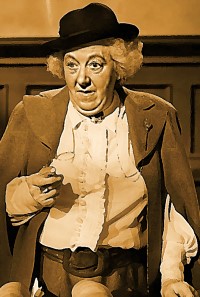
Co-starring roles are taken by Margaret Rutherford as the history professor who confirms Pimlico’s status, Hermione Baddeley as Holloway’s wife and Paul Dupuis (not actually French, but French-Canadian) as the Duke of Burgundy. Notable supporting roles are played by Charles Hawtrey, who filmed his scenes whilst appearing amongst nude showgirls at the Windmill Theatre, and Basil Radford and Naunton Wayne flapping about as buck-passing civil servants.
The plot develops with some nice touches. Cut off from its neighbouring districts, Pimlico experiences shortages. Rationing gets worse, and to help counter this open-air communal eating takes place – thankfully the heatwave continues – to general acclaim that ‘continental cooking has so much flavour.’ The hard line taken by the UK government back fires and provokes international sympathy about ‘crushed cockneys’ with Pimlico being described as the ‘cockpit of London.’ (An analogy, surely, with Belgium, much of which was originally part of the Duchy of Burgundy). Eventually the residents decide independence isn’t so great after all, and that a bit of regulation is no bad thing. To general relief Pimlico returns to the UK, an event marked by torrential rain.
TEB Clarke’s script (which won him an Academy Award nomination) is witty, erudite and accurate as it excavates an obscure corner of European history. The tone of the film was undoubtedly helped by director Henry Cornelius, a South African-born German-Jewish émigré with experience of being stateless. It reached cinemas in April 1949 in what was a bumper year for Ealing with two other films by the studio, Whisky Galore! and Kind Hearts and Coronets quickly becoming regarded as comedy classics. The trio are still highly rated today, along with another 1949 release, The Third Man.

The notion that a part of the UK, or specifically a part of London, might be legally part of another country seems to have had an enduring appeal. Passport to Pimlico was remade for radio in October 1952 (with a cast that included Christopher Lee, as the Duke of Burgundy, and Kenneth Williams) and even plagiarised by comedian Mike Myers as the basis for Wayne’s World 2. Alas, his plot about an ancient scroll allowing a fragment of the US to secede from the union was deemed a copyright infringement, meaning he had to rewrite his script. Then, in 2000, a stage version starring Ian Lavender toured UK repertory theatres.
Perhaps Studio Canal, who inherited the Ealing Films portfolio via EMI, should consider a remake? Okay, they may be French, but they have a London office (next to the Eurostar terminal at St Pancras) and surely, they would see the comic potential? After all, they did Bridget Jones’s Diary and Paddington. Imagine the setting: a ‘woke’ hipster finds deeds in the remains of a building demolished for HS2, proving their area remains part of Europe. Everyone flocks to the location. Passports are issued … and so on. How would the UK government react now?
see also:


Discover more from Lion & Unicorn
Subscribe to get the latest posts sent to your email.
