Carrie Nation gets a paragraph in my new book Little Englanders: Britain in the Edwardian Era, but I didn’t have enough room to discuss her properly, so here’s some additional material…
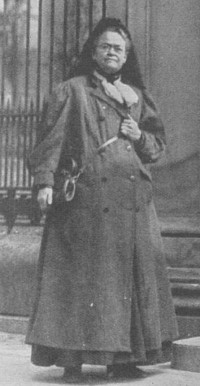
There was a strong temperance campaign in Britain at the turn of the twentieth century. But we didn’t have anyone to compare with Carrie Nation, the Kansas Smasher.
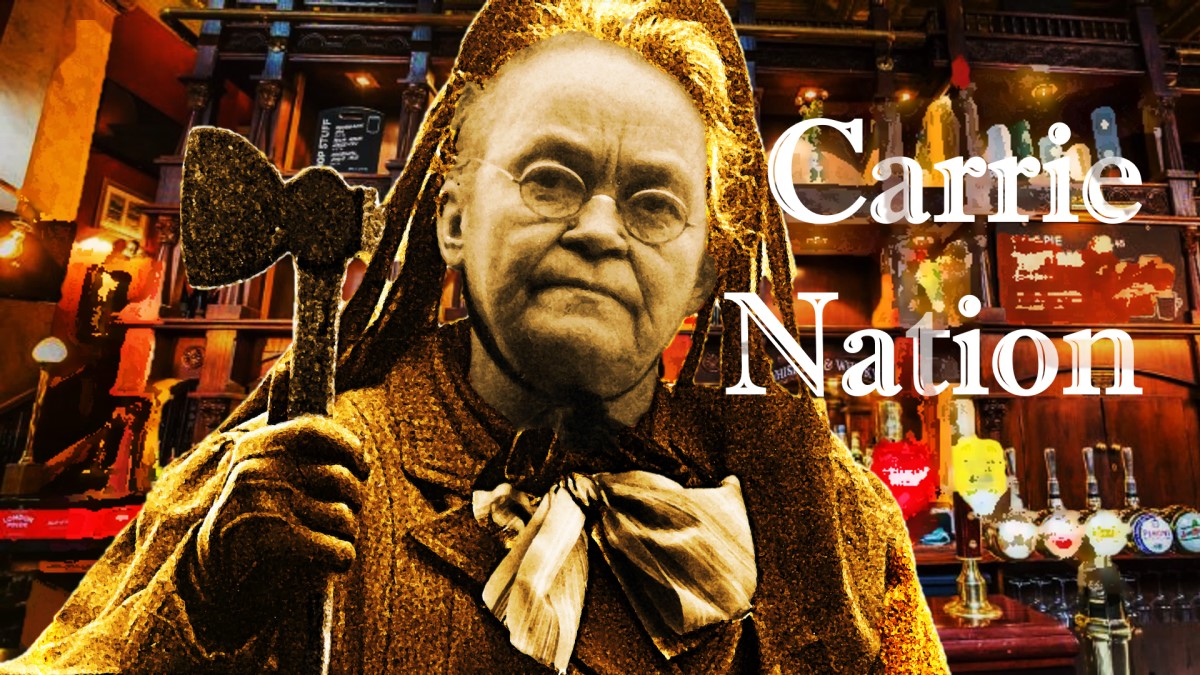
Stories of this fearsome woman first appeared in the British press in 1901, tales of an anti-alcohol extremist in the American Midwest who attacked bars with an axe, smashing up their stock and their furniture in what she liked to call ‘hatchetations’.
‘Threats of lynching are freely made against her,’ it was reported. ‘Insurance rates on saloon fixtures have risen to a prohibitive figure, and publicans have guards protecting their places.’ There was also a string of convictions, dozens of them. Nation was referred to as a temperance campaigner, but the word ‘temperance’ seemed singularly ill-suited.
In December 1908, Carrie Nation came to Britain, now 62 years old and perhaps a little mellower. At any rate, she didn’t bring her hatchet with her, though it remained her symbol: to aid in fund-raising, she sold brooches in the shape of an axe at a shilling apiece.
Nonetheless, British temperance societies kept their distance, nervous of her reputation and her confrontational campaigning style. This really wasn’t how we did things over here. ‘Some people think I’m mad,’ she said, ‘but I know what I’m doing, and I know that if you can get people to talk, you can get them to think.’ Perhaps she was right; certainly she was talked about, loved by the press because of the very good copy she provided.
She arrived first in Scotland, where the need for her work was immediately apparent. There was, she said, ‘more drunkenness in Glasgow than in the whole of America’. In Dundee, she stormed into a restaurant, demanding: ‘Young man, do you sell drink here?’ To which he replied: ‘No, but you can get what you want next door.’
In Aberdeen, she berated the businessmen and local dignitaries having lunch in the buffet of the Royal Athenaeum Club, who responded by drinking her health. And at Thornton railway station, where she had a few minutes to wait for a connecting train, she got thrown out of the bar for her heated exhortations to the barmaids, trying to persuade them to renounce their evil employment for fear of going to Hell. Expelled on to the platform, she contented herself with railing against smokers, warning a man with a pipe that if he came near her, she’d ‘smack the dirty, stinking thing out of his mouth’.
(Her anti-smoking position was as fiercely held as her opposition to alcohol. ‘If I had my way I would arrest every man with a cigarette in his mouth because he is committing suicide,’ she said. She also objected to the impact on her own health of others smoking: ‘A man has no more right to poison the air I breathe than the water I drink.’ She was tolerant of tea and coffee; she didn’t partake, but didn’t insist on abstinence in others.)
Her public profile was such that she was invited onto the music-hall stage, offered £60 for a week’s engagements at the Canterbury, Waterloo and the Paragon, Mile End. So she travelled to London.
Arriving in the capital, she continued in her usual fashion, addressing meetings and haranguing strangers on the evils of drinking and smoking: ‘God has told me to rebuke you.’ Travelling on the tube, she saw a cigarette advert pasted onto a window, so she smashed the glass with her umbrella, for which she was subsequently fined 30 shillings. (‘I expected to pay more for it than that,’ she said, and launched into a lecture on tobacco before the court was called to order.)
Her stage career, however, was short-lived. The first night saw her get a reasonably good-humoured reception at the Paragon, but by the time she reached the Canterbury, where she was the last act on, the audience had lost sight of sobriety.
‘You have heard of the lawless Carrie Nation,’ she said, stepping into the limelight, a large Bible clutched in both her hands. ‘You have heard of the crazy Carrie Nation. But I am glad to introduce to you the lover of the home Carrie Nation.’
And that was as much as anyone heard. There was a torrent of abuse from all parts of the hall – ‘Get off the stage!’ ‘Go back to America!’ – accompanied by the throwing of rotten eggs. One of these hit her above the right eye, but she wiped it away and stood her ground, remaining on stage for a good five minutes. She only left at the urgent request of the manager, whose appeals to the crowd ‘to act as Englishmen and sportsmen’ had failed to quiet the mob. ‘You cowards!’ she cried, shaking her fist as the curtain was being lowered. ‘You drunken cowards!’ She was smuggled out of the building, escorted to her carriage by the police.
Many found the spectacle deeply distasteful, and felt it reflected badly on the music-hall industry. The treatment she received was entirely predictable, observed the press; she was ‘a perfectly harmless but deluded old lady’ whose denunciations of alcohol and tobacco were bound to attract hostility from an audience ‘assembled to enjoy a pipe and perchance a glass’.
It all seemed a little cruel. ‘To see a woman standing in the limelight with a Bible in her hand before a mocking crowd, hardly accords with our insular notion of the fitness of things, however much such a performance may appeal to American tastes.’
Even so, she immediately resolved to return the next night, and had to be dissuaded by the managers of the two halls. They cancelled her remaining engagements, saying they’d had word that things were going to get hotter: ‘some roughs might even resort to bottle throwing’.
She remained impressively defiant. ‘What happened at the Canterbury was a mere skirmish in comparison with my adventures in the States,’ she declared. ‘I have had chairs thrown at my head, and bands of infuriated miners chasing me through the streets, but I have never yet met with a crowd I have not been able to tame.’ And, she wondered: ‘Where is the boasted chivalry of the Englishmen gone?’
Despite the bold face, it had been a humiliating experience for her, and a nudge to society that the raucous old spirit of the music hall was not entirely dead. ‘London is a dreadful place,’ Nation told reporters on her first day in the capital. A couple of weeks on and she had revised this verdict: it was ‘the worst city in the world’ and ‘in the depths of hell’. She departed for America in March 1909, and died two years later.
see also:


Discover more from Lion & Unicorn
Subscribe to get the latest posts sent to your email.
