While researching my book Little Englanders: Britain in the Edwardian Era, I frequently found myself chasing a story that never quite resolved itself, and that consequently didn’t make it into the book. But I like some of these tales, so I’m posting them here. Be warned: they’re intriguing rather than satisfactory…
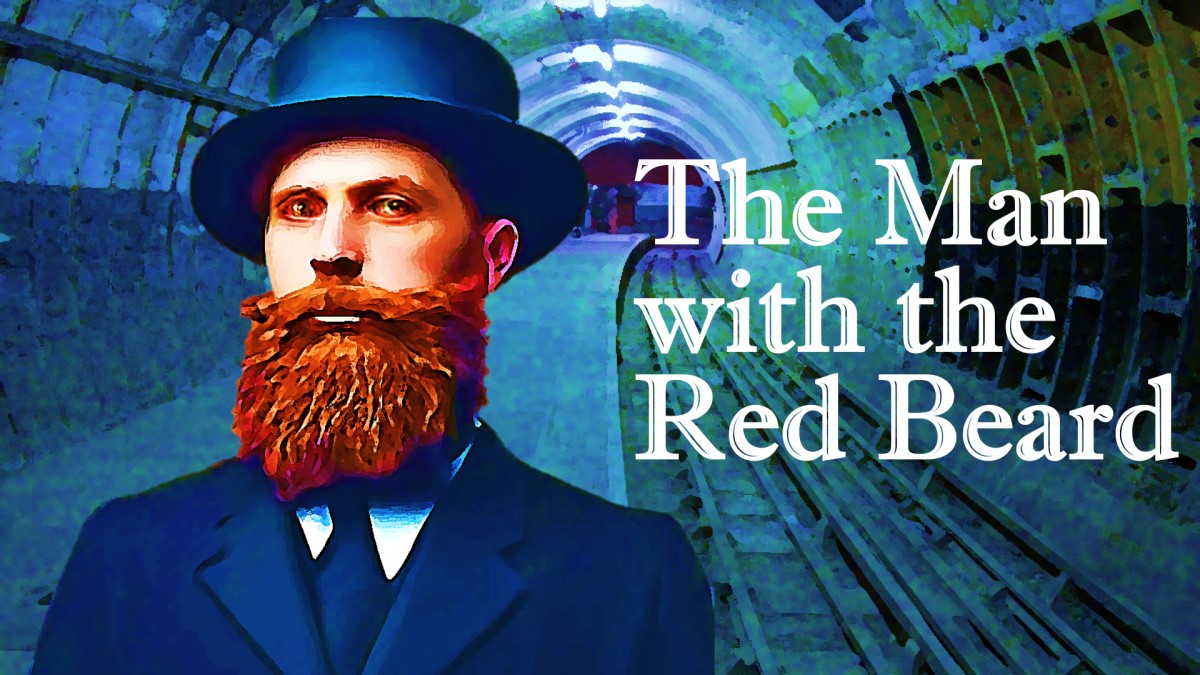
On a Tuesday evening in April 1907, a well-dressed, middle-aged man of medium build, wearing a bowler hat and a bushy red beard, staggered from the platform of Kingsway station on the Great Northern, Piccadilly & Brompton tube line, and then collapsed.
He was a familiar figure at the station, though no one knew him by name. ‘His big red beard was a thing you couldn’t miss, but I never spoke to him,’ one of the lift attendants later told the press. ‘Last night he went up in the lift at about 8 o’clock, and an hour or so later he was seen to come back and go down to the lavatory. A few minutes later he came out again, groaning, and fell unconscious at the bottom of the stairs.’
Police were summoned and the man was rushed to hospital, where he died half an hour after his arrival, having spoken not a single word.
It appeared a straightforward case of suicide by poisoning, but there were some unusual features. First, the method: he had inhaled prussic acid fumes, using a complicated rubber apparatus of his own making, hidden under his shirt. Second, the red beard was false – when it was removed, it revealed a real moustache of the same colouring.
He was identified the next day by his widow as 46-year-old Richard Norman Lucas, from Byfleet, Surrey. As more details began to emerge, they only seemed to deepen the mystery of what kind of man would kill himself in such a manner.
Lucas had obtained a degree in classics from Cambridge, where he was secretary of the Moral Sciences Club. The expectation was that he’d make a career in the ministry or in medicine. Instead he’d gone on to study international politics and modern languages. That in turn led him to an involvement in revolutionary politics in Finland, though later he became an ardent Spiritualist. He was also an engineer who’d been employed as a translator, and his most recent job was as a correspondent for the Auto-Motor Journal. For most of this time, he’d supplemented his salary with an allowance from wealthy relatives.
He’d been in court once, fifteen years back, after a curious, unexplained incident when he’d been found asleep in a backstage dressing-room at the Crystal Palace at one o’clock in the morning. The magistrate discharged him, saying he was satisfied Lucas ‘was not in the Palace for any unlawful purpose, but his being there at all did not say much in favour of his good sense’.
He was, in short, a rootless man, one of many in this uncertain age, constantly chasing interests and obsessions, someone who needed a cause to call his own. But the tragedy at Kingsway station was not the consequence of radical politics, spiritualism or motoring; rather, it was a tale of the music hall.
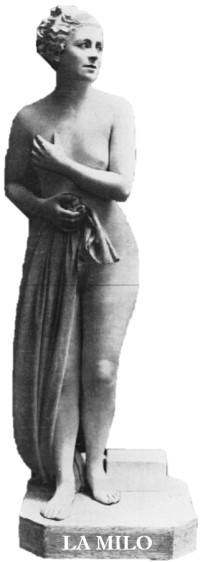
In 1906 Lucas visited the London Pavilion, where he saw an Australian performer Pansy Montague, better known as La Milo, who dressed in a sheer bodystocking and struck a set of poses based on classical statues. She was 22 years old and she was ‘the sensation of the London season,’ according to the trade press, possibly even ‘the most talked-of woman in the world’.
Lucas was fascinated by her act, attracted – as a classical scholar – by its artistic merit. At least that’s what he said, though perhaps it was a little more personal than that; before long he was telling friends that La Milo was ‘the most perfect being upon earth’. He wrote her lengthy letters, giving technical advice on ancient statuary, and sent her heroic poems composed in her honour; one of them was published on the back of the programme at the Pavilion.
Lucas was captivated. He developed what the papers called an ‘extravagant and embarrassing interest in the artiste’, and, growing jealous of other admirers, began to watch La Milo not merely onstage but off.
A match-seller on Northumberland Avenue told of how he used to loiter outside whenever she went to the Charing Cross Turkish Baths. (These baths were also frequented by Sherlock Holmes and Dr Watson – see ‘The Illustrious Client’, set in 1902.) It was during this time that he began to wear the false red beard, adopted as a disguise to facilitate his stalking.
Eventually he overstepped the bounds of decency in a letter to her, and she firmly broke off the acquaintance. The scales fell from his eyes and he was devastated. ‘I have been worshipping an idol,’ he lamented, ‘something which never existed.’
He returned a photograph of her that she had previously sent him, but he couldn’t shake off his obsession. When she came back to London from a tour of the provinces, he made one last trip to see her playing at the Holborn Empire. Then he went to the nearby Kingsway station, inserted a rubber tube down his throat and ingested the prussic acid.
His wife knew of his infatuation but evidently didn’t hold it too much against him. Giving evidence at the inquest, she broke down as she sobbed: ‘He was a very good husband, and I cannot express my feelings and my love for him.’ The case of Richard Lucas was hardly resolved by the inquest – ‘No single aspect of the mystery was cleared up,’ noted the Daily Mail – and a verdict of suicide during temporary insanity was returned. If nothing else, though, it did illustrate the level of stardom enjoyed by the leading music-hall acts.

see also:


Discover more from Lion & Unicorn
Subscribe to get the latest posts sent to your email.
