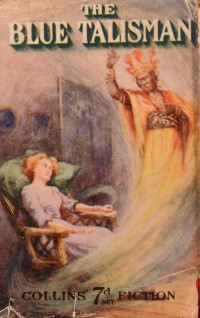
‘Of course, civilised people, who only believe what they see and touch and taste and smell exists, do not credit the genuine truths of black magic.’
Fergus Hume, The Blue Talisman (1912)A thrilling narrative full of life and adventure.
The Scotsman (1912)
Fergus Hume (1859–1932) wrote well over a hundred novels, all of them overshadowed by the massive success of his debut, The Mystery of a Hansom Cab (1887), a detective tale that (undeservedly) outsold even the early Sherlock Holmes novels. The Blue Talisman was also billed as ‘a detective story’, and a murder mystery does drive the narrative, but there’s a love-story that takes up most of the pages. Behind that, though, is a fascinating imperialist yarn.
There is concern in high office over a region bordering British-ruled Nigeria, which has come under the control of a rogue warlord named Ibeno. ‘The man’s a Congo beast,’ says a British Army lieutenant; ‘that kind of atrocity-rotter I mean. He’s a slaver too, and keeps up the traffic with the Arabs. By George, I have heard stories of his doings; theft on a large and comprehensive scale, murder in the form of massacres…’
Two men seek to be appointed commissioner of the area by the British government with the aim of suppressing Ibeno. One is Fodio, a Nigerian chief, educated at Cambridge, where ‘he had been brilliant, as he possessed an acute brain and an industrious disposition’. The other is a monocle-wearing Englishman named Paul Merker, who, despite having ‘the aspect of a Mayfair dandy’, is actually a devil-may-care explorer.
Merker is concerned for the economic impact of unrest in the Empire: ‘Give Nigeria independence, and the natives may choose to trade with the Germans and French rather than with us.’ Consequently, he takes a hardline attitude. ‘My idea is to have absolute power and compel the people to obey,’ he says. ‘They are only a parcel of niggers when all is said and done.’
He, for one, is not fooled by Fodio’s education. ‘That’s the worst kind of savage, who loses the few small virtues of the black races to acquire the vices of the white races. Fodio’s civilisation is only a veneer; scratch him, and you find the Tartar.’ It’s striking, though, that none of the characters of whom we approve accept this dismissive view of Fodio. Nor do they use the same language, as Fodio points out to an English friend: ‘You are not one of those who call us niggers and think we are all that is evil and brutal.’
And indeed the real savage here is Merker, who – in a shock twist – turns out to be the notorious warlord Ibeno himself, as his estranged fiancée reveals:
‘When he went exploring he simply darkened his skin and changed his dress in the ruined city of Ozu. From that place he issued as Ibeno to plunder and murder. When he grew tired, or was in danger of his life, he became a European once more and returned to civilisation.’
It’s one of the strangest variations of the Jekyll and Hyde split-personality: ‘He looks a quiet man, capable of nothing more than walking down Piccadilly and leading an aimless society life. But he is a devil.’
The talisman of the title is a blue heart-shaped stone, which the mysterious Ideno is believed to possess, and from which he derives much of his power. This fetish was imbued with mystical powers by magicians in the lost city of Atlantis…
Hang on, did he say ‘Atlantis’? Oh yes. As Fodio explains: ‘Atlantis really existed, and in its decadence Nigeria formed a portion of it.’
This is the other key strand in the novel. ‘My people come of a stock which attained to civilisation when all Europe was barbaric,’ insists Fodio, and a British missionary who’s lived in Nigeria shares his perspective: ‘Though Africa is uncivilised now, at one time the country was under the rule and government of dead and forgotten nations. Judging from the handiwork of the Hausa, those people must have had a glorious past when Europe was sunken in barbarism.’ Meanwhile, the missionary’s daughter expresses the British fascination with Africa: ‘Life is more highly coloured there, and possible danger always adds to one’s enjoyment of existence.’
It’s daft as a brush, of course. The Atlantis stuff is within the bounds of fictional convention, but the idea of a blacked-up London fop as an African tribal leader is truly absurd, as reviewers noted at the time. Merker, said the Pall Mall Gazette, was ‘the most impossible stage fiend that even the prolific imagination of Mr Fergus Hume has yet invented’. But the Westminster Gazette got it right: ‘A good yarn, the superstitious element being managed with especial facility.’
see also:




Discover more from Lion & Unicorn
Subscribe to get the latest posts sent to your email.
