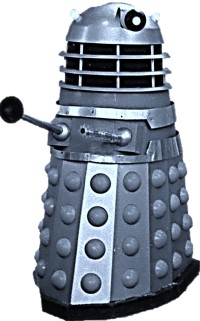
To mark the sixtieth anniversary of Doctor Who, this is an extract from Alwyn Turner’s The Man Who Invented the Daleks. The first Dalek storyline came in 1963…
It was a simple story that drew rather more deeply on Terry Nation’s childhood reading than on the modern science fiction he had adapted for Out of this World. In particular there is a clear debt to H.G. Wells, whose 1895 novel The Time Machine had foreseen an Earth inhabited by the subterranean Morlocks and the surface-dwelling Eloi, twin races not far removed from the hideous, violent Daleks living underground and the beautiful, peaceful Thals. Wells’s later book The War of the Worlds (1898) had centred on a race of aliens who could only operate on Earth if they were inside machines of their own construction, and this combination of an organic life-form within a robotic casing is evoked in the nature of the Dalek: a ‘frog-like animal’, according to Nation’s original storyline, who lives inside a metallic travelling machine. ‘They are invulnerable, they are pitiless,’ a character remarks of the Martians in Wells’s novel.
Then there are traces of Jules Verne’s Journey to the Centre of the Earth (1864) as Ian, Barbara and a group of Thals travel through swamps full of mutated creatures and caves fraught with danger to attack the city from the rear. One might even see, in the depiction of the Doctor and Ian as the man of science and the adventure hero (for it is Ian who tends to lead the action elements of the story), something resembling the relationship between Professor Challenger and Lord John Roxton in Arthur Conan Doyle’s The Lost World (1912) and its sequels.
None of this, it should be noted, was out of kilter with the original conception of the series. Sydney Newman had talked about the concept of the TARDIS being based ‘on the style of an H.G. Wells time-space machine’, while the first adventure, Anthony Coburn’s ‘100,000 BC’, had carried echoes of another Wells tale, ‘A Story of the Stone Age’, published in 1897.
But if the literary references were more than half a century old, they were heavily reworked to address entirely contemporary themes. Whereas Wells had seen the Morlocks and Eloi evolving from current humanity, the extreme products of a split between the proletariat and the bourgeoisie, Nation was interested less in class war than in nuclear war. The development of the neutron bomb, which was to cause such contamination on Skaro, had been widely covered in the media of the early 1960s (a fact noted by Ian in the original script, though his comments were deleted from the final version), and a bomb had in fact been constructed and tested by America in 1963, though that was not publicised at the time.
What was very much in the news, as Nation sat down to write, was the signing on 5 August 1963 of the Test Ban Treaty by America, the Soviet Union and the United Kingdom, the three countries that then possessed nuclear weapons; for the first time an international agreement had been negotiated that attempted to regulate the development of such armaments.
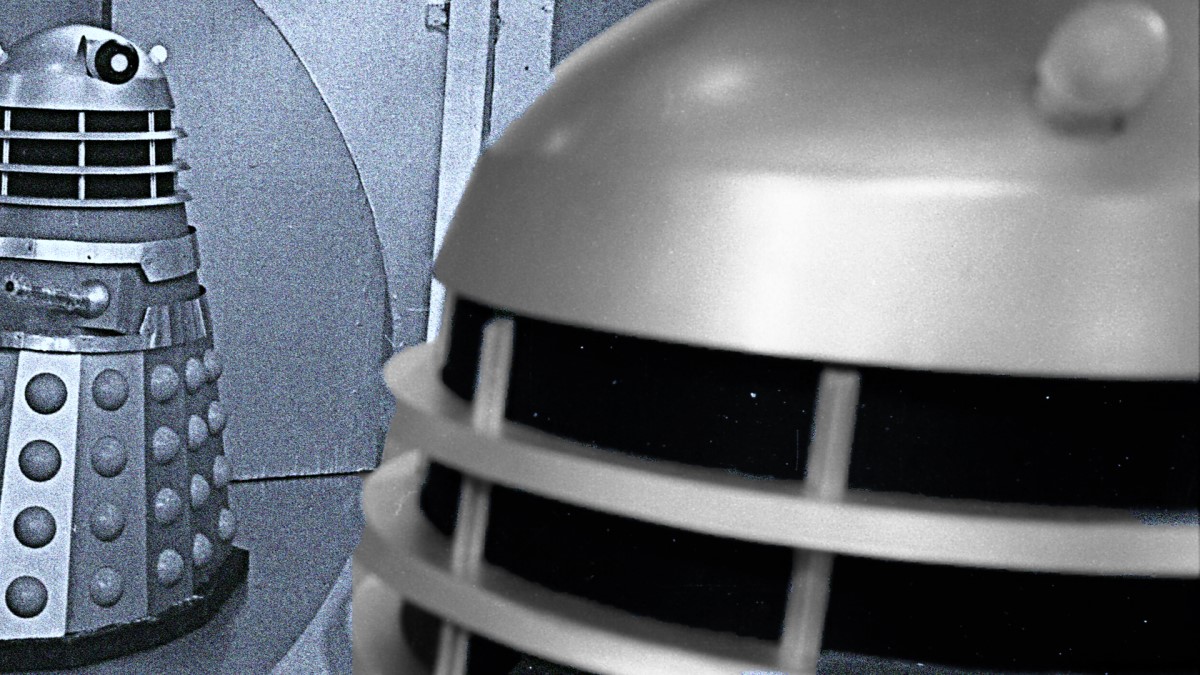
A large part of the central section of ‘The Daleks’ deals explicitly with a debate over pacifism, as represented by the Thals, who have abandoned their past incarnation as warriors and instead become farmers. ‘Fear breeds hatred and war,’ declares Temmosus (Alan Wheatley), the leader of the Thals, as he prepares to encounter the Daleks. ‘I shall speak to them peacefully. They’ll see that I’m unarmed. There’s no better argument against war than that.’ He is promptly killed by the Daleks with their death rays. ‘Can pacifism become a human instinct?’ wonders Barbara, and Ian dismisses such beliefs as pure idealism: ‘Pacifism only works when everybody feels the same.’
He later proves his point by seizing a Thal woman named Dyoni (Virginia Wetherell) and threatening to hand her over to the Daleks, thereby provoking Alydon (John Lee), the new Thal leader, into hitting him. Meanwhile the Doctor, ethically a more complex figure than he was later to become, is proving even more bellicose. ‘We have a ready-made army here,’ he declares, and when it’s pointed out that the Thals don’t believe in violence, he waves away such petty objections: ‘This is no time for morals.’ After further agonising – in which a key role is played by Dyoni, telling Alydon that she’s glad he stood up for her (‘If you hadn’t fought him, I think I would have hated you’) – the Thals decide to abandon centuries of non-violence and join the TARDIS crew in attacking the Dalek city.
The provocation of Alydon is a little glib, derived perhaps from the question so often put to conscientious objectors in the First World War: What would you do if you saw a German trying to rape your sister? (To which the homosexual writer Lytton Strachey famously replied: ‘I would try to interpose my body.’) But in the context of a children’s television drama, the simplicity is effective enough, and it was certainly an issue that caused Nation some soul-searching.
‘I had a bad time with the first episodes of Doctor Who,’ he commented in 1966. ‘The Doctor had to say to the Thals: “If you are worth keeping, if you have anything to contribute, it is worth fighting for, it is worth laying down your life for.” It was against all my beliefs, but I made him say it.’ He added, with the tone of a man more preoccupied with the Second World War than with a possible third: ‘It is a problem we all have to face. I don’t have the answer.’
There had been in Nation’s first storyline, ‘The Survivors’, one further echo of the times. The original concept had been that both the Thals and the Daleks blamed the other side for having started the war on Skaro. It is only at the end – when the Thals have beaten but not (in this version) killed the Daleks – that the Doctor pieces together the historical records of the two races and deduces that ‘both hemispheres were destroyed simultaneously, and there is evidence that before the attack the radar had recorded something in space’.
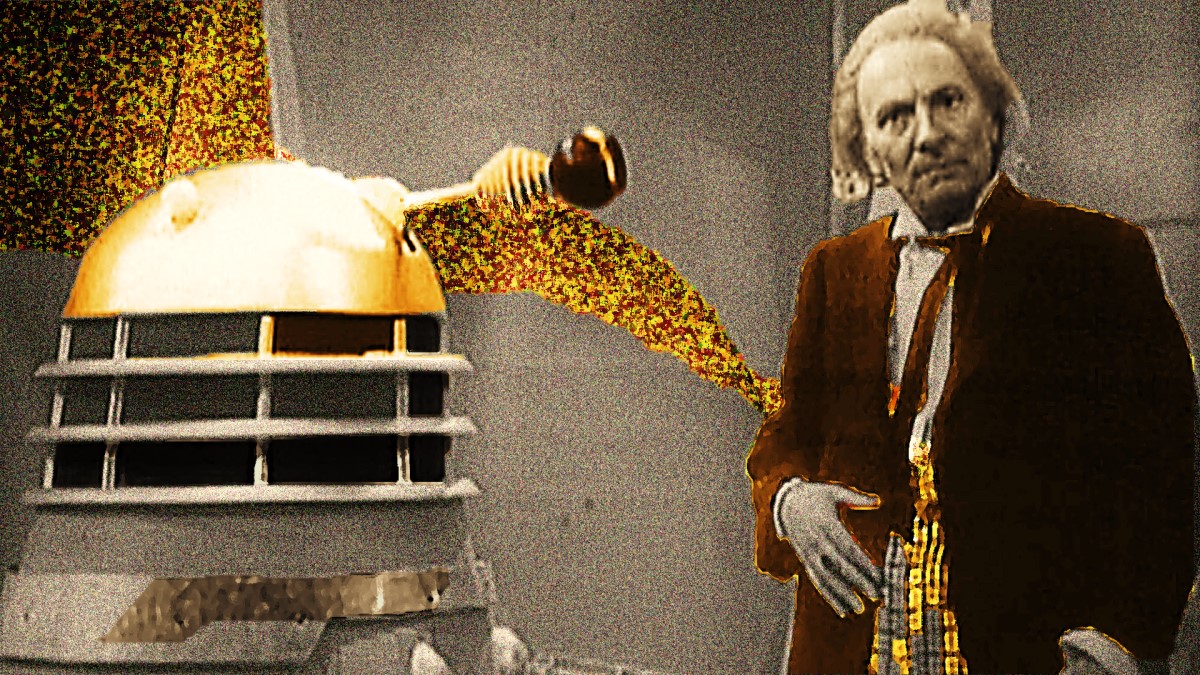
The idea of two power blocs being provoked into war, and thus destroyed, by a third party chimed with contemporary fears about the rise of China, which was then widely seen as a potentially destabilising influence on the fine balance between the USA and the Soviet Union, particularly after the Sino-Soviet split became public in 1960. (An early script for the subsequent story, ‘The Dalek Invasion of Earth’, included a reference to China being at war with both the USA and the USSR.) Unusually for Nation, however, the storyline ends on an entirely upbeat note: rockets arrive on Skaro carrying representatives of this third power, who explain that ‘they have realised the enormity of the crime committed by their forefathers. They have waited for the radiation level to fall, and now they come to make reparations and assist in rebuilding the planet.’
Fortunately this entire plot development was jettisoned, to be replaced by the destruction of the Daleks, thus avoiding the terrible possibility of viewers being left with an image of Thals and Daleks living together happily ever after. Such a denouement would have sat uncomfortably with the imagery of the preceding episodes, dominated as they were by overt Nazi references to the extermination of opponents. The very word ‘exterminate’ was firmly associated in the public mind with the Holocaust, a connection reinforced recently by its repeated use during the 1961 trial of Adolf Eichmann for his part in the Final Solution. And a happy ending would have gone utterly against the grain of the scene in which the Daleks rank up alongside each other, raise their right arms in a stiff salute and announce: ‘Tomorrow we will be the masters of the planet.’
see also:
Discover more from Lion & Unicorn
Subscribe to get the latest posts sent to your email.
