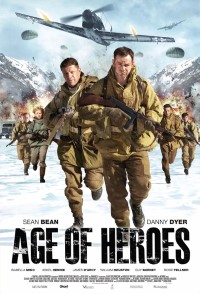
SIMON MATHEWS watches Adrian Vitoria’s 2011 film Age of Heroes.
What do we make of Sean Bean’s career? Old enough to have an entry in the last editions of Halliwell’s Who’s Who in the Movies (and therefore old enough to be gauged, somewhat quaintly, a film-star), he started out in the Royal Shakespeare Company, got noticed in arty Derek Jarman stuff like Caravaggio and War Requiem and then broke into the mainstream with The Field, Patriot Games and Goldeneye. The latter took five years to make, with Bean – the villain – a late addition, replacing Anthony Hopkins. It grossed over $350 million and on that basis alone should have led to the former Sheffield welder appearing in well-paid Hollywood blockbusters for decades to come.
But, just prior to his outing alongside Pierce Brosnan, he starred in a couple of UK television productions that would set his image in stone. The first of these, Sharpe’s Rifles cast him as Richard Sharpe, a career soldier during the Napoleonic wars. The second, Lady Chatterley, had him as Mellors in Ken Russell’s adaptation of D. H. Lawrence’s most famous work. Both appeared in 1993. The former was popular with men, featuring elaborate re-enactments of battles, lots of soldiers in period uniform, portrayals of real historical characters and a determined hero who comes good whatever the odds. He went on to play the role for fifteen years. The latter set female hearts racing and allowed him to hone his unreconstructed northern bloke persona to perfection, the classic rough diamond: passionate, sarcastic, railing against social restrictions and shagging around a lot.
Many of his roles in the years that followed were variations (or combinations) of these, among which we might note Outlaw, made in 2007. Shot in and around Gloucester it features Bean as an ex-paratrooper returning to a UK where crime and corruption are rampant. He joins a vigilante group to exact revenge against society’s many wasters. The critics hated it, Channel Four Film saying it was like ‘Death Wish written by the Daily Mail’. His co-star in this was Danny Dyer, and in 2011 they were paired again in Age of Heroes.
Dyer’s CV was less illustrious. Acting on TV from sixteen, his breakthrough role came at twenty-two in Human Traffic (1999) a kind of Welsh version of Trainspotting. After this he was in uniform in The Trench, alongside Daniel Craig, before co-starring (as Charlie Millwall) in a first ever screen adaptation of Brendan Behan’s Borstal Boy. All three suggested a decent career in reasonable productions. What did for that notion was The Football Factory (2004) as one of the Chelsea hooligans. From a novel by John King, more recently famous for The Liberal Politics of Adolf Hitler (2016) – in which a future European superstate is being doggedly fought by members of resistance group GB45 – The Football Factory also featured actor-director Tamer Hassan.
Dyer and Hassan would make four more films together over the following seven years. In these, Dyer established his persona: a hard nut with a heart of gold, usually on the wrong side of the law. Most garnered withering reviews, achieved low conventional box-office returns and were scorned by critics. Which was hardly the point. They catered to an audience who accessed their viewing via streaming services and on-line subscriptions and were comfortable with simplistic broad-brush plots and lavish doses of violence. This wasn’t arthouse territory.

And neither was Age of Heroes. A war film, it opens in France, May 1940. A group of British Expeditionary Force stragglers led by Dyer are retreating to Dunkirk. They reach safety but Dyer assaults a blimpish officer and ends up in a military prison. Some months later, we meet Ian Fleming – played here by public-school educated James D’Arcy – who is putting together a special forces team that will explore ‘innovative ways to destroy the enemy’ under the command of Major Jones of the Royal Marines (Sean Bean). Jones has wife trouble, and seems glad to be soldiering rather than spending time at home. We speed through the training and preparation rituals for their first mission. Dyer is released from prison to join them, jousting with the unit’s Scottish sergeant (William Houston, very effective).
They head to Norway to do something to a unique German radar device. It isn’t clear when in the war this is happening, but the snow scenes are nice. Unfortunately, the SS are in pursuit. Sadistic and curiously stupid, they don’t actually say ‘For you Tommy, the war is over’, but they might as well do. Cornered, Dyer and a couple of others escape to Sweden, whilst Bean and Houston, by far the best actors in the piece, cover them. The film ends. We don’t find out what happened to Bean, Houston or Dyer and it isn’t really explained why the mission had any particular importance.
Dramatically, this is on the same level as the Victor Book for Boys. There are no major female roles. Instead, we get lots of white men being tough soldiers. Which is fine if you like that, and in fact it’s better, or at least no worse than, many older, and more expensive, war films made in the 1950s and ’60s. The period detail is very good.
A big minus, though, for those prepared to ponder the point, is the central conceit of the plot: the SAS (or whoever they are) can change the course of the war by carrying out a single secret-mission. The presence of Fleming – with the frisson of the Bond angle added to the mix – gives it a veneer of credibility, the possibility existing that it is based on unclassified official records.
Politically, this plays into notions of exceptionalism held by many in UK politics (Tony Blair especially) about ‘punching above our weight,’ ‘playing a pivotal role’ and ‘having unique capabilities.’ Events in the last two decades have shown that ideas like these – in which the UK is deemed to be exceptional – can be dangerous fallacies.
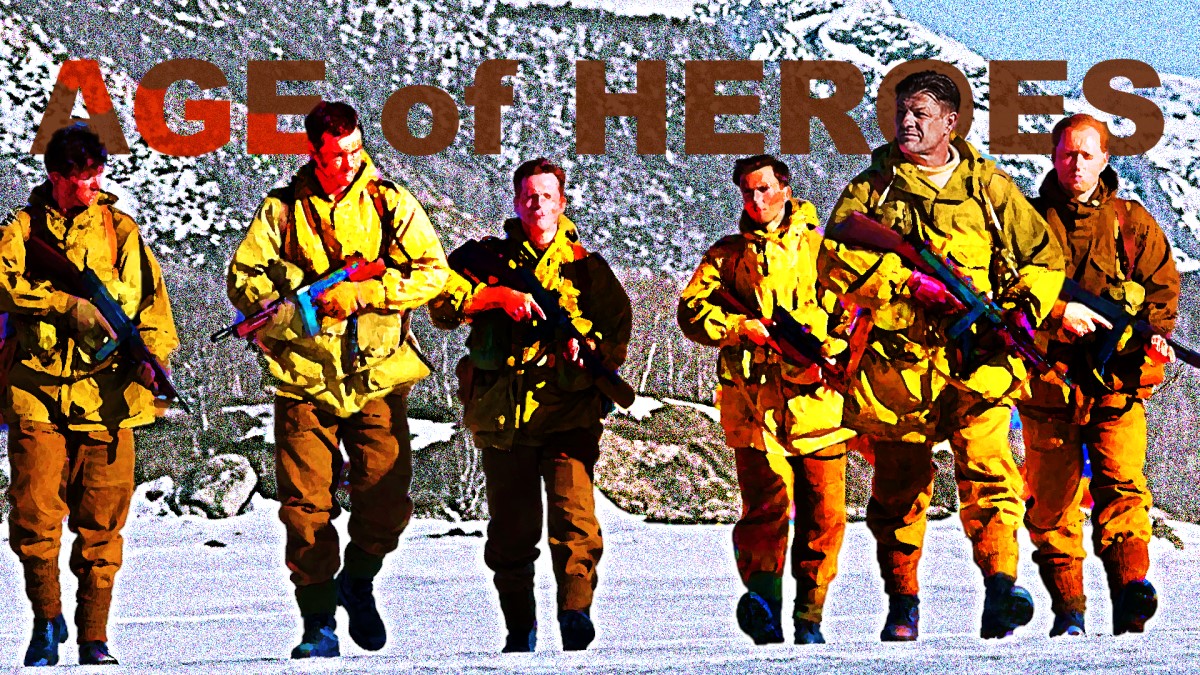
Which makes one wonder if Age of Heroes could be considered a part, albeit minor, of the cultural engine that drove Brexit. But was it? Between 2010 and 2019 the UK produced approximately 800 feature films, with around twenty-three of these covering the World Wars. At most, then, less than three per cent of UK cinema was re-running past glories.
There was, though, a bunching of such productions around 2016–17, all of which were being prepared a year or more earlier. These included the Dad’s Army remake (‘ancestor worship’ according to the Guardian), Brian Cox as Churchill (‘gets absolutely everything wrong’ in the view of Andrew Roberts), Dunkirk (an outlier that was widely praised and won awards despite, according to one US critic, resembling a Call of Duty computer game), Gary Oldman as Churchill in Darkest Hour (‘superb Brexit propaganda,’ said Charles Moore), and even a remake of Journey’s End, fully 89 years after the original opened at the Apollo Theatre, Shaftesbury Avenue, with a cast led by Laurence Olivier. (Generally deemed a superior effort).
Sadly, Age of Heroes received a much curter reception. Nor did its two stars obviously prosper. Bean has coped better. Although no longer getting top billing in major features he continues to appear on TV, often in interesting multi-part series. Dyer, though, did nine years in Eastenders (2013–22) and was last seen presenting The Wall, a celebrity gameshow not dissimilar to The Price Is Right. At the time of writing, he is tenth in the cast of the US (Disney) adaptation of Jilly Cooper’s 1988 bonkbuster Rivals, due to be screened in 2024. It will be interesting to see how many roles the post-Brexit UK film industry provide either Bean or him.
see also:


Discover more from Lion & Unicorn
Subscribe to get the latest posts sent to your email.
