Graham Coster
Train, Train
Bloomsbury, 1989
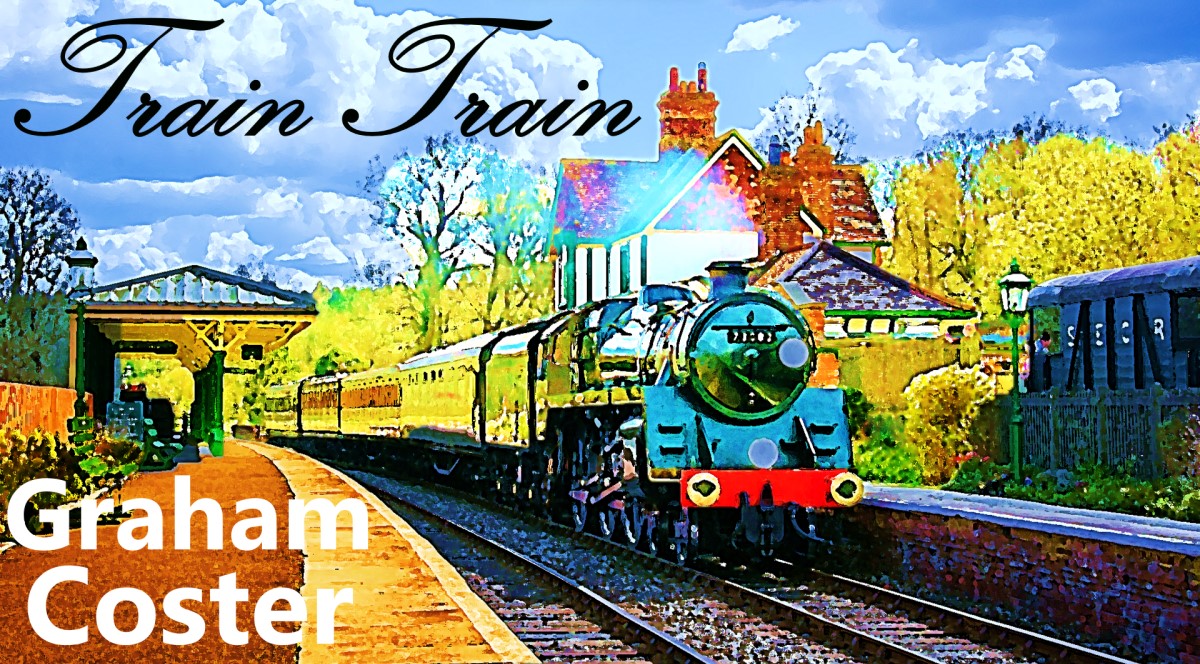
Our children, when young, loved the Bluebell Railway that meanders through rural mid-Sussex. On one of many voyages, a volunteer, acting as the guard, popped into our compartment and asked if we were enjoying the ride. Oh yes, I replied, and presumably it will be even better when you get some modern rolling stock.
A cheap shot, I know, but there is half a point there. Are preserved/restored railways providing actual train services or do they represent nothing more than a hobby for overgrown schoolboys and a distraction for passing tourists during the summer months?

This question provides the axis for debate and conflict in Train, Train. Greg Craven has left his well-paid job in the City and headed to the Lake District to work as an assistant in a youth hostel. On arrival, he finds that plans are afoot to re-open the local railway line, closed fifteen years earlier.
Ashley Edwards, local bookshop proprietor, is the organising genius behind the project and Greg, perhaps inevitably, becomes involved, when work commitments allow. Edwards has no doubt that the objective should be to restore a fully-functioning service:
‘The railway will give the town a sense of itself again,’ said Edwards. ‘This place needs control over its own destiny again. It’s been cut off. It needs a way out. It needs a future.’
Others have different ideas:
‘That is all we can do for the present, but it is quite enough. For the foreseeable future the railway can only be a short, summer-only, steam-operated line for tourist rides. We cannot afford to do any more.’
The narrative is spread across two summers, with a brief winter interlude in the middle. On arriving for his second summer, Greg learns the time-hallowed truth that you can never step in the same river twice. A go-ahead new manager, Mel, has taken over the hostel from the previous, dour incumbent:
Carrock hostel: new, and light and Mel’s. The piles of heavy, hairy blankets in the dormitories had been replaced by flowery duvets, which matched the new flowery curtains…’We’re competing with Ibiza, man. Is this a monastery?’ Wholefood menus for the meals, then; glasses of wine on sale in the evenings; real coffee afterwards.
As is often the way, however, breezy modernity is accompanied by a puritanism that had been absent before:
Mel’s voice: ‘Thanks for lining all our lungs with tar. Can smell it in the kitchen.’
Another voice: ‘We’re allowed to smoke in here, aren’t we?’
‘We’re all allowed not to smoke in here too.’
Greg’s first summer follows immediately after the 1987 Conservative Party election victory, and in both 1987 and 1988 he teams up with Ruth, a part-time student and short-order cook at the hostel. She takes a withering view of the railway restoration project:
‘It’s not just men playing with big trainsets,’ said Greg hotly.
‘But supposing it is – what does that say? Their wives are their mothers who send them out in the morning with their sandwiches to play, and their mothers in the cafeteria give them their tea in the afternoon, and they come home in the evening for their supper and give their mothers their muddy clothes to wash.’
I found Ruth rather irritating, especially with reference to her somewhat-cultivated eccentricities, such as borrowing Greg’s socks, curling up at the end of his bed and pinching his toothpaste. Perhaps we should be grateful to have been spared the trailing Doctor Who scarf and the green spiky hair.
Furthermore, I reported on the City during the years in question and don’t remember too many bright young things reacting with horror to Margaret Thatcher’s third consecutive election victory, unprecedent, at that time, in the modern era.
In general, however, the sense of time and place is beautifully evoked. This is the ‘other 1980s’, far from picket lines, inner-city riots and terrorist outrages. Here are eccentric schemes helped along by the Manpower Services Commission, which supplies a bus-load of jobless youths from Carlisle to help re-open the line.
Spoiler alert: it is, perhaps, unsurprising that Edwards loses the argument as to whether this is to be a “proper” railway or a tourist attraction, and that Ruth has been two-timing Greg.
I recall another visit to the Bluebell Railway, which coincided with that of a 1940s re-enactment society. A man in smart military uniform was explaining to a member of station staff that he would not have needed a ticket to travel as the War Office would have provided the necessary accreditation.
I remarked that a ticket collector who wasn’t a ticket collector was arguing with an Army officer who wasn’t an Army officer about a non-existent travel warrant. ‘This,’ I declared, ‘speaks volumes about how we live today.’
‘What does it speak?’ asked my wife.
‘I have absolutely no idea.’
see also:


Discover more from Lion & Unicorn
Subscribe to get the latest posts sent to your email.
