SIMON MATTHEWS revisits Étienne Périer’s 1971 film When Eight Bells Toll.
It’s the most successful UK cinema export of our time – ever since Casino Royale was adapted for US television in 1954 and Sean Connery jetted off to Jamaica for Dr No eight years after that – but will the James Bond series survive (spoiler alert) Daniel Craig’s death in No Time to Die? Perhaps it will, via prequels. Or via Bond being inserted, Sherlock Holmes style, into specially written period dramas. After all, 007 makes a lot of money for a lot of people. Can he afford to die?
It’s not the first time we’ve had the debate. There have been moments when it all looked a bit jaded, and old hat. Or when there were issues about sourcing a star – the six years between Timothy Dalton (1989) and Pierce Brosnan (1995) being a good example. Searching for the right man (never a woman) for the role takes time. The ideal Bond is a proper actor, with gravitas, who can perform his heroics with gritty intensity.
Back in 1970 many thought his number might be up. Ian Fleming’s hero was in deep trouble. George Lazenby had walked away after a sole outing in On Her Majesty’s Secret Service. Which was not quite the cavalier decision it might seem now. After all, by the end of the 1960s all the popular espionage series had ceased – Michael Caine had given up Harry Palmer, likewise Dean Martin with Matt Helm and James Coburn with Flint. The Man from UNCLE (to which Fleming had contributed) had stopped too. With Connery insisting he wouldn’t return, and Roger Moore committed to The Persuaders! TV series, there seemed a good chance Bond would just fade away.
Which the character might have done. But not the audience. Even if Lazenby and Connery were bored with the part, On Her Majesty’s Secret Service still took $82m at the box office and was the highest grossing film of the year in the UK. It was in this context that producers Jerry Gershwin and Elliott Kastner saw an opportunity to retool the Fleming approach for a new series of hard-hitting films. With Fleming dead, though, they needed another writer. Someone who could roll out best-selling thrillers, and screen adaptations thereof, with annual regularity.

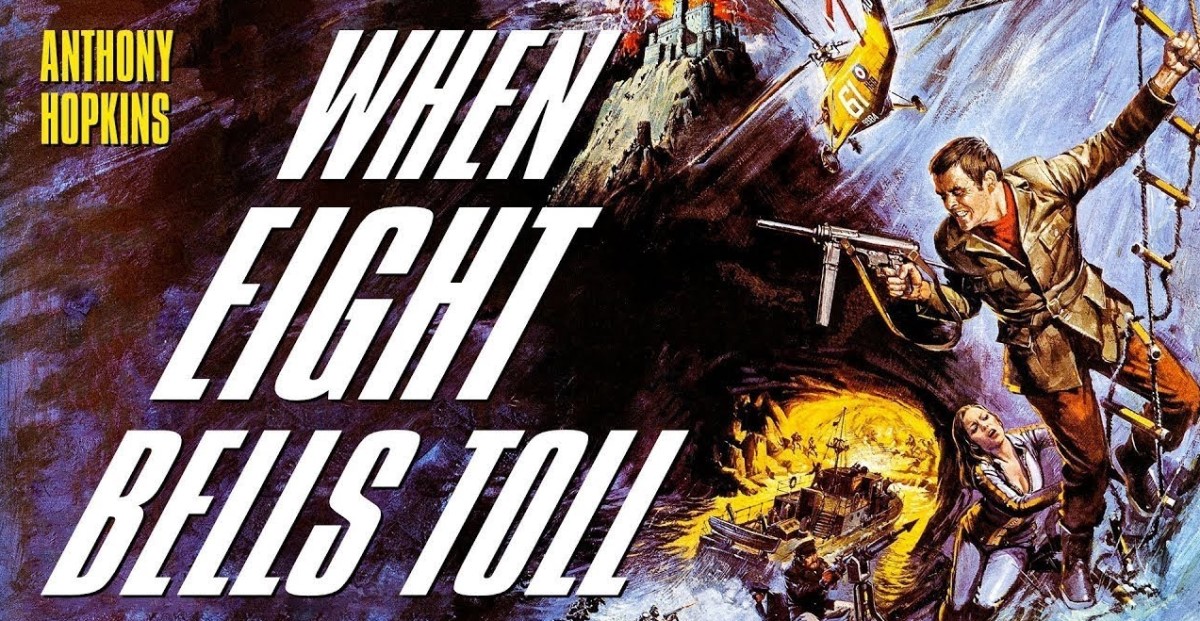
At which point, enter Alistair MacLean. Since his 1955 debut with HMS Ulysses, one of the UK’s more realistic war novels, he published roughly a book a year down to 1971. The majority of them were optioned for films, though not all were made. One that was, The Guns of Navarone, was a colossal success, the second biggest-grossing film of 1961. Five years later, Gershwin and Kastner asked him to write an original screenplay. He knocked out Where Eagles Dare (1968), another huge hit. In the autumn of 1969, with Bond looking likely to fail, they began filming his preceding book, When Eight Bells Toll.
It was striking how closely it follows the Fleming formula. The action man hero is a serving Royal Navy officer, Commander Calvert. He is licenced to kill and given to chippy anti-establishment asides. His operations are overseen with amused irascibility by someone vaguely like Q, who frequents London clubland and expensive restaurants. He and Calvert exchange comic banter as the plot evolves. Finally, there is a glamorous woman.
As Calvert they cast Anthony Hopkins. A good choice, he was thirty-three years old and a solid actor with Old Vic and National Theatre experience. On screen he’d recently appeared in the film of John Le Carré’s The Looking Glass War. Prior to that, he’d been in Tony Richardson’s Hamlet at the Roundhouse with Nicol Williamson and Marianne Faithfull. (Not something you could imagine Connery or Lazenby doing.) Robert Morley was cast in the Q/Bernard Lee role and Nathalie Delon, wife of Alain, as the female lead. An efficient Belgian director, Étienne Périer, was hired to turn MacLean’s script into a hit film.
It opens with a sub-Bond title theme as the camera follows a frogman – Hopkins in a close-fitting wet suit – making his way onto the deck of a moored ship. The plot is quickly explained. Ships carrying gold bullion are being hijacked whilst on passage around the British Isles. Not a terribly likely premise, HM Treasury not being known for transporting gold bars by boat, but by the standards of a Fleming/Bond adventure it’s plausible enough. This being so, we get to see a lot of claustrophobic underwater scenes amidst magnificent Scottish scenery.
Indeed, much of what follows – the combination of surly locals, a laird who is covering something up, police that can’t be trusted and the feeling that one is trapped in a remote location – evokes similarities with The Wicker Man. Nathalie Delon makes her appearance as one half of a mismatched couple cruising the local waters on a large motor yacht ‘like Sotheby’s afloat’. Whilst London dithers, Calvert acts, laconically describing himself as ‘a professional bastard’ as he does so.
It turns out the deeds are being done in an elaborate underground bunker with an entrance off a remote loch. In a scene that plays like a smaller version of the climax of You Only Live Twice, this is stormed. In another Fleming trope, the femme fatale (Delon) is revealed as a double-crossing mastermind. But Hopkins – who handles the obligatory sex scenes and fights very effectively – wins through. The villains are either killed or arrested. He lets Delon escape.

When Eight Bells Toll appeared in March 1971. It did okay in the UK and Europe, but tanked in the US. (Too British, and who wants to see the Hebrides when the real Bond gives you exotic locations?). When it started filming, October 1969, Lazenby was being bolshy post-production of On Her Majesties Secret Service, and Connery was in self-imposed exile. Alas, just before it was released, and very much against expectations, Connery agreed to come back for Diamonds are Forever, which started filming in April 1971. Boasting international settings like Los Angeles and Las Vegas, this did seven times better at the box office.
Gershwin and Kastner held on, hoping that Bond would die at that point, only for Roger Moore to become available for the role when The Persuaders! ended after a single series. Yes, Cubby Broccoli interviewed Hopkins for the part – along with eleven others – but Hopkins declined, and the projected series of McLean scripted Commander Calvert action thrillers quietly died. It had seemed like a good idea at the time.
Hopkins went back to the Old Vic and, before Hannibal Lecter became his most recognisable persona, provided further flashes of his ability to play action-men in A Bridge Too Far (1977, as Lt Col Frost, commander of the paratroopers who managed, briefly, to capture the bridge) and Mutiny on the Bounty (1984, a memorable Captain Bligh). If the cards had fallen differently in 1971–72, we might have seen more of him as Commander Calvert.
In the meantime, will Bond survive?
from the maker of:

see also:



Discover more from Lion & Unicorn
Subscribe to get the latest posts sent to your email.
