
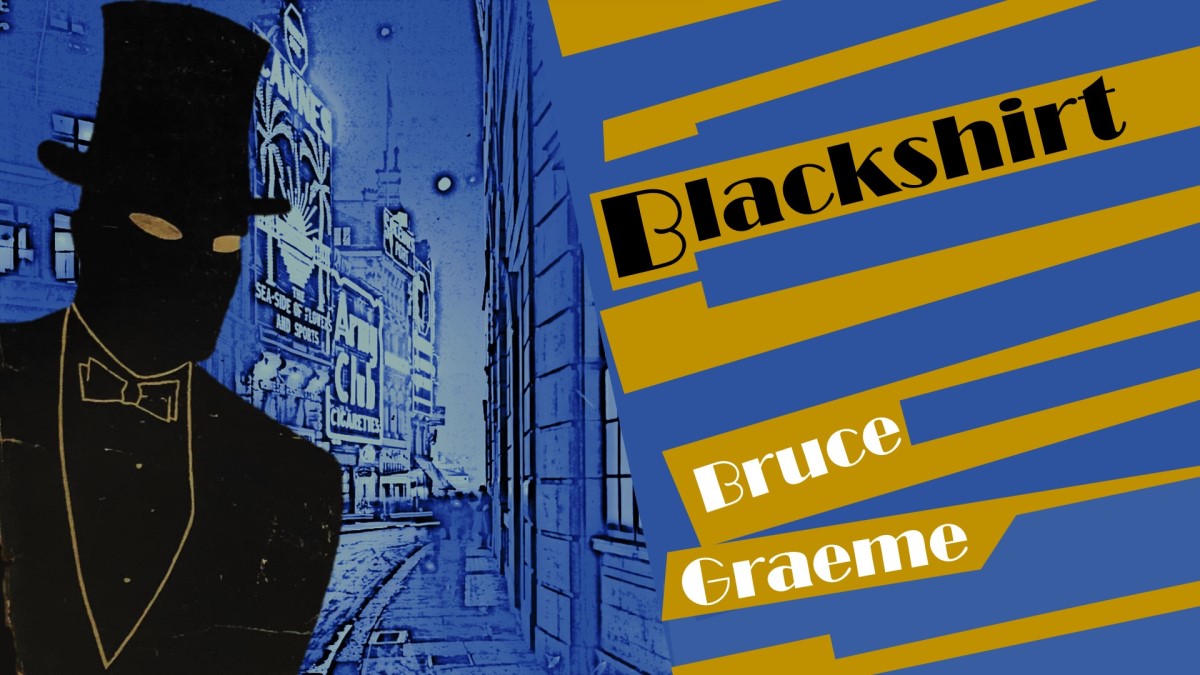
Blackshirt is the most lovable criminal since Raffles.
publisher’s advert, 1925At last, after all these years, his identity was discovered – and by a woman!
Bruce Graeme, Blackshirt, 1925
In his day, Richard Verrell, alias Blackshirt, used to be a big deal, a serious rival to other thriller heroes, the likes of John Mannering, alias the Baron, and Simon Templar, alias the Saint. The first two books, Blackshirt (1925) and The Return of Blackshirt (1927), sold a million copies each, and Bruce Graeme (pseudonym of literary agent, Graham Montague Jeffries) ended up writing a total of thirteen volumes in the series, going up to 1943. Then his son, Roderic Graeme, picked up the torch and added a further twenty, the last of them coming in 1969.
And then… Well, then nothing, really. Blackshirt faded very rapidly. The books must still have been circulating in the 1970s, but I don’t remember ever seeing them. Paperbacks by Leslie Charteris, John Creasey, James Hadley Chase were all over the place, but not those of Bruce Graeme. The one movie – quota quickie The Black Mask (1935), directed by Ralph Ince, starring Ellis Irving – has been lost. (‘Very mediocre entertainment,’ said Picturegoer magazine.)
Now, it’s almost as though he’d never existed. The last reference to Blackshirt in the national press was in 2015, in the Invisible Ink series in the Independent, written by Christopher Fowler (whose death in March this year we note with great sadness). Prior to that, the most recent article I can find is from 1977, an amateur fan-piece that appeared in the Long Eaton Advertiser as well as in the Stapleford and Sandiacre News – both admirable publications, no doubt, but not exactly high-profile. As Fowler concludes: ‘Blackshirt is forgotten, then, but not quite gone.’ Neither he nor Graeme (who wrote ninety other non-Blackshirt books) has a Wikipedia page.
Does Blackshirt deserve this obscurity? Well, perhaps he does, to be honest. But there are aspects that interest me, particularly when it dawned on me that the books aren’t really thrillers at all. They’re romance novels.
It starts with his creation story…

As a very young child, the son of the first Earl of Redbrook got lost in the streets of London, separated from his nursemaid. He was found, and promptly abducted, by a couple who lived in the most squalid part of the East End. They brought him up for a life of crime, with ‘weeks and months of brutal blows, of lessons in the art of picking pockets, until at last, out of fear of his teachers, his arms became nimble and his fingers deft’. He progressed, through ‘lessons and more lessons, of scaling walls, of slipping window-catches’, to become a burglar.
After his foster-parents – for want of a better way to describe these ‘drunken, cringing sycophants’ – were killed in an accident, he continued his criminal activities, but now used the proceeds to educate and to better himself, until ‘the slum-bred grub emerged into the polished, educated gentleman, who, as a famous author, renowned for his crime stories, became a popular society favourite’. Reinvented as Richard Verrell, he wrote novels like The Vanished Heirloom, perhaps drawing on a buried memory of his origins that’s long been lost to his conscious mind. When the Great War broke out, he volunteered and ‘did his bit magnificently,’ thereby enhancing his social standing no end.
This is how we first encounter him. He’s in his late twenties, an elegant man-about-town, a carefree bachelor living in Notting Hill.
That’s not the whole picture, though. He also has a secret identity, because despite his worldly success, there’s something inside that still yearns for the visceral excitement of his earlier career. And so, dressed from mask to toe in black, he ventures out at night, becoming known and feared as Blackshirt, the greatest burglar of the time. ‘He was likened by many to a Napoleon of crime, a veritable Moriarty, a superman possessing the tactics of Jim the Penman, the skill of Frank Kent, the luck of Max Shinburn, the genius of Adam Worth, and the brutality of Landru.’*
So here he is, ‘author by day, cracksman by night’, and you’ll be thinking: hang on, that’s A. J. Raffles. And indeed, Blackshirt is a knock-off of E. W. Hornung’s character. Not as good, of course, but there’s no shame in that: Raffles is one of the great creations of British fiction, and none who followed in his rubber-soled shoes could ever match up to the master.
Like the others, Verrell/Blackshirt steers clear of Raffles’s homosexuality, but the note of being outside society remains. That abusive childhood nags away at him, his secret life an expression of his divided self. Despite the façade of the detective writer, he’s not a carefree bachelor at all, he’s a desperate man in search of salvation from himself. He finds it in an unexpected way.

The first episode (the stories were originally serialised in The New Magazine) sees Blackshirt burgling the home of Sir Allen Dunn and stealing the jewellery of Bobbie, daughter of the household. Back in his own flat, he’s startled to get a telephone call from an anonymous woman telling him to return the jewels. Aware that his secret identity has been discovered, he has no choice but to comply.
And thus begins the strange relationship between Verrell/Blackshirt and the Lady of the Phone, as he thinks of her. She continues to call, giving him instructions, directing his thefts so they become socially responsible – she secures a large donation to a charitable school in one episode. He does what he’s told, because she has the power to expose him, and also because he gradually realises that he likes her exerting that power. He needs to be controlled, to yield to someone else’s absolute authority, just as he had been forced to yield to his foster-parents. This is not a relationship of equals. In his dealings with the Lady of the Phone, ‘he might have been a child standing fearfully before his teacher.’
As their relationship (all conducted by telephone) continues, she’s cold and haughty and sometimes flirtatious, ever more assertive. ‘She was cracking the whip now, and Verrell was feeling its lash.’
In The Durable Desperadoes (1973), his very wonderful study of the genre, William Vivian Butler quotes that line and comments: ‘No doubt a Freudian would have no trouble detecting sado-masochistic elements beneath this novel.’ To be fair, it’s hard not to detect such elements. Her psychological domination extends to stripping him not just of power but of privacy; using a telescope, she can see from her bedroom into his, and watches him dress up in his Blackshirt outfit. ‘Are you requiring a pet slave?’ he asks her.
Well, you don’t need me to tell you that the mysterious Lady of the Phone turns out to be Bobbie, nor that she conquers him with love. The first volume ends with him renouncing his life of crime as they resolve to get married. He has found fulfilment, and his pretence of being an independent free spirit can be set aside, along with his Blackshirt uniform.
The success of the book necessitated a sequel, which presented a problem, given the happy ending. Graeme gets round this by having the honeymooning couple involved in a rail crash. Believing that Bobbie is dead, Verrell has a breakdown in which he loses his memory of everything that happened in the first book, though he remembers everything up to that point. It’s such a shameless reset that one can’t help admiring the cheek. Anyway, he reverts to burglary, donning the Blackshirt garb again, Bobbie – who of course isn’t really dead – has to pull him back again, and she does so via the telephone.
Again, you don’t need me to tell that she succeeds. ‘You saved me when my soul was turning blacker than the night,’ he says.
The Return of Blackshirt is a rewrite of the first book, though even more implausible. In the interests of creating jeopardy, Verrell’s alter ego is repeatedly uncovered by person after person, jeopardising his position. Even he notices the absurdity: ‘Good God! Was there no end to the list of people who knew him?’ Happily, many of them fall under his spell and collude to protect his secret. He brings out the maternal instinct in the most unlikely of people, including a retired Scotland Yard detective and a hard-bitten Fleet Street hack; the latter spikes the biggest scoop of his life, when he realises it will ruin the happiness of Verrell and Bobbie.
As I said, these are essentially romances, rather than thrillers. There’s far too much introspection for an action adventure, too much agonising over the legacy of Verrell’s childhood. He’s a damaged, lost boy and the message is clear: he needs the love of a good, stern woman – and a love like that is the greatest power on earth.

It’s not all introspection, though, and there are some nice touches. Making Verrell a detective writer gives an opportunity to tease about the influence of genre fiction. This is an unmarried woman in her twenties: ‘Every action of Nellie’s was affected, studied; he guessed that this was due not so much to mere affectation as to the fact that she was an enthusiastic cinema-goer, an ardent reader of romance.’
There’s a good sequence in which he has to return, in disguise, to the crime-ridden neighbourhood where he grew up, and discovers that there has been considerable progress over the last decade or so. ‘Everything had changed for the better, though still it was an eyesore, a blot on the landscape of an otherwise clean, if ugly, city.’ Some of the old characters are still there, such as China Joe, who runs lodgings for ‘some of the worst criminals in London’, though even with him there have been changes: he runs an opium den in traditional fashion, but he’s also now involved in ‘a traffic in “snow”, better known as cocaine’.
Best of all, is an episode set in a Chiswick variety theatre:
From afar off Verrell saw the brilliant lights of the Palliadrome, casting a halo of illumination around the music hall, so that even the sky reflected back the vivid colouring. In flashing, scintillating letters of fire, the names of the “star” performers were blazoned to the world: the Houston Sisters, Noni and Horace, Ethel Hook.
Blackshirt is supposed to be robbing a safe in an adjacent office-block, but the night is so dark that he gets the wrong building and is discovered. As he tries to escape, he falls to the stage from the lighting rig, right into the act of the Gimcrack Brothers, ‘the “make-you-laugh” acrobats’, clowns who do tumbling tricks. Luckily, he lands on their trampoline and isn’t injured, and the Brothers improvise to incorporate him into their routine. Then an audience-member identifies him as Blackshirt, and he’s back on the run again, this time pursued by clowns, chased out of the building and down a railway sidings, with the only illumination on this pitch-black night coming from the trains that thunder past. Graeme can do action, when he tries.
Having written the same story twice, Graeme evidently decided he needed to find a new direction, and Blackshirt soon settles into a more sustainable role, a writer with a sideline as a government agent, using his secret identity in the service of his country. To sustain the long series of titles, there was also an ancestor discovered, allowing for a historical setting to some of the stories, and eventually Son of Blackshirt (1941), in which a pipe-smoking RAF pilot discovers his father’s hidden past. (This is set, optimistically, in a post-war Britain.)
I haven’t read any of these, beyond the first two, and I doubt that I shall. Blackshirt isn’t a strong enough character to warrant too much attention. The masochistic streak in an action hero is dealt with far more entertainingly in John Buchan’s Richard Hannay stories. Buchan could write better, as well, without the need for Graeme’s long conversations that elucidate a little too clunkily. ‘Richard dear,’ says Bobbie on their wedding-day, ‘you are happy, aren’t you, or do you regret giving up your adventures and the attendant thrills?’
One last thing: even by modern standards, the books are mostly harmless. Graeme, noted Christopher Fowler, ‘managed largely to avoid the swivel-eyed rabidity of early English thriller writing’. Given that the biggest hero when he was starting out was the racist, quasi-fascist Bulldog Drummond, it’s worth recording that alternative views were available. (The Blackshirt tag has no fascist intent; it’s just about camouflage.)
* Jim the Penman was a fictional forger in Victorian Britain, in a play by Charles Lawrence Young, Worth and Shinburn were both crime bosses, and Henri Désiré Landru was a serial killer. But I don’t know who Frank Kent was.
see also:



Discover more from Lion & Unicorn
Subscribe to get the latest posts sent to your email.

Thanks so much for this piece. I read several of these novels when I was about 10 but until now couldn’t find any mention of the author or a copy to see how they havr held up
LikeLike