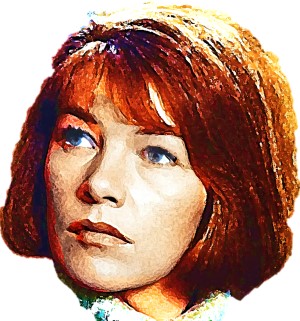
SIMON MATTHEWS pays tribute to the late Glenda Jackson, star of Peter Brook’s 1968 film Tell Me Lies and mayor manqué.
The greatest actor of our time? Quite possibly. An esteemed part of Global Britain, appreciated by many? Definitely. The passing of Glenda Jackson earlier this year produced fulsome tributes and weighty obituaries. This piece attempts to say a little bit more about the teenage girl from Birkenhead who won a scholarship to RADA in 1954.
To begin with, it took her the best part of nine years to make any sort of impact. When she did it was in the 1963 West End theatre production of Bill Naughton’s Alfie. This had John Neville as the protagonist with Jackson playing ‘Siddie’, one of his many conquests, a part taken in the film by Millicent Martin. By the time that was being cast, her ascent had continued when she joined the Royal Shakespeare Company.
Here, under Peter Brook’s direction, she scored a huge success in The Persecution and Assassination of Jean-Paul Marat as Performed by the Inmates of the Asylum of Charenton Under the Direction of the Marquis de Sade. Not surprisingly most commentators made do with Marat/Sade, but gave it rave reviews nonetheless, and it ran for several years, including a New York transfer which brought Jackson, who played Charlotte Corday, Marat’s assassin, a Tony nomination.
A film version appeared in February 1967, by which time Brook and Co were back on the London stage with US, an excoriating, and very topical, critique of American involvement in South East Asia. This was deemed so remarkable that Peter Whitehead – just back from filming the Rolling Stones touring Ireland in Charlie Is My Darling – made a documentary, Benefit of the Doubt, about its run at the Aldwych Theatre. After which, awash with the plaudits from that and Marat/Sade, the RSC launched out on their own film adaptation, Tell Me Lies, the title being taken from a poem by veteran CND activist Adrian Mitchell.

A protest against both US foreign policy and how the war in Vietnam was being reported in the western media, it still makes for interesting viewing 55 years later. Brook and his players cannot disguise the theatrical origins of their material: there are lots of talking heads, poetry readings and monologues to the camera. It’s part-acted and part-documentary, with newsreel footage intercut. Shot in a mixture of colour and black and white, there are also songs – like a Joan Littlewood review – and plenty of agit-prop effects. Everything is terribly serious.
An anti-war demonstration in London (14 August 1967) is edited in and preserved for posterity. Jackson appears addressing a rally in Trafalgar Square, quoting Mao Tse-Tung. She looks absolutely gorgeous. Very attractive, with closely cropped hair. Around the 80-minutes mark, an extended session is shot inside the UFO club, with plenty of light show but no band (sadly). Amidst all of this, Brook and his camera team gate-crash a literary soirée, where they record arguments between the cast and Tom Driberg, Kingsley Amis, Stokeley Carmichael and Allen Ginsberg, the latter pair in town for the Dialectics of Violence conference at the Roundhouse.
Granted an X-certificate, Tell Me Lies was screened at the August 1968 Venice Film Festival. Here, as part of a riotous counter-culture feast, it was shown alongside Me and My Brother (more Allen Ginsberg), Monterey Pop, Wild in the Streets, Theorem (Pasolini), Partner (Bertolucci), and The Castle (Kafka). The Golden Lion that year went to the inscrutably high-brow West German Artists Under the Big Top: Perplexed.
Tell Me Lies sits somewhere in the middle of these. Muddled and not exactly a great night out, it was, nevertheless, political, boundary pushing, left-wing stuff. (And the cast and crew liked making it so much that the producer, Peter Sykes, took the cameraman and a couple of the actors with him when he directed The Committee, with music by Pink Floyd and Arthur Brown).

Importantly, it showed Jackson could act as well in film as she could on stage. From this point on she was in demand. Next, she made Negatives (1968), as a woman who only gets aroused by her partner when they role-play Dr and Mrs Crippen, in vintage clothing. After which audiences could appreciate her in DH Lawrence’s Women in Love (1969), which won her an Academy Award; in a love triangle with a bisexual man and his gay partner in Sunday Bloody Sunday (1971; a BAFTA); in The Triple Echo (1972), from an HE Bates novel in which she disguises her lover as a woman; and in Jean Genet’s The Maids (1975) as one of two domestic servants in a sado-masochistic relationship.
There were many others of course, but it was surely part of the zeitgeist that much of her best work showed a willingness to explore sexual boundaries. Despite her success – which included a second Academy Award for A Touch of Class – she had a hankering to branch out into a line of work that would be more useful than acting. At the end of the 1970s she tried and failed to complete a course at the Open University to be a social worker. Circa 1981 the possibility arose of being the Labour candidate for the newly created Welsh seat of Bridgend at the 1983 general election. She turned this down to start a humanities degree at Thames Polytechnic, only to drop out and make Giro City (1982) instead. Finally, after starring in Ken Russell’s adaptation of Oscar Wilde’s Salome’s Last Dance (1988) she sought a career as an MP.
Which brings us to her politics. A card-carrying Labour member since the late 1950s, she detested Militant (‘self-indulgent crap’) and had no time either for the macho trade-unionism of Arthur Scargill. It is tempting to see her rejection of both as evidence of a less than left-wing outlook. But this is to overlook the way the ultra-left view the world: they believe in the primacy of class and often have negative views (or no views at all) about culture. Jackson in contrast thought culture vital and, like Jurgen Habermas, would have argued for its primacy in determining an individual’s understanding of the world. Thus, Jackson fitted the pre-Blair Labour Party quite well. After fielding an approach from Leeds East CLP to succeed Denis Healey, Hampstead and Highgate came knocking in late 1989. They adopted her on 28 March 1990. She was 54 and Neil Kinnock led Margaret Thatcher by 23 per cent in the opinion polls.
Alas, as we know, Kinnock failed to convince the electorate that he was preferable to John Major. Jackson won Hampstead and Highgate but languished on the back benches, and Labour began its journey to the right. In 1997 Blair gave her a junior role for transport. Some thought she might, like Jenny Lee in earlier times, have been a more than competent Minister for the Arts. But others – among them Baroness Blackstone, David Lammy, Margaret Hodge and Barbara Follett – were preferred for this. All were less troublesome.
Later Blair backed Frank Dobson for the London Mayoralty, only to be easily outmanoeuvred by Ken Livingstone’s Socialist Action machine. Jackson – the third option in the membership ballot – came nowhere. Given that Dobson didn’t actually want to be Mayor of London (he wanted to stay in the cabinet), had Blair endorsed Jackson instead its possible she might have beaten Livingstone, and the difficulties that Labour subsequently faced with its Trotskyist factions might well have been avoided. But this is to assume that Blair would have wanted someone popular, open minded and relatively left-wing as Mayor of London. He didn’t.

After 1999 Jackson held no government position at any level. Instead, she became a critic of Blair, initially over the introduction of higher education tuition fees. By 2004 she was calling for him to resign following Lord Hutton’s Judicial Enquiry into the death of David Kelly, later expanding this to threatening to challenge Blair as a stalking horse candidate in a leadership contest if he did not stand down within a reasonable amount of time, before finally (2006) backing Plaid Cymru and the Scottish National Party’s call for an inquiry into the Iraq War.
Looking back, it was almost as if Tell Me Lies and the character she plays in it, had been a premonition of the direction her own career, and UK politics would take in the early twenty-first century.
In truth, by the time David Cameron became PM, the UK had changed so much that she represented someone from a by-gone time: the vanished post-war period of immense public spending and social mobility. Memorably, after the 2013 death of Margaret Thatcher, she attacked the former PMs legacy with gusto, and later (2014) told Iain Duncan Smith that his period as Work and Pensions Secretary, was only notable for the ‘destruction of the welfare state and the total and utter incompetence of his department’. But opposition MPs can do little other than make speeches, and in 2015 she stood down to return to acting. There was a memorable King Lear on stage, a radio play as Edith Sitwell, a radio series adaptation of Zola and a couple of films before the curtain came down.
UK politics should really have more use for people of this calibre. As it doesn’t, we can only mull over what might-have-been and continue to enjoy, frozen as they are for posterity, Glenda Jackson’s magnificent performances before she swerved into politics, particularly those that both entertained and pushed boundaries.

from the maker of:
see also:


Discover more from Lion & Unicorn
Subscribe to get the latest posts sent to your email.
