‘We are democratic in England – truly democratic. We can grumble and say what we think and laugh at our politicians. We’re free.’
Agatha Christie, One, Two, Buckle My Shoe, 1940The right thing to say about Mrs Christie has long been said: ‘She’s done it again…’
Illustrated London News, 1941
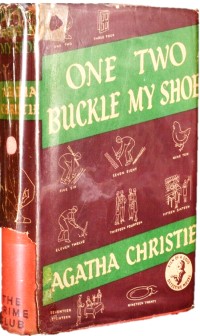
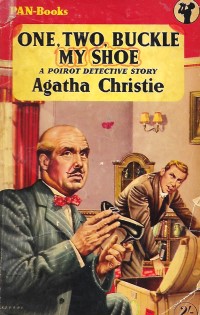
Agatha Christie’s thirty-first novel (the seventeenth to feature Hercule Poirot) was published in November 1940 and, although it’s clearly set a few years earlier, before the war, there’s a weight to proceedings that reflects its time. In America, it appeared as The Patriotic Murders, and that’s a more accurate title: behind the now-familiar murder mystery, the backdrop is saturated with politics – to which we shall come in a moment.
The story is a decent one. (Be warned: it’s all spoilers from here on in…) On the morning that Poirot has some dental work done, his dentist is murdered. Two other killings follow, and for a while it seems as though an innocent man will hang for the crimes. But before we get to the reveal, we have all the requisite coincidences, red herrings and unexpected twists
There is, though, slightly too much implausibility for it to count among Christie’s best works. When Poirot blithely says that it’s ‘easy to arrange a loaded pistol amongst laurels so that a man, clipping them, shall unwittingly cause it to go off,’ one does wonder whether it’s really as easy as all that. Let alone to arrange for this accident to happen just as the right person happens to be passing through that part of the garden. (Clive Exton evidently wondered, since he rewrote this bit in his 1992 television adaptation.) And there are loose ends that Poirot simply doesn’t bother with – as the Birmingham Evening Post reviewer noted at the time, while acknowledging that it doesn’t really matter when ‘the whole story is so ingeniously woven’.
There are also some good jokes. The characters are nicely lived-in by this stage, so when Poirot starts theorising too fancifully, Japp can reprimand him: ‘You’re talking like a thriller by a lady novelist!’ And it’s hard to resist Poirot reading Punch in the dentist’s waiting-room: ‘He went through it meticulously, but failed to find any of the jokes funny.’
The point where it really turns is when Chief Inspector Japp is told by the Foreign Office that all the deaths have now been adequately explained, and – against his wishes – he is to terminate his investigation. Why? Well, it appears that one of those mixed up in the killings is married to a secret agent and any further publicity would be most unwelcome; her husband is currently ‘somewhere abroad in a ticklish spot and they don’t want to queer his pitch’.
Poirot, of course, is not bound by such official strictures, so he keeps on investigating. And he soon realises that the business about a secret agent is a cover; the real concern is that one of the dentist’s other patients that morning was Alistair Blunt, ‘a quiet nondescript Englishman who was the head of the greatest banking firm in England’. Blunt matters. He isn’t famous, he has no public profile, but behind the scenes he is, more than anyone, responsible for the economic stability of the nation. He is ‘a man in whose hands lay supreme power’.
It is largely thanks to his endeavours that Britain remains safe from the totalitarianism that has swept Europe. (Remember that this was published after the fall of France.) He is, the doomed dentist tells Poirot, ‘the answer to their Hitlers and Mussolinis and all the rest of them’. Blunt himself, a normally modest man, has a similar view: ‘I’ve done something for England, M. Poirot. I’ve held it firm and kept it solvent. It’s free from dictators – from Fascism and from Communism.’
Consequently, there is no shortage of those who want to get rid of Blunt. ‘Quite nice people, some of ’em,’ says a retired spy, who knows about this world. ‘Long-haired, earnest-eyed, and full of ideals of a better world. Others not so nice, rather nasty in fact. Furtive little rats with beards and foreign accents.’ People – in other words – like Frank Carter, the police’s #1 suspect in the case.
‘He lost his job some weeks ago and doesn’t seem able to get another,’ we learn of Carter, but before we can feel too sympathetic for his plight, he turns out to be a thoroughly unpleasant young man: arrogant, bullying, belligerent. We’re not much surprised to find that he’s a fascist, one of ’those Imperial Shirts, you know – they march with banners and have a ridiculous salute’. On the other hand, that status of being the police’s #1 suspect ensures that, this being Christie, he’s definitely not a murderer.
Nonetheless, the threat to Blunt’s life is to be taken seriously. What would happen if he were to be killed? ‘I’ll tell you,’ he says. ‘A lot of damned fools would try a lot of very costly experiments. And that would be the end of stability – of common sense, of solvency. In fact, of this England of ours as we know it.’ His picture of a well-ordered society appeals to a man who had to flee Belgium the last time it was invaded by Germany. ‘Poirot nodded his head. He was essentially in sympathy with the banker.’
Also in sympathy, we are to understand, are the British people. ‘We’re very tiresome people in this country,’ the retired spy tells Poirot. ‘We’re conservative, you know, conservative to the backbone. We grumble a lot, but we don’t really want to smash our democratic government, and try new-fangled experiments. That’s what’s so heart-breaking to the wretched foreign agitator.’ Blunt is the great symbol of that conservatism.
There’s a flaw in this vision, though. There’s bound to be, because human beings are flawed creatures. Democracy is underpinned by the great financial institutions, but those institutions are in the hands of people who, in the dentist’s words, are ‘just like you and me’. And that means they’re prey to the temptations of power. ‘For a long time you have been virtually a dictator,’ Poirot tells Blunt, ‘and to a dictator his own life becomes unduly important and those of others unimportant.’
That’s the recurring theme in the novel. ‘What does the death of one miserable dentist matter?’ an ‘idealist’ asks rhetorically, and Poirot replies: ‘It does not matter to you. It matters to me. That is the difference between us.’ Another character is similarly dismissive of the dead dentist: ‘He was of no importance.’ And again Poirot has to correct her: ‘There you are wrong.’
Eventually, he confronts Blunt, accusing him of murdering three people and of planting evidence that would have hanged a fourth (the disagreeable Frank Carter). The death of the dentist was a regrettable necessity, the banker admits, but the other three were no great loss to the world.
‘That is where you and I, M. Blunt, do not see alike,’ retorts Poirot. ‘For to me the lives of those four people are just as important as your life.’ Blunt certainly doesn’t see it like that. He’s far too important to be brought down over such a trivial matter, he insists. The fate of the nation is at stake. Poirot is not to be swayed. ‘I am not concerned with nations, Monsieur. I am concerned with the lives of private individuals who have the right not to have their lives taken from them.’
And so Alistair Blunt is arrested for murder.
As I said, One, Two, Buckle My Shoe is good, but not one of Christie’s best, not in the same class as the most celebrated Poirot stories: The Murder of Roger Ackroyd (1926), Murder on the Orient Express (1934), Death on the Nile (1937). Even the political dimension doesn’t work as well as in the first Tommy and Tuppence novel, The Secret Adversary (1922) – there the action and the politics are entwined, whereas here the murder story is separate: Blunt kills for purely personal reasons.
Even so, I am interested in the question of power that nags away throughout the narrative. At its heart is the then-timely question of how Britain has preserved liberty, why it has not fallen for – or fallen to – a dictatorship. Perhaps surprisingly, Christie’s answer is not an appeal to the ancient traditions of freedom, or to the national spirit, but an assertion that in the final analysis it’s all about the economy. Without sound finances, democracy will be jeopardised.
And yet this system too is far from perfect. The exercise of power needs to be balanced by the wisdom and humanity embodied in Hercule Poirot.
These are old lessons, summed up famously in a couple of nineteenth-century quotes. ‘Power tends to corrupt,’ as Lord Acton observed; ‘eternal vigilance is the price we pay for liberty,’ in the words often attributed to Thomas Jefferson. And maybe there’s a foreshadowing too of Winston Churchill’s 1947 comment: ‘Democracy is the worst form of government except all those other forms that have been tried.’
I think this is the central point of Golden Age detective fiction. In the aftermath of the Great War – and with the growing likelihood of further slaughter – it became important to assert the sanctity of the individual human life. One murder should not be lost amidst millions of dead. This is true even in times of conflict, because wars end, some version of normal life will return, and the need for the rule of law will remain. Standards must be upheld.
Poirot’s final thought is offered to a young couple who are inclined to radicalism. ‘The world is yours,’ he tells them. ‘The New Heaven and the New Earth. In your new world, my children, let there be freedom and let there be pity. That is all I ask.’
from the maker of:
see also:


Discover more from Lion & Unicorn
Subscribe to get the latest posts sent to your email.
