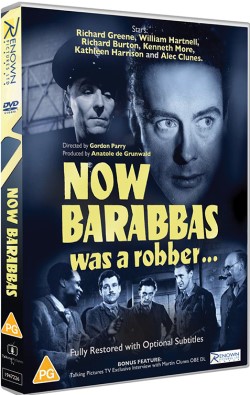
SIMON MATTHEWS on Gordon Parry’s 1949 film Now Barabbas Was a Robber
For most people, the definition of what preceded the UK’s Kitchen Sink era of drama and film, would be anything by Terence Rattigan. Which is fine. Even now Rattigan is remembered as a purveyor of impeccably written, solidly middle-class plays that mixed serious and comic themes. A great entertainer for maiden aunts. Through the 1940s and 1950s, he was run a close second by William Douglas-Home, whose career peaked in 1955, when The Reluctant Debutante started its lengthy run on the West End stage, and The Colditz Story – for which he wrote much of the dialogue – boosted cinema admissions.
Sadly, if there was a grudging consensus that Rattigan had redeeming features, this was rarely extended to Douglas-Home, about whom Kenneth Tynan observed ‘There comes a time when there are more important things in life than driving William Douglas-Home off the stage’. Despite this critique and many others like it, he had a long career. His last West End outing, at the Old Vic with a Patrick Cargill comedy After the Ball is Over, came in 1985, when its cast of dukes, butlers and chief constables was well past its sell-by date.
As might be guessed, he was related – younger brother – to the prime minister of the same name. They were cut from the same political cloth too: both were firm appeasers in the 1930s. Thereafter, Alec kept his head down after Churchill dropped him from the government. William, though, campaigned actively for a ‘negotiated peace’ with Germany, standing in parliamentary by-elections on this ticket in April and June 1942. (In the latter, at Windsor, he took 42 per cent of the vote). Then came war service, which came to an abrupt end during the Normandy campaign, when he was court martialled, cashiered and sentenced to a year’s imprisonment with hard labour, for refusing to obey lawful orders. He served eight months, at Wormwood Scrubs and Wakefield.
He put the time to good use, writing two plays, the first of which, Now Barrabas ran at Vaudeville Theatre for a few months in 1947. It did well, Anatole de Grunwald (who frequently worked with Rattigan) bought the film rights and brought in Warner Brothers to produce. Renamed Now Barabbas was a Robber, it premiered in May 1949. Whatever one may think of his output – and most of it is now watchable, at best, only as an exercise in nostalgia – this is actually rather fine.
Opening with a quote from Oscar Wilde’s ‘Ballad of Reading Gaol’, this is a claustrophobic prison drama, revolving around a group of inmates and a condemned man, as the clock ticks down to his execution. There are flashbacks to their lives before jail, the corrupting effect of the war is shown (a topic of much thought at the time, with talk of crime waves and a much readier resort to violence) and, indeed much of it, with its succession of interior scenes and wardens, plays like a POW film. The dialogue, and acting, are impressive.
The terrible formality of the rituals preceding an execution hang over everything. Like Orwell’s 1931 essay ‘A Hanging’, or Behan’s 1954 play The Quare Fellow, this is part of the sub-genre of anti-death-penalty dramas that existed in the UK until the impact of the James Hanratty case, and the advent of Roy Jenkins at the Home Office finally swept away hanging as a punishment. A bold, and humane, thing to do: the UK, particularly England, was an enthusiastic enforcer of an-eye-for-an-eye, hanging 196 people between 1946 and 1964. Nothing like Communist China or Saudi Arabia today, but still immensely high by contemporary Western standards. (America executed eighteen criminals in 2022, the UK hung 25 in 1952; adjusted for population, the UK then was six-to-seven times more prolific than the US now).
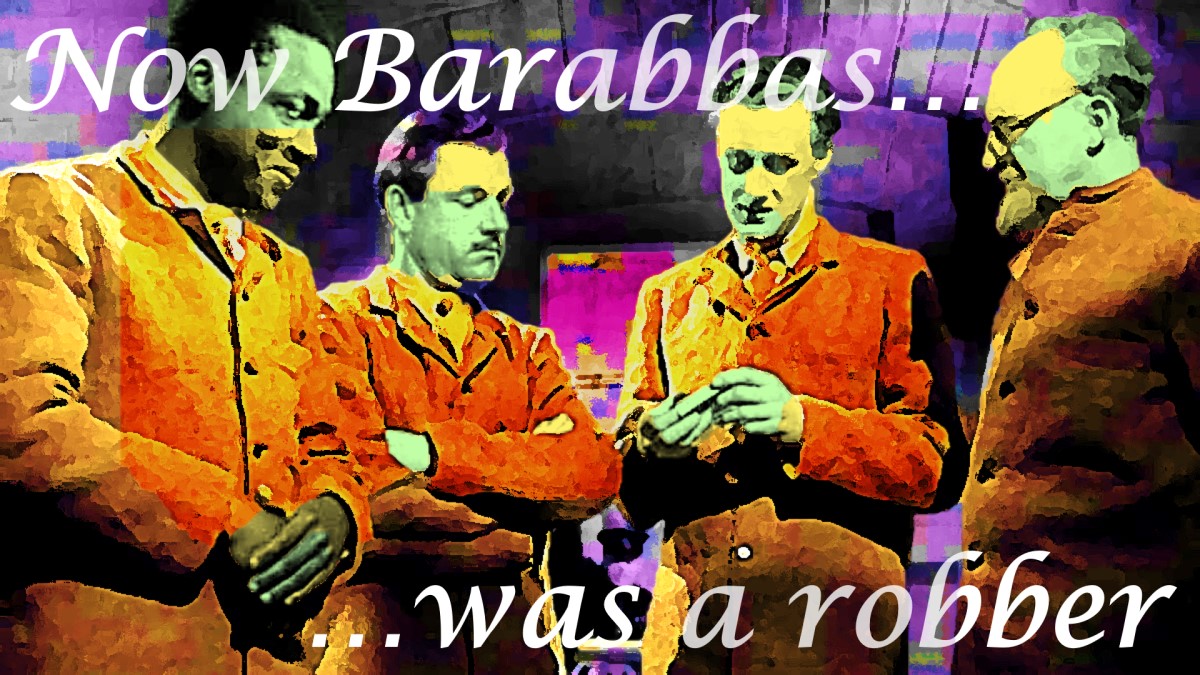
The condemned man is played by Richard Greene, later famous as TVs Robin Hood, though calling it a starring role would be inappropriate in a film that derives its power from ensemble playing. Key performances come from Cedric Hardwicke, effective as the prison governor, Stephen Murray as the chaplain and William Hartnell as a warden, played in his brusque and down-to-earth style. The inmates include a West Indian and a ballet dancer (the latter jailed for unspeakable offences) and two shortly-to-emerge stars: Kenneth More and Richard Burton. This was a major step up for them both, and they took it: More fantasising he’s an RAF Squadron Leader but really a shoplifter with a penchant for women’s underwear, and Burton as O’Brien, an IRA man jailed for bombing offences who harbours a discreet liking for his fellow men.
That, and the intro from Oscar Wilde, suggest this was quite a radical piece of theatre back in 1947. Fair play to Douglas-Home for taking that line. It was clearly linked to his political views; active in the Liberal Party, he made two more attempts at entering Parliament in 1957 and 1959 before concentrating on theatre. And, on occasion, mixing the two. After his brother’s elevation to PM, he responded with The Reluctant Peer, a comedy in which a prime minister resigns, and his successor has to relinquish his peerage. Sensing box-office lucre, it ran at the Duchess Theatre, Aldwych, from January 1964, ousting the stage adaptation of Alfie (with John Neville and Glenda Jackson) as it did so.
What did Alec think? It certainly did him no harm to be a playwright’s brother. At the time he was appointed, the Conservatives were at 36 per cent in the polls. Come January they had reached 39 per cent, and by the time he dropped in to see the play on his birthday (2 July 1964) they had hit 40 per cent, within striking distance of Labour. Sadly, on the night, Alec had to return during the interval to the Commons because of a close vote, and the moment passed. Four days later A Hard Day’s Night hit the cinema screens, sweeping away The Reluctant Peer and any notion of William Douglas-Home being contemporary. Alec lost the election on 16 October and the England that followed belonged, for the moment, to the Beatles and to Alfie.
The entertainment value of William Douglas-Home should not be underestimated, though. As recently as 2003 a remake of The Reluctant Debutante – What A Girl Wants – appeared with Colin Firth, Jonathan Pryce, Eileen Atkins and Amanda Bynes. It grossed a respectable $50m worldwide. But his most interesting work is surely Now Barabbas, and it repays viewing.
from the maker of:


see also:


Discover more from Lion & Unicorn
Subscribe to get the latest posts sent to your email.
