
SIMON MATTHEWS on Maurice Elvey’s 1935 film The Tunnel.
Had you been reading Strand Magazine in November 1895, you would have found – wedged between Arthur Conan Doyle’s The Exploits of Brigadier Gerard and an interview with WG Grace – a short story: An Express of the Future. Wrongly attributed to Jules Verne, and actually written by his son Michel seven years earlier, it describes a Boston to Liverpool pneumatic subway. The epitome of nineteenth-century science fiction, this is a world where wealthy passengers zoom across the Atlantic at 1720 mph, safe and secure within ‘elegant cigar-shaped saloons’. Reprinted down to the 1960s, it struck a chord with those who were escapist as well as those who thought, given the exponential nature of progress from the sixteenth century onward, that nothing was unlikely, and, indeed it was only a matter of time before such a means of travel became common place.
The idea was picked up again in 1913 with the publication of Der Tunnel by German author Bernhard Kellermann. One of the most successful books of its time, millions of copies were sold, much helped by a plot, a Wellsian alternative future, set in the 1940s, in which world war doesn’t occur and the pre-1914 simple faith in technological progress has continued. Kellermann’s railway runs between France and the US and his novel features Woolf, a financial magnate from Eastern Europe, attempting to sabotage the enterprise, which is undertaken by noble, far-sighted and apolitical experts.
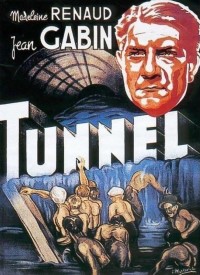
A German silent film adaptation followed in 1915, scripted by Kellerman who was likewise involved with a 1933 sound remake. Directed by Curtis Bernhardt, the man behind Beau Brummell (1954), this was made at the tail end of a period when German-French economic co-operation had many supporters. Notably French Prime Minister Aristide Briand, who proposed with German Chancellor Gustav Stresemann, a European Union, starting with a German-French Customs Union, in July 1929. Although this crashed in ruins when Stresemann died just three months later, among the practical measures intended to facilitate it was the making of common versions of the same feature film for each country. Hence Bernhardt’s 1933 German adaptation, with Paul Hartmann, was remade two years later in France with Hartmann replaced by Jean Gabin, but otherwise featuring interchangeable footage and the same supporting cast.
With audiences agog for positive, optimistic visions of the future, a UK version quickly followed. Produced by Michael Balcon, who did Hitchcock’s The 39 Steps the same year, this was a big film. Richard Dix came over from the US to star, as ‘the man who built the Channel Tunnel in 1940’. Commissioned to cross the Atlantic, he starts from the UK – no faffing around with Europe here – in a drama set circa 1945.
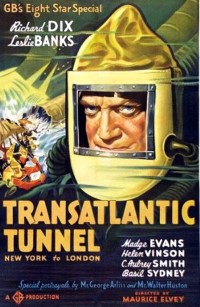
No matter that the immense practicalities of building a transatlantic tunnel are never explained. Politicians back the scheme because it means employment (lots of it) and an abundance of private, plutocratic, funding quickly materialises. The governments, led here by George Arliss, as UK Prime Minister, and Walter Huston as President of the US want ‘World peace through the union of the English-speaking peoples,’ with Arliss warning a gravely attentive House of Commons about ‘the eastern federation of powers’ (presumably Japan and the Soviet Union, China being scarcely a player then). Peace is a BIG theme in the film, possibly because Balcon was anti-Nazi and aware of the need to promote peace. He was also Jewish, and unsurprisingly this version is less antisemitic with no immoral eastern European financiers.
Pitched somewhere between Metropolis and Things to Come, though lacking the avant-garde outlook of the latter, Balcon’s production has all the tropes of the 1930s view of the future, including a modern, dynamic leader (Dix) capable of rousing the workers with speeches, wearing a nicely cut, slim-fitting boiler suit and driving about in a streamlined car. Most of the sets are art deco/industrial and some of the extras in crowd scenes appear to be wearing jackboots.
The plot chugs along. At one point construction gets suspended. (They hit a subterranean volcano somewhere deep in mid-ocean). There are boardroom machinations, and some romantic, family-centred scenes. But Dix does it all for peace and drives the boring machine through to complete the work. The tunnel duly opens with ceremonies at either end. Both national anthems are played and the film concludes with solemn reminders of the importance of the English Speaking Union.
The end result is just about satisfactory as entertainment. The Tunnel was screened on UK TV through the 1950s and ‘60s, and managed an entry in Halliwell’s Film Guide (1977). But in truth it isn’t that good. The script is dull, simple stuff, worked over by three separate hands, one of whom, Lawrence du Garde Peach, was later responsible for the Ladybird Adventure from History series. The direction, by Maurice Elvey, is poor, scenes being cobbled together with little continuity. It’s hard to know why.
What did audiences make of it then? The pitch for an English Speaking Union as the key to ensuring peace is a major theme, possibly the only time such an argument was actively pushed in a feature film. Apparently, this was thought possible in the UK where the English Speaking Union of the Commonwealth had existed since 1918, advocating, shorn of Germany, the same type of co-operation between the British Empire and the US that Joseph Chamberlain, Lord Milner, Cecil Rhodes and Theodore Roosevelt had sought from the late nineteenth century. The political practicalities of this, then and now, don’t appear to be understood. No US President is going to join anything involving ‘the Commonwealth’.
In the meantime, the idea of a transatlantic tunnel is still around. Currently costed at $20 trillion and boasting supersonic trains, it’s an ‘oven ready scheme’. A real-life umbilical cord attaching the UK permanently to the US, it has its advocates. As does the English Speaking Union, now one of several bodies promoting ‘the Anglosphere’.
The film is a curio. File under Utopian.
from the maker of:


see also:



Discover more from Lion & Unicorn
Subscribe to get the latest posts sent to your email.
