
SIMON MATTHEWS on Joel Hopkins’s 2017 film Hampstead
At first glance, this looks like a Richard Curtis production, one of the quartet of films – Four Weddings and a Funeral, Notting Hill, Bridget Jones’s Diary and Love Actually – that appeared 1994-2004. Set in nice, clean, upmarket bits of London with a red bus in every shot, polite middle-class people everywhere, and seemingly filmed during a continual, glowing late afternoon. An elegant cast, like a superior repertory company, charm us with their ensemble playing, effortlessly pushing an image of Englishness that seemed so apposite – and marketable – during the Major/Blair years.

It opens in London in 2017, starring Diane Keaton, in the same type of slightly mannered, kooky female role 40-plus years after her spell as Woody Allen’s co-star in films like Annie Hall and Manhattan. Here she plays a widow left with heavy debts by her late husband. She works in a shop, a la Notting Hill. But it’s a charity shop, the growth of the internet and its apps in the two decades since Hugh Grant rocketed to stardom meaning that she has none of the skills needed for present day life. Nor are things happy locally. Luxury apartments are springing up everywhere and the young are getting agitated.
One day she meets a middle-aged Irishman (Brendan Gleason) by Karl Marx’s tomb, the symbolism of this providing a clue as to the direction the plot will take. He lives on a plot of land deep in the woods, grows his own food and fishes in one of the Hampstead ponds. He is facing eviction; she starts a campaign with impeccably well-mannered local activists, to prevent this – no Class War or Stop the City demonstrators in sight here. Ranged against them are the service-economy profiteers, portrayed as creepy, grasping, privately educated hypocrites: accountants, developers, estate agents, tax lawyers and various hangers on.
The English don’t look too clever here, their portrayal being decidedly un-Richard Curtis. Sure enough, Keaton (US) and Gleason (Irish) – supported by Asian barrister Adeel Akhtar (one of the jihadists in 2010s Four Lions) and helped along by some last-minute testimony from a firmly working-class Phil Davis – carry the day. Gleason is allowed to stay on his plot and the films ends with Keaton and him, now an item, chugging off into the sunset somewhere along the Regents Canal.
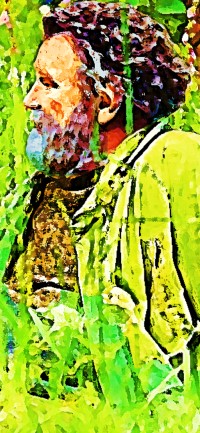
It’s all based on the real-life story of Harry Hallowes, who arrived in Camden from Ireland in the 1950s, became homeless in 1987, and ended up camping in the heavily wooded grounds of Athlone House, at that point an NHS dementia treatment centre. In the years that followed, neither the NHS, nor Camden Council, the local planning authority, nor the Corporation of London, owners of the Heath, seem to have contacted Hallowes or made any attempt to move him on.
The hospital was closed in 2003 – dementia treatment was being out-sourced – and Athlone House, a public asset, was sold for £16 million to the Kuwaiti Kharafi family, who held the KFC franchise across the Middle East. Billionaires, they wanted Hallowes off their land. Alas, they failed, to general wonderment that a squatter might end up a potential multi-millionaire: Hallowes, having been in unimpeded occupation of his site for more than twelve years, was allowed to remain.
Subsequent attempts to demolish Athlone House and replace it with a new mansion failed after a seven-year planning battle, and the Kharafis sold up to Russian-Ukrainian-Jewish oligarch Mikhail Freedman (for £65m) in January 2016. He remains in situ today, albeit subject now to EU sanctions after the Russian invasion of Ukraine, and, since December 2022, detained by the UK’s National Crime Agency on charges of money laundering, conspiracy to defraud the Home Office and conspiracy to commit perjury, at his ‘multi-million pound residence’ in the British capital.
Given that we end up in McMafia territory – ironic, given the presence in the film of James Norton as Keaton’s son – it may be lucky that Hallowes passed away in February 2016 (thankfully of natural causes; he was 80), otherwise he might have had problems. In any event, due to covenants and planning restrictions, it turned out his plot was only worth £154,000, much less than reported. The film portrays the developers as being completely brutal. In real life they didn’t need to be. Both Kharafi and Freedman are comfortably placed among the Top 100 richest people in the world. They knew Hallowes was elderly, and that you couldn’t build on the Heath, so they duly played the long game.
But it was a good story, and from 2012 no fewer than seventeen different producers (including Harvey Weinstein, the case against whom began four months after the film’s release) worked at getting a fictionalised film about Hallowes onto the big screen. Shooting eventually started in the summer of 2016.

What emerges is a missed opportunity. Made when the Curtis type notion of Englishness was on the backfoot due to the Iraq war and Brexit, it offers a gentle riff on affordable housing, but remains a rom-com throughout. It could have been a lot harder. Something about how public property in the UK has been ransacked by the super-rich and their political servants.
Had that been so, contemporary audiences might have responded better. Instead, its takings came nowhere near those of Curtis’s quartet, which with earnings of $1.7 bn (to date) are equivalent to the GDP of an emerging economy. The definitive drama about the (current) UK housing crisis is yet to be made, but, for now, Hampstead is an interesting outlier.
from the maker of:

see also:


Discover more from Lion & Unicorn
Subscribe to get the latest posts sent to your email.
