I do love a political diary, and these are my favourites from the last 50 years.
1. Tony Benn
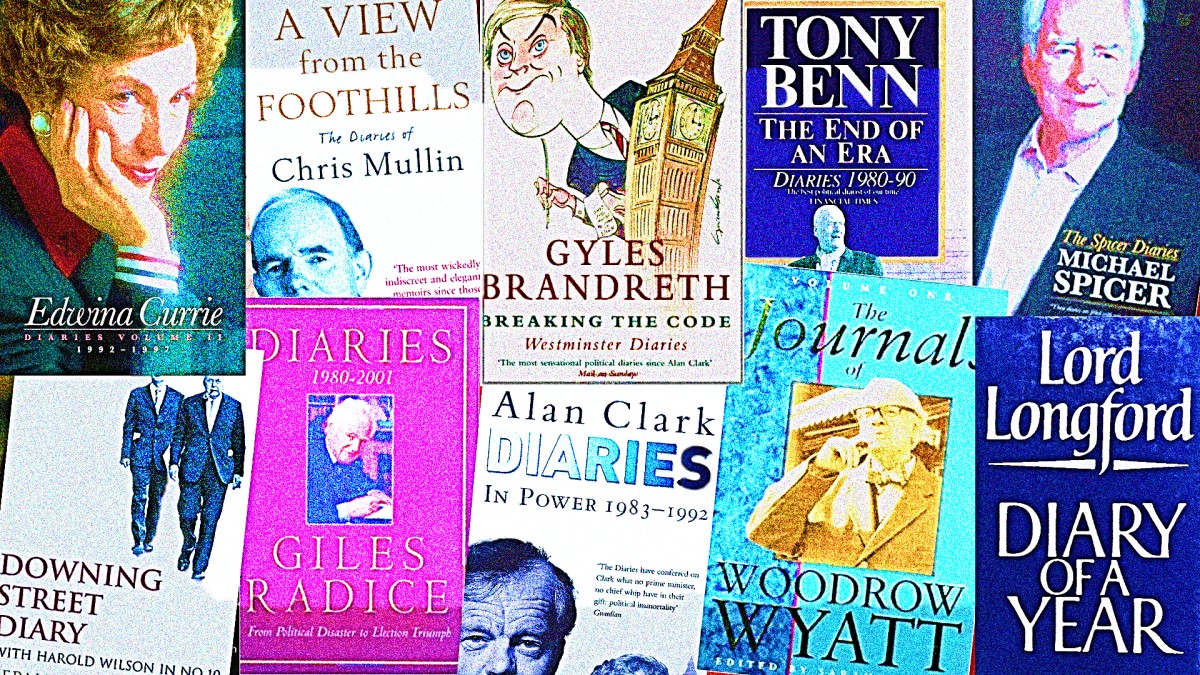
The daddy of all diaries, even the edited version of Benn’s journal amounts to eight published volumes, covering 1940–2009 and containing millions of words. They’re obviously an invaluable commentary on Labour and left politics in that period, but they’re also the most fabulous self-portrait in the whole of English literature. Politically, the best is the 1980s volume The End of an Era (Hutchinson, 1992); personally, the most touching is Free at Last (Hutchinson, 2002), which includes the death of his wife. ‘I started writing them because in a vague way I felt I had a responsibility to give an account for my life,’ he said in 2001, ‘so when the day of judgment comes and God asks what did I do with my life I can hand him fifty million words.’

2. Gyles Brandreth
Don’t be fooled by his book Something Sensational to Read in the Train, which skims too rapidly through his entire life. Go instead for the brilliant Breaking the Code: Westminster Diaries (Weidenfeld & Nicolson, 1999), which covers his time as a Conservative MP in the 1990s. It’s a gripping account of John Major’s doomed government, with all the appeal of a political car crash. Brandreth’s political analysis is nothing much, but he’s the most delightful gossip and name-dropper, and he has a gift for summing up colleagues in a pithy phrase: Ann Widdecombe resembles ‘a death-watch beetle’, John Redwood is ‘Daddy Woodentop’.
3. Edwina Currie
Best known for including memories of her affair with an unnamed (but rapidly identified) senior Conservative politician, the most interesting material in Diaries 1987–1992 (Little Brown, 2002) is actually about the particular pressures of being a woman MP. Currie is equally strong on the new breed of Conservatives who arrived in Parliament in the wake of Thatcher. The second volume, Diaries 1992–1997 (Biteback, 2012) attracted far less attention, but it’s even better. These should have been her years as a cabinet minister; Lord knows she was better qualified and more talented than most in John Major’s cabinet. Instead we have the benefit of one of the sharpest observers of politics. ‘We are not slaying dragons any more, just cleaning up the shit they leave behind,’ she noted in 1991, after the departure from office of Margaret Thatcher.
4. Bernard Donoughue
Donoughue was an adviser to Labour prime ministers in the 1970s. Downing Street Diary: With Harold Wilson in No. 10 (Jonathan Cape, 2005) gives a tremendously detailed insider’s version of Wilson’s second period in office, buried within which are some gems for those fascinated by the psychosexual relationship between the PM and his secretary Marcia Williams. The sequel – Downing Street Diary: With James Callaghan in No. 10 (Jonathan Cape, 2008) – isn’t quite as gripping, since Sunny Jim can’t make up for the absence of Our Harold, but is still valuable for historians of the period.
5. Chris Mullin
The success of A View from the Foothills: The Diaries of Chris Mullin (Profile, 2009) was something of a surprise, though it shouldn’t have been: after all, this is the man who gave us the great novel A Very British Coup, so we already knew he could write. These first diaries covered his brief moment in the sun as a junior member of Tony Blair’s government and, though they were followed by further volumes, they’re still the best, since he mixes a bit more freely with the big players, none of whom comes out of this account very well.
6. Giles Radice
A veteran Labour MP on the social democrat wing of the party, Radice wrote a terrific triple-biography of Tony Crosland, Roy Jenkins and Denis Healey titled Friends and Rivals. His Diaries 1980–2001 (Weidenfeld & Nicolson, 2004) cover the fall and rise of Labour reformism, though they never get round to answering his own question: ‘What will Tony’s success consist of: election victories or something more permanent? The jury is out.’
7. Michael Spicer
Not exactly a household name, Spicer was a Tory MP for 36 years and chairman of the 1922 Committee for nearly a decade. He was also a Eurosceptic, and The Spicer Diaries (Biteback, 2012) is a fascinating glimpse of the civil war over the Maastricht Treaty from the rebel position. ‘In the voting lobbies it was not unknown for one Conservative MP to spit at another,’ he wrote. ‘Physical violence occurred during the course of one or two crucial votes.’
8. Lord Longford
As far as I know, he only published the one volume, Diary of a Year (Weidenfeld & Nicolson, 1982), but what a year to choose. As an old Labour peer, he makes a fascinating witness to the high water mark of the left’s attempted takeover of the party in 1981. Worth reading alongside Tony Benn’s version. This is him on the conference in January 1981: ‘Many, perhaps half, of the delegates could not have passed as working class at any time in their adult lives. Yet whenever the proletarian note was struck, it was the winner.’
9. Alan Clark
Clark wasn’t quite as good as some claim, partly – perhaps paradoxically – because he was such a one-off politician. The best political diaries come from MPs who express private opinions shared by others, but since no one agreed with the idiosyncratic extremism of Clark, his books stand or fall on the strength of his personality alone. And although he was quite something by the conformist standards of modern politics, the truth is that he’s not really interesting enough to sustain three volumes. ‘I will be a figure of fun, like Mellor,’ he worried when he published the first, and indeed he was. The best is probably the third, The Last Diaries: In and Out of the Wilderness (Weidenfeld & Nicolson, 2002), which is dominated by our – and ultimately his – awareness of his impending death.
10. Woodrow Wyatt
Another appalling gossip, Wyatt was the turncoat Labour MP who became a slavish devotee of the cult of Margaret Thatcher. In his last years he decided to keep a diary so that it’d make some money for his family after his death. Consequently the three volumes of The Journals of Woodrow Wyatt (Macmillan, 1998–2000) contain as much tittle-tattle as he could find. And since he’d penetrated Thatcher’s inner circle, it’s good stuff. He does go on a bit, though: he’s a dreadfully self-important little snob and you’ll probably want to skip the dull bits about the Queen Mother, horse racing and wine.
Honourable mentions to Barbara Castle, particularly the volume covering 1974–76 (Weidenfeld & Nicolson, 1980), and to Lance Price, The Spin Doctor’s Diary (Hodder & Stoughton, 2005). And for the semi-fictional version, Sue Townsend’s chronicles of Adrian Mole (1982–2009) provide a fabulous running commentary on the country’s travails.
Discover more from Lion & Unicorn
Subscribe to get the latest posts sent to your email.
