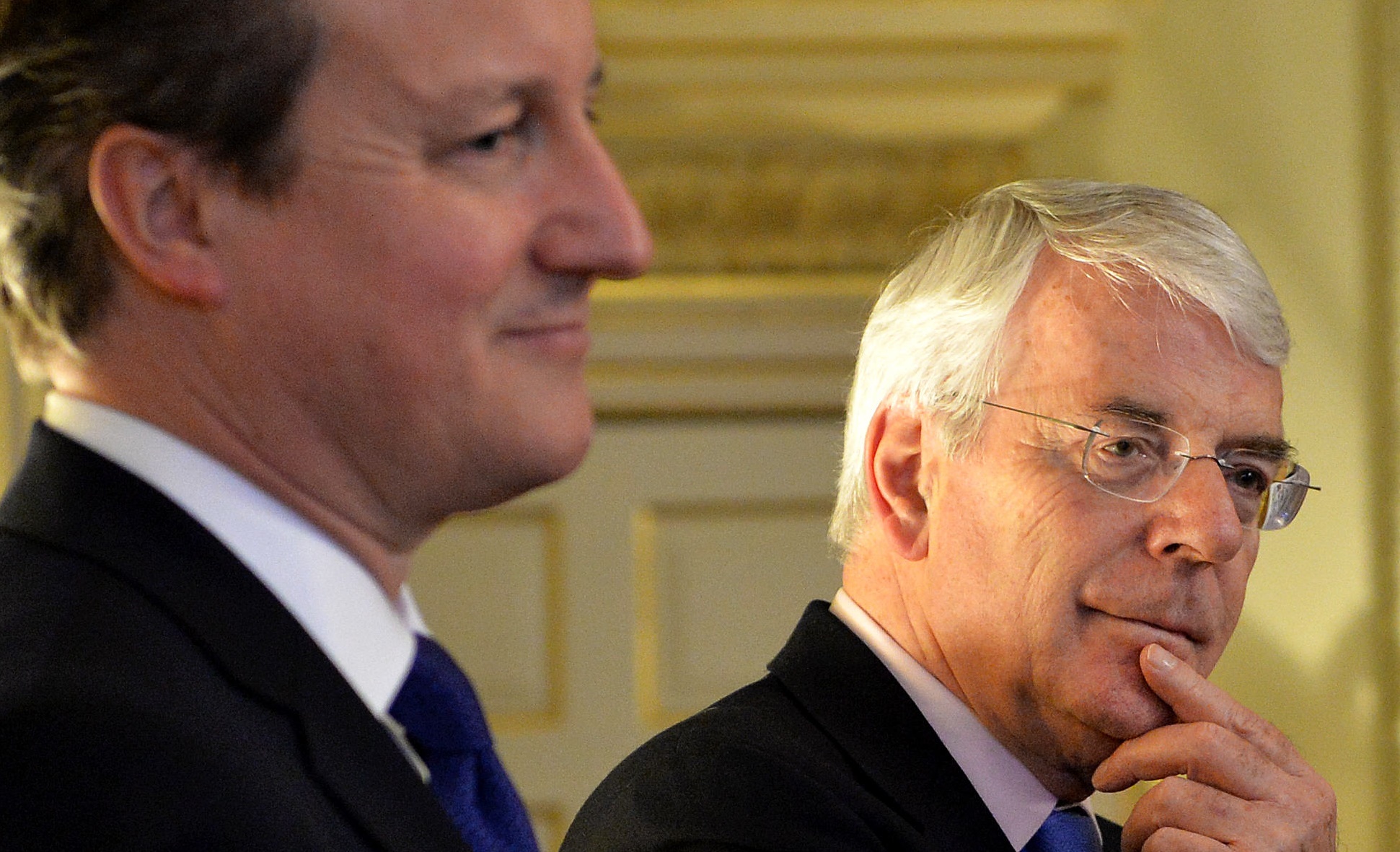
Tories tempted to proclaim David Cameron an all-conquering hero should remember John Major’s more astonishing victory in 1992. (Number 10)
Through gritted teeth, Britain elected a Tory Government… The Government’s first mistake was to view that general election as a great victory won in the shadow of a recession. The truth was that they had been bought on approval and would have to keep their promises.
Hywel Williams, Guilty Men (Aurum Press, 1998)
There have been 14 general elections since 1960 and in more than a third of them – five in all – the opinion polls called the result wrongly: 1970, February 1974, 1987, 1992 and, of course, 2015. That is not a very good batting average, but one man has cause to be grateful for the pollsters’ incompetence.
David Cameron arrives in Manchester for the Conservatives’ annual conference as the man who defied the odds and took his party to an unexpected victory. In fact, he defied only the polls which, as we have seen, have a very mixed record of prediction. But that will make no difference. Like those who try to frighten themselves into punctuality by keeping their watches fast, the Conservative Party seems to take the view that those scary poll numbers may have actually been true, while knowing that they were not.
The upshot of all this is that no one will have the bad taste to ask how Mr Cameron managed to win only a 12-seat majority when up against Ed Miliband, given John Major in 1992 achieved a majority of 21 seats in the face of (by common consent) an impressive campaign from Neil Kinnock and his Labour Party.
Furthermore, Sir John (as he now is) went into battle just six months after the end of a recession for which his party was widely (and properly) blamed. Hard though it is to believe, given the five-year 2008–2013 decline in real pay, there was no recession at all during the period of the 2010–2015 Tory-led coalition; Britain’s local experience of the global Great Recession ended with the resumption of growth in the third quarter of 2009.
Had Mr Miliband been the absolute dud that the Conservatives claimed, Dave and his colleagues ought to have enjoyed a landslide. But the Tory campaign was dire, with the low tone set from top as the prime minister addressed bogus ‘rallies’ staged for the cameras in empty buildings, forgot not only which football team he was pretending to support but even in which conurbation it was located, and reacted to accusations that his hustings persona was dull and uninspiring with a truly bizarre performance at the Institute of Chartered Accountants on 4 May at which he bellowed at an audience of business owners, ‘Taking a risk! Having a punt! Having a go! That pumps me up!’ Not sufficiently, however, for Mr Cameron ever to have started a business of his own, as far as anyone knows.
None of this will matter in Manchester. The conventional wisdom is that the prime minister has only one thing about which to worry – the Europe referendum – and that otherwise all is set fair for indefinite Tory rule and an orderly handover to the architect of Britain’s impressive economic superstructure, the chancellor and first secretary of state, George Osborne.

The obligatory Osborne-in-a-hard-hat shot. (HM Treasury)
Indeed, it is the supposed success of the economy that underpins this Panglossian view of Tory prospects, so it is on the economy that any proper scrutiny of those prospects ought to focus.
On 30 September, revised figures for post-recessionary growth in gross domestic product (GDP) were interpreted as a fillip for the chancellor ahead of the party conference. The numbers showed that output had expanded by 2.2 per cent in 2013 and by 2.9 per cent last year, putting Britain at the head of the Group of Seven advanced nations in 2013 as well as (which had been known already) 2014.
How big a deal is this revision? Not very, is the answer. It boils down to the fact that two years ago we grew more rapidly than Canada, the only G7 member thought to have outpaced us in 2013. Furthermore, the International Monetary Fund (IMF) is forecasting that this year the United States will grow more quickly than the UK, at 2.5 per cent, while we will have dropped 0.4 percentage points to 2.4 per cent.
Next year, the fund sees the US at 3 per cent and Britain at 2.2 per cent.
True, compared with the average prediction for all advanced economies, Britain’s 2.4 per cent and 2.2 per cent this year and next respectively looks solid enough up against 2.1 per cent and 2.4 per cent. But interestingly, tucked away in the IMF predictions is a category called ‘other advanced economies’. This excludes both the G7 (other members are Japan, America, France, Germany and Italy) and all the 16 euro-zone countries that are not in the G7. Here, the fund is forecasting 2.7 per cent growth this year and 3.1 per cent in 2016.
It can be argued that all this ‘my growth is bigger than yours’ stuff is fairly irrelevant, but if Mr Osborne’s fans are going to raise a ballyhoo about it, then it is only right that the figures be subjected to some forensic analysis. Although in truth, the real fragility of the economy is not exposed in the growth figures but in four other sets of numbers: the government’s own borrowings, household debt, the productivity data and the current account deficit.
Net government borrowing in 2015 is forecast by the IMF at 4.8 per cent of gross domestic product (GDP), against an average of 3.8 per cent for all advanced economies. The two forecasts move closer together next year, according to the fund: 3.1 per cent for the UK and 3.3 per cent for the advanced economies as a whole. Unsurprisingly, the national debt continues to grow as a proportion of GDP, despite the austerity shtick, from 91.1 per cent of GDP this year to 91.7 per cent next year.
Household borrowing, the drug off which the Great Recession was supposed to have weaned us, is on the move again, according to figures from the Bank of England. Mortgage advances for house purchases totalled £10.8 billion in May, and had jumped to £12.2 billion in August. These figures are seasonally adjusted, so there are no ‘calendar affects’. On consumer credit, the £1 billion advanced in May dropped slightly to £0.9 billion in August, but the total outstanding moved smartly ahead from £171.6 billion to £174.1 billion.
Then here is productivity, or rather the lack of it. On 18 September, the Office for National Statistics announced, ‘First estimates for 2014 suggest that output per hour in the UK was 20 percentage points below the average for the rest of the major G7 advanced economies, the widest productivity gap since comparable estimates began in 1991.’
Twenty percentage points. That’s not exactly within the margin of error, is it?
The current account is the real shocker, a figure that has not been in balance or surplus since 1984. The IMF expects all advanced economies to run a surplus on their dealings with the rest of the world of 0.6 per cent of GDP this year and 0.4 per cent next year, while the ‘other advanced economies’ are predicted to clock up healthy surpluses of 4.9 per cent of GDP and 4.3 per cent respectively. Britain’s numbers – 4.8 per cent and 4.6 per cent – are fairly similar, the only difference is that they have a minus sign in front of them. We have not paid our way in the world for a very long time and show no sign of doing so in the immediate future.
Summed up, we – households and government – borrow heavily from abroad to fund a standard of living that we are insufficiently productive to earn. Chronic dependence on inflows of foreign capital plus political instability comprise the classic recipe for serious trouble ahead. We suffer from the first of these factors. With a possible second referendum in Scotland alongside the UK European vote, a government with a narrow majority, and widespread revulsion with the political class, I would suggest we suffer from the second as well.
So Messrs Cameron, Osborne et al should enjoy their current ‘hero’ status while it lasts. Because it won’t.
Discover more from Lion & Unicorn
Subscribe to get the latest posts sent to your email.
