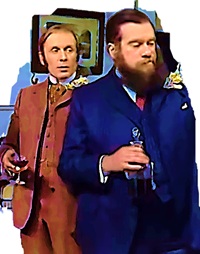
Peter Lovesey’s Victorian sleuth, Detective Sergeant Daniel Cribb, first appeared in the novel Wobble to Death (1970) and later turned up in a television pilot at Christmas 1979, which did well enough to warrant Granada making two series over the next couple of years.
The timing is important. The cultural revolution of the 1960s had self-consciously rejected, yet been fascinated by, Victorian morality. There was an assumption – particularly after Steven Marcus’s study of sex and pornography, The Other Victorians (1966) – that nineteenth-century Britain was riddled with hypocrisy, seething with suppressed sexuality, and this became the defining portrayal of the era. Cribb shares this perception, though the tide was about to turn. In 1983 Margaret Thatcher declared her approval of ‘Victorian values’ – and no one thought she was talking about sex.
The second series, broadcast in 1981, turns to the other great obsession of class. Cribb was working-class, which is why he’s still a sergeant.
Here’s a guide to each of the fourteen episodes.
1. ‘Waxwork’
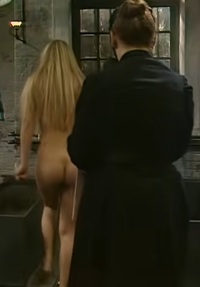
In 1882, a twenty-year-old woman who was a member of the Highgate Literary and Artistic Society, was persuaded by another member to pose for some photographic studies. Artistic poses, you understand. Naked, but artistic. ‘We had been advised that the photographs were to be used for a painting to be exhibited at the Royal Academy.’ No such painting ever emerged, but six years later, now respectably married, she was blackmailed by a man who had bought a copy of the revealing photos in Holywell Street. When he returned with more demands, she poisoned his wine and murdered him.
Or did she? She confessed, and was tried and sentenced to death, but there are inconsistencies in her account, and DSgt Cribb is charged with tying up the loose ends. In the process, he meets the original investigating officer, Inspector Waterlow – who owes his promotion to having invented the truncheon-pocket – and Inspector Moser, who gives him access to the obscene material seized by the police: ‘All the fun of the fair sex,’ as he says.
He’s not the only one having fun. A prison wardress tells the convicted woman to undress for a bath, while reminiscing about happy times: ‘On Friday night, we had four baths on the go, and eight others naked and waiting.’
James Berry, the hangman, approaches Madame Tussaud’s wax museum, offering to sell them the clothes of the murderer. They’re also keen to get his own likeness for the Chamber of Horrors. Elsewhere, the national infrastructure is in good shape: ‘The trains are most reliable,’ a man says.
2. ‘Swing, Swing Together’
So it’s 1889, there are three men (and a dog) in a boat, and they’re rowing down the Thames. But there the resemblance to Jerome K. Jerome ends – these three men spend their evenings in the company of prostitutes. ‘I understand you were paying them to take off items of clothing at a shilling a garment,’ says Cribb.
There are also three young women at Elfrida Teacher Training College, who decide to have a midnight swim in the Thames. Naked, of course, since female nudity is fast becoming the leitmotif of the show.
A man who’s a suspect in the Jack the Ripper killings has a postcard of Marie Lloyd. His uncle is the governor of Coldbath Fields House of Correction, where they’re still keen on using the treadmill and the crank, while giving the prisoners improving texts from the Bible.*
Names are important. The two coppers accompanying Cribb are called Thackeray and Hardy, though neither is what you might call a literary gent. A character introduces himself with the words: ‘My name is Bustard. Spelt with a “u”.’ And another is concerned that his meat products are correctly identified: ‘It’s not a sausage, it’s a Polony.’
* This is a little confusing, since Coldbath Fields closed as a prison in 1885.
3. ‘Abracadaver’
Cribb is worried. ‘Seven music-hall accidents in four weeks. Uncommon hard to credit.’ Among these crimes: someone shortened a rope used by trapeze artists the Pinkus Sisters, spread axle-grease on the barrel used by Balotti the Barrel Dancer, and smeared mustard on the sword of Professor Virgo the sword-swallower. Worst of all, when the comic Sam Fagan put up the song-sheet for his closing number, ‘The words had been shamefully altered. There were references to a certain gracious personage.’
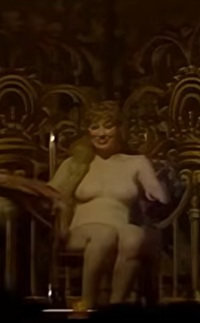
It’s all an elaborate plan to recruit acts for the Paragon, a sleazy music-hall that regularly stages a secret midnight-show. This attracts a distinguished audience: dukes, generals, members of Parliament, even senior officers from Scotland Yard – it’s ‘like Rotten Row at the height of the Season’. The acts include naked women and, says Cribb, ‘such performances as can sometimes be seen in penny gaffs in the back streets of Cairo… but I’m not here to reminisce.’
4. ‘The Detective Wore Silk Drawers’
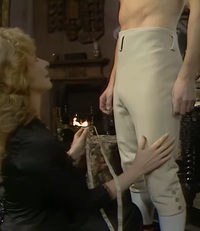
‘Knuckle-fighting went out twenty years ago. It’s Queensbury Rules now,’ says Constable Thackeray. But Cribb disagrees. ‘You can ban a sport, but you can’t stop ’em. It’s been established over 150 years.’ And of course it does still survive, underground, attracting gamblers and criminals. It even attracts some women, or at least the pugilists themselves do. ‘Quite a handsome display of flesh,’ says one lady. Indeed.
Cribb hints at a familial connection with Regency Era champion, Fearless Tom Cribb.
5. ‘The Horizontal Witness’
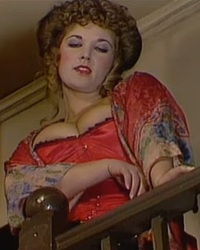
One of London’s richest property-owners – whose money comes from organised crime – is found murdered in a brothel. It’s one of his own establishments, as it happens. A leading surgeon at Charing Cross Hospital spends one day a week doing free consultations in the East End, though it turns out he’s spending more time with prostitutes than patients.
Medical practice is a bit primitive. ‘Cupping works for almost any ailment,’ says a nurse.
6. ‘Wobble to Death’
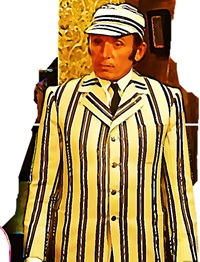
We’re at the 1879 Pedestrian Championship of the Word – a six-day endurance walking event, in which competitors are expected to cover over 500 miles. The two favourites are social opposites: Captain Erskine Chadwick, a chap from Eton, Baliol and the City, up against Charlie Darrell, a ‘sometime ostler, sometime brickmaker’. The rest of the field can be disregarded. ‘Drunks and halfwits,’ says Chadwick, ‘clowns and criminals.’
But then Darrell gets murdered. The assumption is that the motive is financial gain. The winner gets a £500 prize, but the real money is in the betting; Chadwick has backed himself heavily, and will collect £11,000 if he wins. ‘Money – it’s the ruination of sport,’ tuts a competitor. Cribb disapproves, as well. ‘Gambling is a social evil, gnawing at the vitals of the British Empire.’ Which doesn’t stop him having ten quid on Chadwick.
7. ‘Something Old, Something New’
‘In every parish, there are gullible old men, not especially rich, but living on their savings, in cottages of their own,’ says Cribb. ‘Enough, if it were left to the ladies, to keep the wolf from the door for a few months.’
The ladies in question are a genteel, if impecunious, mother and her two daughters, who move around the country from village to village. In each, one of the daughters – they take turns – marries such a gullible old man and gets him to write a will in her favour, shortly before he dies of a suspected heart attack. It’s their bad luck that their latest conquest is an old friend of Constable Thackeray’s father, and the policeman is roped in as Best Man at the wedding.
Now here’s a queer thing: Cribb walks past a poster advertising Graham Moffat’s play Susie Tangles the Strings, which wasn’t staged until 1924. Yet Cribb and Thackeray don’t look a day older than they did in the 1870s and 80s.
8. ‘A Case of Spirits’
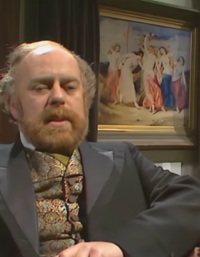
Dr Probert is ‘a very distinguished physiologist’, but his home life is unsatisfactory. ‘In this family, we are not in the habit of communicating with one another,’ says his wife. He takes more interest in his art collection than he does in her. ‘My husband hasn’t noticed me for years,’ she says. Mind you, it’s a very fine collection: nice big paintings on classical themes, all including depictions of naked women. His interest is purely aesthetic, of course, but that’s not true of everyone. ‘I believe there are men who look at pictures like mine for the wrong reasons.’ He’s just had a William Etty stolen.
Dr Probert is also very active in LADS, the Life After Death Society, pursuing scientific research into seances and mediums, mostly at the home of Miss Crush, a very liberated and broadminded woman. ‘In 1865 I heard a speech by Mr John Stuart Mill on the emancipation of women, and it changed my life,’ she remembers. ‘I vowed then I would never be the slave of man.’ It was in pursuit of her feminist researches that she seduced a cabman. ‘I had to know what I was fighting against.’
9. ‘Mad Hatter’s Holiday’
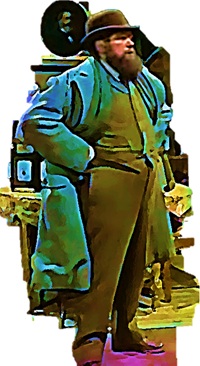
Brighton’s a gay sight in holiday season. There’s a Punch and Judy show and a blackface minstrel on the beach, and there are fireworks in the evenings. Oh, and there are bits of a dismembered body, starting with a hand that’s found in the crocodile pool at the aquarium.
One of the holiday-makers has ‘a small optical shop in London’ and has come equipped with telescopes and binoculars, through which he spies on women and is suitably outraged. ‘They were kissing! Kissing on the beach. A sixteen-year-old boy and a servant girl. I was shocked!’ ‘Observing a lady seems a hobby of a great many here in Brighton,’ notes Constable Thackeray.
Cribb encounters an unpleasant teenage boy. He has been moved from public school to public school, each of them covering up his offences. ‘Torturing animals, bullying, then as he got older, he turned his attention to women.’ His ‘last headmaster urged his committal to an institution for the mentally deranged’.
We are in 1888, yet Brighton is only now staging a parade for the homecoming of ‘the heroes of Tel-El-Kebir’ – a battle that was fought in 1882.
10. ‘The Last Trumpet’
There’s trouble at t’Zoo. The Zoological Society of London, that is, where it’s been discovered that Jumbo the elephant has developed musth, ‘a condition peculiar to elephants and camels’, which manifests in increased levels of reproductive aggression, ‘a kind of frenzy associated with the baser instincts’. One shudders to think what would happen if he had one of these fits when members of the public were around. It’s certainly not the kind of thing that one can tell Her Majesty, however fond she is of Jumbo.
So the Zoo has agreed to sell the animal to American showman Phineas T. Barnum for £2,000, provoking a wave of public protests, an outbreak of ‘Jumbo-mania’. Chief Inspector Jowett reflects that ‘This has touched the sympathy of the British public like nothing since…’ and Constable Thackeray finishes his thought: ‘the passing of Prince Albert’. That prompts thoughts of ‘a certain wily old Scot in the royal household,’ says Cribb; ‘but that’s in confidence, of course…’
11. ‘The Hand that Rocks the Cradle’
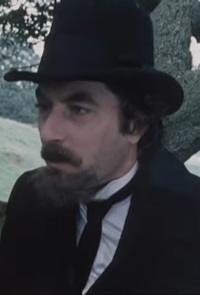
…continuing that thought: ‘The Queen is partial to all things Scottish,’ nudges her son-in-law, Prince Henry of Battenberg. He and his missus, Princess Beatrice, are looking for a new nursemaid for their baby, and Cribb is tasked with making discreet enquiries about Mrs Innocent, the candidate favoured by Her Majesty. Her current employer, the composer Lord Caspar-Jones, gives her the highest reference: ‘I don’t see her, don’t see the children for, oh, days on end.’
However, Mrs Innocent is a committed campaigner for women’s suffrage, and that’s going to count against her, as the previous nursemaid points out. ‘The Queen is utterly opposed to the women’s movement. In her mind, it is on a par with smoking. Or Mr Gladstone.’
It’s 1887, the year of Victoria’s Golden Jubilee. ‘Every crowned head in Europe will be coming to London, and we can also expect less desirable visitors,’ says Chief Inspector Jowett: ‘nihilists, anarchists, revolutionists. Don’t ask me what they believe in.’ ‘Propaganda by the deed,’ offers Cribb. Constable Thackeray has encountered just such a one: ‘He was a foreigner, I’d say. He was dark-haired, swarthy, about five-foot-eight or -nine. He was bearded, he was wearing a dark overcoat, a black hat with a wide brim.’
He certainly looks like a dangerous anarchist and indeed he is. ‘Long live the social revolution!’ he cries, which doesn’t impress Mrs Innocent: ‘Sounds like someone wants his mouth washed out with soap.’
12. ‘The Choir that Wouldn’t Sing’
It’s 1885, four years on from the Cardwell Reforms that restructured the regiments of the British Army. The late Colonel Dawson was in the 61st Foot, the South Gloucesters. ‘Fine man. Served right through the Mutiny. Decorated for gallantry,’ says Captain Allbright. Dawson’s son, Harry, followed the old man into the newly amalgamated Gloucestershire Regiment, but, says Allbright, Harry was ‘a bit of a milksop. Colonel Dawson got him commissioned to make a man of him. Devil of it is that the regiment hasn’t seen any action for twenty-five years. He was posted to India and cholera got him.’
Colonel Dawson has been found dead at the bottom of a quarry, and it’s assumed that it was suicide – he was heartbroken by the loss of Harry. Allbright doesn’t believe it. ‘If he’d wanted to put an end to himself, he’d have done it like a gentleman: settled his affairs and blown his brains out.’
‘When I went into plain clothes, I dropped my helmet and badge over Blackfriars Bridge,’ reflects Constable Thackeray. ‘Sold mine to a music-hall turn for half a crown,’ says Cribb.
13. ‘Murder Old Boy?’
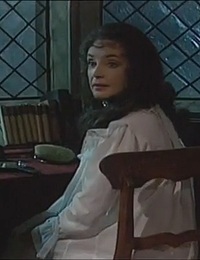
Chief Inspector Jowett – ‘Penguin’ Jowett, as he was then known – went to Petersham, ‘a first-class school’. Now he’s invited back, along with a handful of other notable old boys, the likes of Montague ‘Inky’ Penn, actor-manager at the Lyceum, and the consultant surgeon Dr Partridge, who used to be the school bully, nicknamed ‘Killer’. When one of them is found hanged with an old school tie, Cribb’s investigation is hampered by loyalty to the alma mater. ‘At Petersham, we close ranks in adversity,’ says Penn.
As it turns out, though, Petersham’s not quite as first-class as it’s made up to be. ‘We all spent our time here in a state of unmitigated terror,’ says one, and the others chip in with their childhood nightmares. ‘The flogging block.’ ‘The ushers, the monitors.’ ‘Roastings, dunkings, matron.’ They all agree on this last. And the old boys aren’t quite the success stories they seem, either. Penn isn’t at the Lyceum; he’s at the Lyceum, Hackney Wick. And Dr Partridge practises not in Harley Street, but Wapping High Street.
Still, they got a better education than Constable Thackeray received. He left Bermondsey Church of England School when he was nine.
Cribb delivers a monologue, hinting again at his connection to Fearless Tom Cribb:
‘Thousands of men since 1810
have graced the fighting game,
But when all’s said and done, remember one:
Gentlemen, Cribb’s the name.’
14. ‘Invitation to a Dynamite Party’
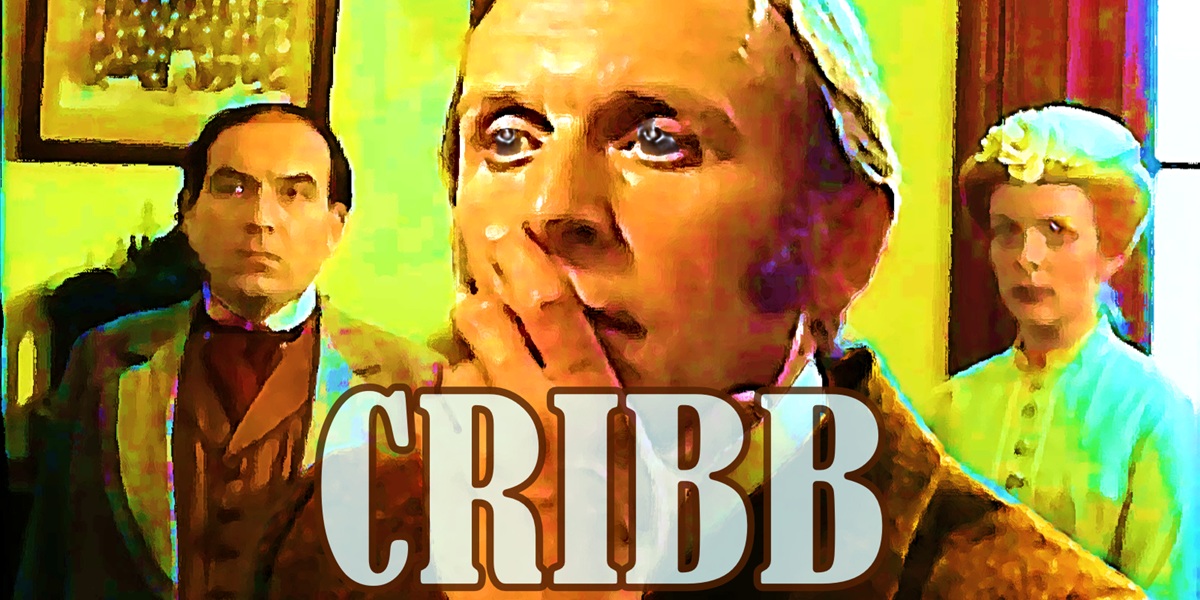
‘The whole country is threatened,’ warns Chief Inspector Jowett. There have been dynamite attacks on local government offices, the underground railway, Victoria station, the offices of The Times, even Scotland Yard, where Jowett’s own office has been wrecked. The bombs are of American origin, and it’s assumed (correctly) that this is Irish terrorism. These Fenians are well funded – ‘We have access to over 100,000 American dollars’ – and are planning to destroy the battleship Leviathan, ‘the pride of the British fleet’. Cribb, who’s had explosive training, infiltrates the gang.
One of the leaders is a woman. As she says, ‘We’re not all the insipid creatures some men take us for.’
see also:

Discover more from Lion & Unicorn
Subscribe to get the latest posts sent to your email.
