BEN FINLAY celebrates the best of the television cooks…
Chefs are odd characters, and their television counterparts no less so. Mind you, so would you be if you spent the majority of your life dressed in an apron and checked trousers, slaving away in an excruciatingly hot rabbit hutch to serve a never-ending slew of customers. It’s like feeding an ever-ravenous giant mouth that can’t be satisfied. Painting the Fourth Bridge doesn’t come into it.
I can say this with confidence because prior to my incantation as a mature student and subsequent tenure as a university lecturer, I spent the ‘best’ part of twenty odd years as a full-time chef. In this guise, I was understandably interested in what was going on in the wider food world, and of course, TV was one of the most direct ways to find out.
In the time I was gainfully employed as a purveyor of grub to the masses (1990 to 2014), British food went under a huge transformation that was particularly indebted to how cookery was presented on TV. The relatively staid, studio-based cookery programming of the 1970s and early 80s was revolutionised by characters such as the mercurial Keith Floyd, restaurants standards were seriously raised by the virtuosity of Marco Pierre White (mentor to Gordon Ramsay), and food became ubiquitous on the box. From accessible domestic cookery programmes to documentaries about extortionate and exclusive high-end London restaurants, it was everywhere, and at one time was even toted as the ‘new’ rock and roll (absolute rubbish of course, apart from the habitual late-night drinking common to both practices).
Anyway, after handing in my chips (first food metaphor of the piece), I discovered I still liked cooking, just not the industry and the hours. Over the years, I enjoyed TV cookery that was less ‘professional’ and more on the entertaining and informative side of things. And I still do. With that in mind, I decided on a top ten of what I see as the best television cooks and their attendant shows.
Whilst considering this, I decided on the following criteria: the best TV cooks have to exhibit some skill, but more importantly charisma, accessibility, and a healthy sense of humour – which is why Jamie Oliver isn’t anywhere to be seen on the list.
That said, let’s pour a generous glass of vino, fire up the burners, put the oven on to preheat, and enjoy the L&U top ten TV cooks
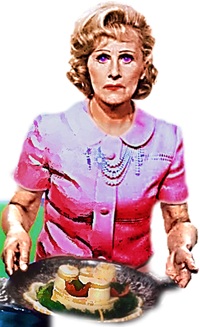
10. Fanny Cradock
Theatrical, bossy, rude, condescending and somewhat terrifying, Fanny Cradock has nevertheless been credited as saving British cooking after the war. With her hen-pecked husband, Major Johnnie Cradock, she presented twenty-four television series between 1955 and 1975, often appearing in an excessive amount of make-up and wearing vast chiffon ballgowns.
Although her style of cookery dated quite quickly, and by today’s standards, her food is quite dreadful, Fanny made a considerable contribution to TV cookery in Britain, making cookery economically viable in the post-rationing years. She was a true eccentric, inspired the likes of Delia Smith, and has subsequently been the subject of plays such as Doughnuts Like Fanny’s by Julia Darling and Fear of Fanny by Brian Fillis, which was adapted into a television drama starring Mark Gatiss and Julia Davis in 2006. Not bad for a cook that once made an absolute abomination, the infamous mincemeat omelette, ‘dusting’ it in so much icing sugar that one was guaranteed type-2 diabetes by just watching the clip. Good Lord.
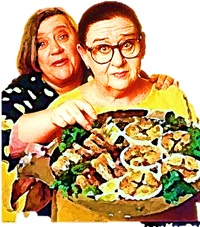
9. Jennifer Paterson and Clarissa Dickson Wright (the Two Fat Ladies)
The Ladies are cooks not chefs – they reject the pretensions and elaborations of haute cuisine and are aggressively unfashionable, delighting in such ingredients as clotted cream, lard and fatty meats. – Producer of Two Fat Ladies, Optomen Television
Broadcast between 1996 and 1999, the four series – twenty-four episodes in total – made for delightful viewing, featuring a complete disdain for healthy food and lashings of politically incorrect banter. Presented by cookery writer Jennifer Paterson and former barrister Clarissa Dickson Wright (Clarissa Theresa Philomena Aileen Mary Josephine Agnes Elsie Trilby Louise Esmerelda Johnston Dickson Wright to give her full name), the programme saw the portly pair travelling around the UK on a Triumph Thunderbird motorcycle driven by Paterson.
Their repartee would now be considered far too risqué for television, with Dickson Wright, a recovering alcoholic, particularly salty (food metaphor again there), once declaring that, during her alcoholic years, she had sex with an MP behind the Speaker’s chair in the House of Commons. Both were strongly opposed to vegetarianism, with Dickson Wright arguing that vegetarians are fascists: ‘I’d fight to the death for their right to be vegetarian, but they won’t return the compliment. I hate fascism in any guise.’ Paterson was also horrified at the increasing number of vegetarians, commenting that ‘there were few around in my young days, and those we did come across we considered to be German spies. After all, Hitler was a veggie.’ Such outspokenness caused several death threats; after Paterson’s death from lung cancer in 1999, Dickson Wright remembered one person yelling ‘one dead Fat Lady, one to go’. Apparently, killing animals is heinous, but wishing for the demise of hilarious food presenters is fair game.
Not likely to be repeated on the BBC anytime soon, thankfully much of the four series are available on YouTube.
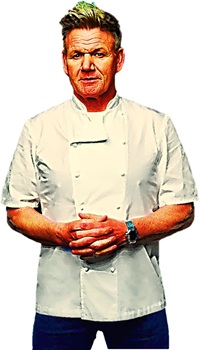
8. Gordon Ramsay
Potty-mouthed cooking machine Ramsay blazed on to our screens with Channel Four’s Boiling Point, broadcast in 1999 as he was in the process of acquiring his third Michelin star. The series sealed his reputation as a volatile, perfection-obsessed bad boy, dragging British cuisine to hitherto lofty standards. A career in television followed alongside his restaurateur duties, not least the famed Kitchen Nightmares.
These days, the inferior American formulaic franchise gets repeated endlessly, but it is the British version (aired in 2004) where Ramsay’s talents shine. Tackling difficult, un-self-aware chefs and restaurant owners, Gordon offers excellent advice to turn around their ailing businesses, displays rare empathy, and – in life imitating art – the awkward silences inadvertently ape reality spoofs such as The Office. See if you can find the episode where Ramsay visits Sheffield tapas bar The Runaway Girl and works with the chef Ritchie to change his business partner who is in denial; it’s often cringeworthily funny and demonstrates that some reality TV has a point.
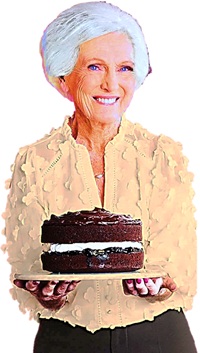
7. Mary Berry
One of the most popular ever TV cooks, Le Cordon Bleu-trained Berry has had a long career. Her first volume, The Hamlyn All Colour Cookbook, was published back in 1970, and she has since written over seventy books.
Berry first appeared on television in the early 1970s, guesting on Thames Television’s Good Afternoon hosted by Judith Chalmers. There is a memorable clip on YouTube of her preparing a quite frankly horrendous beef casserole during the three-day week which I used to show to students to demonstrate just how far British cookery (and Berry) had come since those days. I also remember an episode of the live Saturday Kitchen a few years back, where a call from a soon-to-be-cut-off viewer asked her what can be ‘cooked with a ‘Camberwell Carrot’ (a reference to the film Withnail & I’s slang for a large marijuana cigarette). Church of England member Mary had absolutely no idea what he was on about.
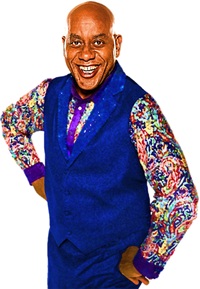
6. Ainsley Harriott
Beginning his TV career as an extra on Hale and Pace, there is something of the all-round entertainer about Harriott, something that annoys the serious chef fraternity. Indeed, the late New York chef Anthony Bourdain once wrote that watching Harriot was like viewing ‘a black and white minstrel show. It’s bad on so many different levels I just don’t know where to start. He does to cooking what Hitler did to Poland.’ Ouch. However, his jokey style, at times full of innuendo and barely concealed double-entendres has endeared him to masses of viewers. And despite my appreciation of Bourdain, Harriott’s cooking is pretty good to, as witnessed in Ainsley’s Caribbean Kitchen from 2019.
On an interesting trivia note, Ainsley’s father, Chester Harriott, was a cousin of saxophonist Joe Harriott, one of the greatest figures in the British jazz scene of the fifties and sixties.
We’ll be back with the top five after this short commercial break…
Discover more from Lion & Unicorn
Subscribe to get the latest posts sent to your email.
