BEN FINLAY selects the best shows from the days when factual television was any good.
As promised in Part One, here is the top ten series from the golden age of factual TV.
All should be easily available, and I urge you to watch and engage with these series, as the rewards are valuable. The pace, delivery and presentation of course hark back to a slower, more thoughtful and less gaudy age, and are all the better for it. And there’s not a dopey ‘celebrity’ in sight. Wonderful.
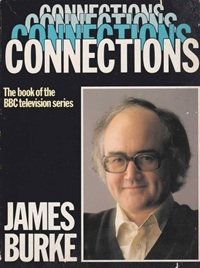
10. Connections (BBC, 1978)
James Burke’s tenacious presentation style and dry wit had already marked as a popular figure of factual TV, and in 1978 he devised, wrote and presented his greatest work to date, Connections. Aired on the BBC between October and December 1978, Connections explored an ‘Alternative View of Change’ (the subtitle of the series), Burke’s argument being that the modern world is the result of a web of interconnected events, with no piece or achievement of modernity existing in isolation.
In episode one, ‘The Trigger Effect’, for example, Burke traces the world’s dependence on complex technological networks; in episode eight, ‘Eat, Drink and Be Merry…’, he connects plastic, the plastic credit card and then the concept of credit, before going into a myriad of links ending with the Saturn V rocket that put man on the Moon. It’s all completely absorbing, fascinating and ultimately satisfying viewing. Accompanied by a book, the series was hugely popular and influential, so much so that Burke revived it in 1994, 1997 and 2023.
Available on DVD, Episodes 1-4 currently on YouTube
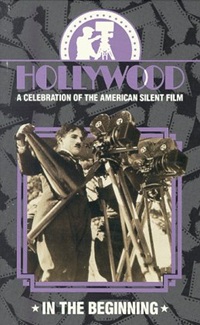
9. Hollywood: A Celebration of the American Silent Film (ITV, 1980)
One of the lesser-known titles on this list, Hollywood is nevertheless an excellent series, and well worth exploring. Broadcast on ITV between Jan and April 1980, the thirteen-part series was directed by film historians Kevin Brownlow – who notably wrote and co-directed It Happened Here (1964) and Winstanley (1975) with Andrew Mollo – and David Gill.
Hollywood explored the establishment and development of the Hollywood studios and their cultural impact during the silent film era of the 1910s and 1920s. Narrated by James Mason, with a score by Carl Davis, this superbly produced series was painstakingly created using the best archive film sources available, and filmed the recollections of many of the period’s surviving participants, illustrating their interviews with scenes from their various films. A number of these are notable for being among the only filmed interviews given by their subjects. A work of incredible dedication, it is not easy to come by on DVD (due to the complexity of obtaining home video rights) but it is luckily available on the Internet Archive.
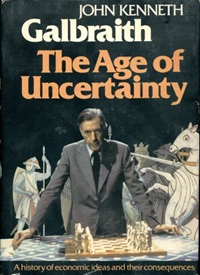
8. The Age of Uncertainty (BBC, 1977)
Repeated recently on BBC Four, this series – presented by Canadian-born Harvard economist and author John Kenneth Galbraith – was co-produced by the BBC, the (Canadian Broadcasting Corporation), KCET (PBS member station) and OEC (TV Ontario). Within its thirteen episodes, Galbraith argues that the market system is prone to instability and causes social inequality. As one of the most popular social scientists, Galbraith was associated with the US Democratic Party and tirelessly argued for progressive taxation, public housing and the public ownership of certain corporations – what he called ‘a new socialism’.
Unsurprisingly, The Age of Uncertainty was met with objection by the future doyen of free market economics Margaret Thatcher (then opposition leader) and her mentor Keith Joseph, with them both arguing that it was too biased for the publicly owned BBC. None other than Milton Freidman responded by presenting his own series Free to Choose broadcast by PBS in January 1980. Could one imagine academic economists arguing in such a manner today? I imagine not, so if anything, the power of TV in this age is amply illustrated by the Galbraith/Friedman standoff.
Ultimately, The Age of Uncertainty is of its time, coming within a couple of years of the Thatcher/Reagan economic revolution of the 80s, and is even more compelling viewing for it. I watched it last year and was glued to every episode, particularly the final two-and-a-half-hour episode Weekend in Vermont (filmed at Galbraith’s Vermont farm) in which our host discusses economics, politics and international relations with guests such as Henry Kissinger, Soviet-Russian political scientist Georgy Arbatov and Edward Heath.
Available on BBC iPlayer.
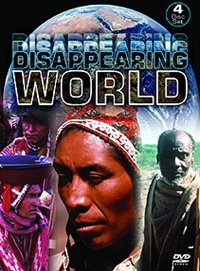
7. Disappearing World (ITV, 1970)
Produced by Granada Television, Disappearing World ran from 1970 to 1993, amounting to forty-nine episodes in all. It was conceived by Granada chairman Denis Forman in the late 60s, convinced that detailed ethnographic films could have a broad appeal. Each episode was made in consultation with an anthropologist and episodes were used for teaching undergraduate anthropology.
Beautifully filmed on 16mm, the series initially dealt with the practices and folklore of cultures threatened with extinction, before broadening into urban societies. Its credentials as a vital piece of factual TV were assured in 1985 by New York Times writer John Corry who praised the programme as a ‘throwback to the old days of educational television, with an austere ethos’ that allowed viewers to make up their own mind. Music to my ears.
Some episodes available on YouTube, and much of the series is now available on DVD.
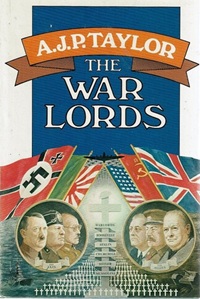
6. The War Lords (BBC, 1976)
A strong believer that history should be open to all, eminent historian, journalist, author and broadcaster A. J. P. Taylor became a household name in the 50s and 60s. This was due to his appearances on BBC’s In The News from 1950-54, ITV’s rival discussion programme Free Speech from 1955-61, and his half-hour programmes on ITV in which he lectured without notes on a variety of topics – such as the Russian Revolution of 1917 and the First World War – and achieved large viewing figures.
Fluctuating between ITV and BBC in the 60s and 70s, in 1976 he wrote and presented (again delivering his lectures to camera without an autocue) The War Lords, a six-part series (accompanied by a book) where Taylor examines the lives and motives of the key leaders in the Second World War. Taylor’s affable, approachable style, and his use of wit and humour earnt him the title the ‘people’s’ or the ‘everyman’s’ historian, which he was particularly pleased with. The ‘inform, educate and entertain’ ethos was in safe hands with Taylor, and The War Lords is just one very good example of his work.
All episodes – and an introduction to the series by historian Andrew Roberts – are available on BBC iPlayer.
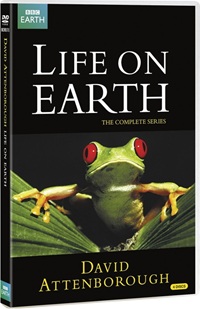
5. Life on Earth (BBC, 1979)
David Attenborough’s finest (several) hours, and a landmark series for the BBC. Broadcast between Jan and April 1979, the programme received countless plaudits, saw Attenborough elevated to a British cultural hero and set a benchmark for wildlife television. Attracting an initial fifteen million viewers when first broadcast, it became a major international success, sold to over a hundred territories and watched by an estimated audience of 500 million people worldwide.
The wonderful soundtrack, written by British composer and electronic music pioneer Edward Williams, is also notable, and its pioneering use of the British synthesiser, the EMS VCS 3 (previously employed by bands such as Pink Floyd) only added to the depth of Life on Earth; the soundtrack (never intended to be released commercially) has subsequently sold well on record since its eventual release in 2009. One of the greatest series ever, and the peak of the factual TV era.
Available on BBC DVD.
4. The World at War (ITV, 1973)
Factual TV rarely came as epic as this series broadcast by ITV between late October 1973 and May 1974. Commissioned by Thames Television in 1969, the twenty-six episodes of The World at War remain the greatest of all World War Two documentaries, with invaluable witness accounts from civilians, enlisted men, officers and politicians. It took four years and cost a small fortune to make (£900,000 was a huge amount of money in the early 1970s) and is worth every bit of it. Indeed, it was ranked at number nineteen on the British Film Institute’s list (made in 2000) of the 100 Greatest British Television Programmes, with no documentary coming higher. Absolutely essential viewing and quite possibly the best series ever broadcast by ITV.
Available on DVD.
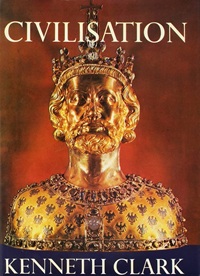
3. Civilisation: A Personal View by Kenneth Clark (BBC, 1969)
‘A truly great series, a major work … the first magnum opus attempted and realised in terms of TV.’ Huw Weldon, BBC managing director
‘I had no clear idea what ‘civilisation’ meant, but thought it was preferable to barbarism, and fancied that this was the moment to say so.’ Sir Kenneth Clark
The daddy of them all. With the advent of colour television, Civilisation was conceived by David Attenborough (then controller of BBC Two) who convinced historian Sir Kenneth Clark to write and present a thirteen-part series about the history of Western art, architecture and philosophy since the Dark Ages. The production took three years, with filming taking place over one hundred and seventeen locations in thirteen countries.
Civilisation still stands as a masterpiece of factual broadcasting, is visually breathtaking and educational and informative beyond compare. Furthermore, it set the bar for future themed documentaries, irrevocably changed cultural television and is simply one of the best series ever made.
In 2018, the BBC broadcast a sequel, Civilisations, that was a thinly veiled attempt to play down the achievements of European civilisation, instead focusing on non-European cultures which is quite honestly dreadful in comparison. Dear old Ken would be spinning.
Available on BBC DVD.
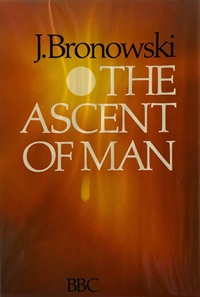
2. The Ascent of Man (BBC, 1973)
‘Man is unique not because he does science, and he is unique not because he does art, but because science and art equally are expressions of his marvellous plasticity of mind.’ Jacob Bronowski
Commissioned specifically to complement Civilisation, the incomparable Polish-born mathematician and historian of science, Jacob Bronowski, travelled the world tracing the development of human society through its understanding of science. The result was an exquisite series filmed in 16 mm with Bronowski delivering perfect monologues to camera in a variety of locations. Bronowski’s ability to explain complex ideas made him a compelling presenter. ‘These programmes’, he said, ‘are about the making of creation – Man making mistakes, then seeing the right answers. Science is creative, not a mere mechanical practice.’
Again commissioned by David Attenborough, The Ascent of Man is about as good as factual television ever got, and deserves every plaudit it ever received. As with all the series on this list, it was accompanied by a book, which became a bestseller and was recently reprinted with a foreword by Richard Dawkins.
A beautifully explained account of the pivotal steps in the history of ideas, The Ascent of Man is the epitome of television’s educational value and its influence was inestimable. Go and watch it – now.
Available on BBC DVD and iPlayer.
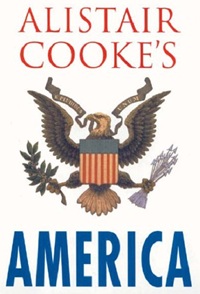
1. Alistair Cooke’s America (BBC, 1972)
For me, this the greatest of all factual television. Salford-born Cooke was debonair, erudite and somewhat patrician, and all the better for it. His relaxed presenting style, thoughtful analysis and unpatronising delivery made the series an absolute delight to watch.
Cooke first visited the US in 1932, and in 1937 he emigrated there. In 1946 he began writing and presenting a radio series called American Letter (renamed Letter from America in 1950), initially for a thirteen-week run. The series came to an end fifty-eight years later in March 2004, after 2,869 instalments and less than a month before Cooke’s death.
In 1971 the BBC commissioned Alistair Cooke’s America, a thirteen-part series charting the history and development of the US, which was duly broadcast between November 1972 and February 1973. A huge success in both Britain and the US, it was nominated for a Golden Globe Award and a BAFTA and resulted in Cooke’s invitation to address the joint Houses of the United States Congress as part of the Bicentennial celebrations.
The accompanying book sold over two million copies (I clearly remember a copy standing prominently on the living-room bookshelf when I was a child). Cooke, when asked how long it took to make the series, quipped, ‘I do not want to be coy, but it took forty years.’ And on a personal note, episode one includes the best three minutes of television ever when Cooke visits a bar in New Orleans, plays a twelve-bar blues on an old piano and attempts to explain the origins of jazz. Exquisite.
Available on BBC DVD.
see also:
Discover more from Lion & Unicorn
Subscribe to get the latest posts sent to your email.
