JONATHAN CALDER on Philip Leacock’s Innocent Sinners (1958), a movie about children and bombsites…
The best-known scene from a British film involving children and bombsites is the climax of Hue and Cry (1947), where the office boys and errand boys of London stream across a ruined cityscape to confront the villains. It feels more Roberto Rosselini than Ealing.
Here, you sense, is the exotic London captured by Rose Macaulay in her novel The World My Wilderness (1950). A city where the bombsites are bright with flowers and lush with vegetation. A city of sudden unaccustomed vistas of Italianate churches. A city where the displaced sleep at night among the ruins.
But this vision was not to be repeated. Because terrible things started happening to boys who wandered on to bombsites in British films.
The best of these boy-and-bombsite films was The Yellow Balloon (1953). Early on, we see its lead, a twelve-year-old Andrew Ray, chasing through the upper floors of a ruined building with a friend. The friend trips and falls to his death, as Ray finds when he reaches him. Whereupon William Sylvester steps from the shadows, says he saw Ray push the other boy and entraps him in his web.
Ray first steals from his parents and is then taken along by Sylvester, much as Oliver Twist was by Bill Sikes, to help with a spot of housebreaking. The job goes wrong and Ray becomes the only witness to a murder. Sylvester pursues him, and the denouement set in a bombed-out tube station is genuinely scary – so scary that The Yellow Balloon became one of the first British pictures to be given an X certificate. This at once ruined the distributors’ plan for a marketing campaign aimed at children and barred Andrew Ray from viewing his own performance.
The film ends with Ray and his parents embracing on a London pavement – the family has triumphed over the dangerous allure of bombsites. This particular family falls short of being the model family of the 1950s, as Ray’s father is himself little more than a boy in character, though that may just be what you get from casting Kenneth More.
So dangerous did bombsites become for boy actors that Jon Whiteley ventured on to them twice and got caught up with a murderer both times. In Hunted (1952) he comes across Dirk Bogarde dumping the body of his wife’s lover, while in The Weapon (1956) he finds a gun, accidentally shoots a playmate and, thinking he has killed him, goes on the run. In reality, it’s not the police Whiteley needs to worry about but a villainous George Cole, who used the gun to kill some years before and now fears detection.
Like Andrew Ray in The Yellow Balloon (The Weapon is in many ways an inferior remake of that film), Whiteley appears infantilised if set against the boys from Hue and Cry, with their jobs and long trousers. And the changed role of the obligatory American actor is telling too. William Sylvester was the villain, but in The Weapon Steve Cochran is a shining knight who tracks down Whiteley and brings him home to his mother, having first dispatched Cole from the top of a ruined warehouse with a straight right.
The danger never ended. David Hemmings, aged sixteen but playing younger, takes to a bombed-out ruin to escape the local hoodlums in The Heart Within (1957) and is saved from falling to his death by Earl Cameron. In this early, timid treatment of racial questions, Cameron is hiding out there after having been wrongly accused of murder.
Things got so bad that not even an adult Richard Attenborough was safe. In The Eight O’Clock Walk (1954) he is seen on a bombsite by a nosy neighbour and as a result later accused of murdering a child. The film was born out of opposition to the death penalty and concern at reliance on circumstantial evidence, but he is saved from the noose only by some absurd Perry Mason antics on the part of his counsel.
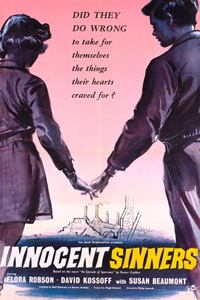
But in 1958 a film appeared that showed that children who played on bombsites weren’t harassed by murderers but by mundane forces like magistrates and residents’ associations. It also showed that those children might be finding there the privacy that their overcrowded and inadequate homes lacked. And, uniquely and importantly, it had a girl at its centre.
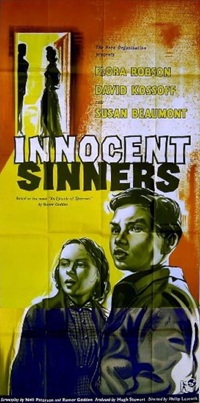
Innocent Sinners was made from Rumer Godden’s novel An Episode of Sparrows – her work had already been successfully adapted by Jean Renoir (The River) and by Powell and Pressburger (Black Narcissus). If you think the film’s title was unfortunate, then so did its director Philip Leacock:
I don’t know why they changed the title … it hurt it because it was a well-known novel, you know. And the Rank Organisation didn’t think An Episode of Sparrows would mean anything, and in those days – well, they still are – they’re so ridiculous about titles. But I think it hurt the picture.
Innocent Sinners tells the story of Lovejoy, the young daughter of a theatrical performer. When she was a little girl, Lovejoy would join her mother on stage, but she has now been dumped on a couple who are struggling to run a restaurant in an unfashionable quarter of London and is aware that her clothes are growing shabby.
In an attempt to maintain her self-respect and recapture some of the glamour of her early life, she begins to plant a garden on a bombsite. It is soon rubbed out by a gang of boys, who tell her that girls have no business there. It wasn’t only British film directors who saw these spaces as a male preserve.
But the leader of the gang, Tip, takes pity on Lovejoy and finds her a better site behind a bomb-damaged church. Here she begins planting again, her ambitions now extending to having a formal Italian garden, complete with statuary, and Tip helps her.
The friendship between Tip and Loveday grows, to the extent that the film eventually shows them holding hands, but they start to sound like a married couple long before that:
‘You’re late.’
‘I had things to do. With the boys.’
‘But you’re always with the boys.’
‘For Pete’s sake! All the days I’ve spent working with you on your blasted garden.’
The children begin taking soil from the gardens in the middle of a genteel square. This is where the restaurant that Loveday lives above is located; Tip lives on a working-class road that runs from there down to the Thames. Their depredations arouse the ire of the residents’ committee, a policeman is detailed to lie in wait for them and they are duly nabbed.
Then it transpires that Lovejoy’s mother has remarried and left for Canada without making provision for her to follow. At the same time, her guardians are forced to admit they will never make money from a restaurant in this location and shut up shop. Nor can they afford to pay for Lovejoy’s care any more, so the girl finds herself consigned to an institution where her idiosyncratic ways are not appreciated.
Everything is resolved for the best by a dea ex machina in the shape of Flora Robson, who plays one of two sisters who share a tall house on the square. In poor health and confined largely to her room, she has looked down on the action of the film and seen much that has transpired.
Aware that she does not have long to live and haunted by the feeling she has left her life unlived – certainly when compared with her sister, who runs the residents’ association and everything else in the neighbourhood – she resolves to make an impact with her will. So she leaves the couple at the restaurant the money to buy premises in the West End on condition that they continue to care for Lovejoy.
Tip gets sent to a training ship and it’s possible to ask if he should be quite as delighted at this as the film makes him. The respectable classes could never decide if these institutions were a great opportunity for a lad or a fearsome punishment. But he’s one of nature’s NCOs – he takes pleasure in making Lovejoy do a penance after she has stolen money from the church to pay for gardening tools – and you feel he will be well able to look after himself.
The film is sentimental about the fate of the adult characters, but never about Tip and Lovejoy. With their odd names and strong, quirky personalities, they are typical Rumer Godden children, while Philip Leacock was noted for his ability to draw good performances from young actors.
It helps that Christopher Hey and June Archer, who play Tip and Lovejoy, convince as street children; they lack the fetching looks of the conventional child star. June’s casting was a happy accident: it was her younger sister who was up for the part and June had come along to look after her at the audition. When Leacock found June had learnt much of the script to help her sister, he got her to assist him with the auditions. Before long, he knew who he wanted to play Lovejoy.

The films were not wrong: bombsites were dangerous places for children to play. In a review of how newspapers reported on them in the Fifties, Rose Staveley-Wadham turns up a case in Southwark from October 1950 where a wall collapsed on top of three boys. One was killed at once and a second, it was reported, was very ill in hospital. She also finds, in the same year, housewives in Croydon demonstrating about one site and carrying placards saying ‘Remove the War Scars’ and ‘Give Us Homes’.
Ealing Studios had got there the year before in a scene from Passport to Pimlico. A police constable calls to see Stanley Holloway and, while he waits for him to return, looks at a model the public-spirited Holloway has made.
‘It’s an idea for that dump out there,’ his wife explains, indicating a bombsite outside her window. ‘Give those kids somewhere decent to play.’
The constable, watching two small boys scuffling in the dirt, replies: ‘They seem to be doing pretty well as it is.’
She is less convinced: ‘I’d have something to say if I was their mother.’
Visit Jonathan Calder’s excellent blog Liberal England.
see also:


Discover more from Lion & Unicorn
Subscribe to get the latest posts sent to your email.
