When researching my new book, A Shellshocked Nation: Britain Between the Wars, I read a hundred or so British novels of the interwar years. Here are some of my favourite quotes from those books.
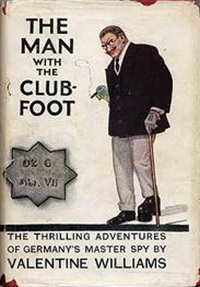
‘He does not like music,’ Dewinski explained suavely. ‘No Englishman likes music. The British, when they have to meet any business that is very unpleasant, from which there is no escape at all, they call it “facing the music”.’
John Ferguson, Stealthy Terror (1917)
I have often remarked in life that there are days when some benevolent deity seems to be guiding one’s every actions. On such days, do what you will, you cannot do wrong.
Valentine Williams, The Man with the Clubfoot (1918)
The capacity to love as our forefathers loved is passing away. Even a spirit of commercial enterprise is lacking. The world goes from bad to worse.
Robert Nichols, ‘The Smile of the Sphinx’ (1919)
I understood what a precious thing this little England was, how old and kindly and comforting, how wholly worth striving for. The freedom of an acre of her soil was cheaply bought by the blood of the best of us.
John Buchan, Mr Standfast (1919)
Somehow it seemed strange that there could be any happiness left in the world.
F. A. Voigt, Combed Out (1920)
‘Ever since the war you poisonous reptiles have been at work stirring up internal trouble in this country. Not one in ten of you believe what you preach: your driving force is money and your own advancement. And as for your miserable dupes – those priceless fellows who follow you blindly because – God help them – they’re hungry and their wives are hungry – what do you care for them?’
Sapper, The Black Gang (1922)
‘There’s nothing gross and material about stockbroking. It’s like pure mathematics. You’re dealing in abstractions, ideal values, all the time. You calculate – in curves.’ His hand, holding the unlit cigar, drew a curve, a long graceful one, in mid-air. ‘You know what’s going to happen all the time.’
May Sinclair, Life and Death of Harriett Frean (1922)
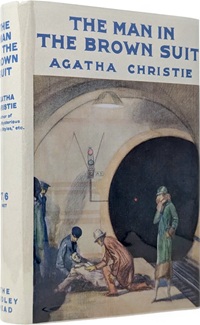
I yearned for adventure, for love, for romance, and I seemed condemned to an existence of drab utility. The village possessed a lending library, full of tattered works of fiction, and I enjoyed perils and love-making at second hand.
Agatha Christie, The Man In the Brown Suit (1924)
That night they were not divided.
Radclyffe Hall, The Well of Loneliness (1928)
‘Nay nay! Fuck’s only what you do. Animals fuck. But cunt’s a lot more than that. It’s thee, dost see: an’ tha’rt a lot beside an animal, aren’t ter? even ter fuck! Cunt! Eh, that’s the beauty o’ thee, lass!’
D. H. Lawrence, Lady Chatterley’s Lover (1928)
There, on that Norman sandbank, those queer English played and played, like no other nation on earth, serious about a game as about nothing else, scrupulous about its rules as they were careless about theology, politics, economics and language.
R. H. Mottram, The English Miss (1928)
‘What’s the damn good of it, Wimsey? A man goes and fights for his country, gets his insides gassed out, and loses his job, and all they do is give him the privilege of marching past the Cenotaph once a year.’
Dorothy L. Sayers, The Unpleasantness at the Bellona Club (1928)
‘Those who set out to lead the mob are apt to end by following.’
John Buchan, Castle Gay (1930)
It was surprising to see so many men with thin necks and large Adam’s apples; it had something to do with Nonconformity, she supposed.
E. H. Young, Miss Mole (1930)
‘Life’s too short to get metaphysical. I’ve got to go and earn some bread and butter.’
Freeman Wills Croft, Mystery In the Channel (1931)
‘Human nature is much the same everywhere, and, of course, one has opportunities of observing it at close quarters in a village.’
Agatha Christie, The Thirteen Problems (1932)
‘Artist was stamped unmistakably upon him. His black hair was worn exceedingly long; he had a carelessly tied, very flowing piece of silk round his neck; his fingers were stained with paint; he had a broad-brimmed hat crammed on to his head; and was the owner of a pointed beard.’
Georgette Heyer, Footsteps in the Dark (1932)
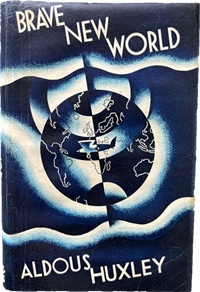
‘Most historical facts are unpleasant.’
Aldous Huxley, Brave New World (1932)
He had an engaging callousness about the value of political lives.
Leslie Charteris, The Happy Highwayman (1933)
What moved him was the pleasure and excitement it gave him to think of a naked body, its flesh torn and bloody and scarred with the strokes of a whip.
E. R. Punshon, Information Received (1933)
‘British justice is deservedly respected all the world over.’
Mavis Doriel Hay, Murder Underground (1934)
Bright young things with few morals and less sense might be amusing enough to read about in the pages of a novel, but they were pretty punk to meet in the flesh.
Your true adventure and mystery story lover demands but one thing from heroes – competence.
Eric Ambler, The Dark Frontier (1936)
‘If another world war is loosed then all, all will be destroyed. Socrates and Copernicus and Newton and Galileo and Velazquez will have lived in vain, and the four Gospels might just as well have not been written.’
A. G. Macdonell, Lords and Masters (1936)
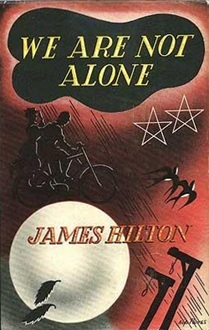
The whole span of centuries from cathedral to cinema was but a scratch upon the heritage of a million weather-beaten years.
James Hilton, We Are Not Alone (1937)
I had not expected equality in England, but neither was I prepared for a colour bar.
Rollo Ahmed, I Rise (1937)
‘Are we not facing a rising tide of ideological intolerance, and are not terrorism and violence more and more in men’s thoughts?’
Michael Innes, Hamlet, Revenge! (1937)
‘Class is like sex or the electric light supply, not worth thinking about as long as yours is all right but embarrassingly inconvenient if there’s anything wrong with it.’
Margery Allingham, The Fashion in Shrouds (1938)
During the Great War he had held down a staff appointment of bewildering unimportance which had kept him in Tunbridge Wells for the duration and which had not hampered his sound and at times brilliant activities in the City.
Ngaio Marsh, Death in a White Tie (1938)
‘The times are theatrical. The whole world has lived in the atmosphere of the theatre for the last fifteen years.’
Francis Beeding, The Eight Crooked Trenches (1938)
A Frenchman named Chamfort, who should have known better, once said that chance was a nickname for Providence.
Eric Ambler, The Mask of Dimitrios (1939)
Slim Grisson was a killer. He had killed things as a child, not for any reason, but because to kill was in his blood.
James Hadley Chase, No Orchids for Miss Blandish (1939)
from the maker of:

Discover more from Lion & Unicorn
Subscribe to get the latest posts sent to your email.
