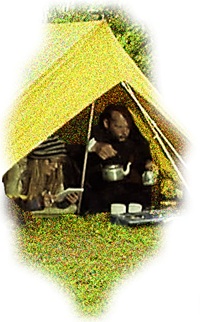
BEN FINLAY celebrates Mike Leigh’s Nuts in May fifty years after it was first broadcast.
It is now available in high definition on the BBC iPlayer.
We’ve come down here to get away from the hurly-burly of town life, the hustle and the bustle of living in an urban conurbation. We’ve come to be in the peace of the countryside.
Our larder isn’t sticking in you, is it?
First broadcast as part of the BBC’s Play for Today strand on 13 January 1976 – my second birthday, and a particularly cold Tuesday night – Mike Leigh’s Nuts in May has acquired a fond reputation over the decades since.
The hilarious story of a nature-loving, self-righteous couple – Candice Marie Pratt (Alison Steadman) and eccentric-obsessive Keith Pratt (Roger Sloman) – and their quest to enjoy their vision of an idyllic camping holiday is noticeably less strident than some of Leigh’s overly political works, but it still has an uneasy resonance. For at the very core of this cherished comedy is an irreconcilable class tension: the clash between middle-class suburbanites and working-class campers, played out against the realities of rural life.
Despite the title, Nuts in May was actually filmed in the March of 1975 in just sixteen days during a BBC industrial dispute. It’s set, and was shot, in the beautiful and historically rich Isle of Purbeck area of Dorset, making the most of the locale, with the characters visiting several significant points of interest including Corfe Castle (staying at the Corfe Castle Campsite, which is still in use), Stair Hole, Kimmeridge, Lulworth Cove and the Jurassic Coast.
The film starts with the Pratts boarding the Sandbanks ferry in their Morris Minor before pitching up at the campsite. What is so well observed is how Candice Marie and Keith move their suburban home to the countryside; we see them planning their meals as if they were in their own kitchen, obsessing over proteins, rather than relaxing into rural bonhomie.
Furthermore, they are strict vegetarians – utterly mainstream now but still fairly niche in 1976. (The same year, incidentally, the BBC broadcast a programme about the burgeoning Vegan Society on Open Door – a series that gave campaign groups an opportunity to make a half-hour programme explaining their case – which resulted in over 9,000 enquiries about veganism.) The Pratts have genuine concerns and well-meaning intentions in their attitude to diet and the environment, but they are also ultimately unrealistic, rigid and somewhat neurotic. Which is what makes them so irritating.
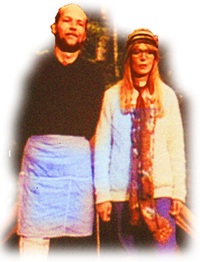
While Candice Marie exhibits childlike qualities and an unwitting naivety, it is of course Keith who is the main protagonist of control. These days he might be diagnosed with a mental health issue, but back in 1976 he appears just to be a mighty pain in the arse. His heart is undeniably in the right place, but he is uptight and at times downright pompous, carrying a set of rules that are impossible to live up to.
Early in the film we see the Pratts visit Corfe Castle, and Keith’s control freakery is much in evidence. When they discover the road to Lulworth Cove is closed, thereby extending the time of their planned trip by forty-five minutes, Candice Marie suggests that they visit it tomorrow, saying that one doesn’t always have to stick to a schedule. Keith retorts that there is ‘no point having a schedule if you don’t stick to it’.
Their rigid routine is interrupted by Ray (Anthony O’Donnell), a lone student and trainee PE teacher (he also takes History as a ‘subsidiary’ subject) who camps nearby and has the temerity to play his radio. Keith asks Ray to turn the radio down, only to be ignored; he is to a point right, but his pious inflexibility and bossiness can’t help but rankle. In the wake of the ‘incident’ Keith decides that they should move their tent; Leigh would later describe this as ‘urban siege mentality’, which of course is exactly what it is.
On the way home from a day trip to Stair Hole, it begins to rain, and the couple notice Ray walking along the road and give him a lift back to the campsite. It is here that we find out that Candice Marie works in a toy shop, and Keith is employed by Social Services organising ‘pensioners’ holidays. Meals on Wheels. That sort of thing.’ One can just imagine what sort of pedantry and control Keith exercises in his job. and how that spills out into the couple’s everyday life.
When Candice Marie innocently visits Ray’s tent to show him the stones she has collected on the beach, Keith explodes with rage. We see him fuel his jealousy by spying on them from behind the bushes with his binoculars, exhibiting a paranoid insecurity that later manifests itself in his patronising attitude towards Ray in one of the film’s best and most hilarious scenes. In an attempt by Keith to absolve his behaviour, Ray is asked to take a photograph of Keith and Candice Marie, only to be coerced into participating in ‘The Zoo Song’, an excruciating composition ‘written’ by the Pratts.
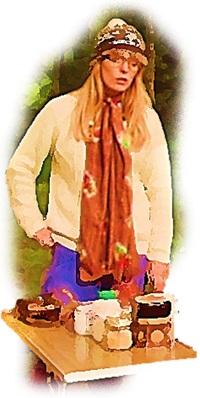
The arrival of Brummie couple Finger (Stephen Bill) and Honky (Sheila Kelley) on their motorbike, equipped with an army tent, a football and a fondness for late-night drinking, is where all hell lets loose, as Keith is driven to apoplexy. Finger and Honky befriend Ray, and arrive back at the campsite together in high spirits after getting drunk at the local pub. The following morning, Keith is incandescent with rage at Finger’s plan to light an open fire, with much hilarity ensuing. Keith’s reasoning with them fails, ultimately culminating in the release of his own pressured violence, swinging at them psychotically – and appropriately – with the branch of a tree.
Eventually the Pratts leave and find another place to camp. The final scene is masterful, as Candice Marie’s guitar reverberates on its own in the wind, and they wax lyrical about it being ‘in harmony with the birds’. Unbeknown to them, the farm they are staying on practises battery farming of chickens and mechanical cow-milking.
What is so difficult for Candice Marie and Keith to accept is that, because of the fallibility of others, it is impossible to impose their dreams of rural sanctuary. And it is this that Leigh so wonderfully urges all to consider; because there is an inner Keith in all of us (and I thoroughly include myself in this), bent on a quest to enact control over our immediate environment.
Indeed, there are many times during Nuts where I fully understand and empathise with his frustration; other times when I’m repelled by him. Yet it is the mirror image we see in the character that causes this.
To an extent, we are all now less tolerant, more insular. In the present day, we have become increasingly unsocial and atomised. This extends to a rage against every opinion that is different to our own, and anger at every contrary position. Further, Keith’s absolute obsession to stick to the ‘rules’ (or at least seen to be) provides an uncanny parallel to today’s unquestioning conformism.

Nuts in May was of its time, made in an era where the retreat to rurality, the ‘back to the land’ movement, was being romanticised by the urban middle-class. The Good Life had proved to be successful television the year before, with the character of Tom Good as inflexible at Keith Pratt, for all his affable breeziness. But it has had a long legacy.
Among its fans are Vic Reeves and Bob Mortimer, who chose the film to end At Home with Vic and Bob, the evening of programmes they scheduled on BBC Two in 1993. Its influence is evident in the latter-day dystopia Sightseers (2012) by Ben Wheatley; an unfathomable tension transferred from the urban and released in the rural, where there are fewer curtain-twitchers to witness the hatred. In recent British cinema, simmering hostility from the local working-class directed towards self-important down-from-Londoners can be seen in Mark Jenkins’s masterful Bait (2019), a contemporary story of gentrification in a Cornish village that exposes a class standoff long running through British society.
Ultimately, it is a visionary work. It can be enjoyed at face value as the farcical comedy that is, but it also provides a metaphor for the future, with the Pratts’ lack of self-awareness and sense of humour, intolerance of others (while claiming their own virtue), and obsession with diet and rules. The suburbanite quest for the sanctity of the rural hasn’t gone away either, but instead of the campsite, the illusion is now sold as part of the Airbnb package.
So happy fiftieth birthday Nuts in May. It presents an underlying message in a humorous and non-doctrinal way, full of a ‘think for yourself ethos’ that has long passed in television and cinema. And, of course, it is a prescient, hilarious and salutary warning to always check one’s inner Pratt.
see also:

Discover more from Lion & Unicorn
Subscribe to get the latest posts sent to your email.
