ALAN TYLER on The Lion & The Unicorn, Big Brother and Auntie.
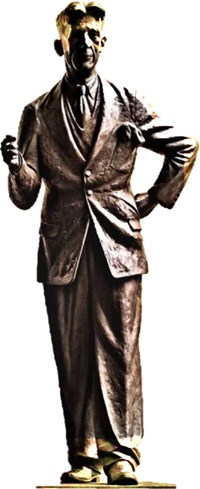
In May 2017, a statue of George Orwell was unveiled at Broadcasting House, London W1. Visitors to the home of the BBC are now greeted by a figure of the great author, leaning a little forward with pen in hand, standing next to an inscription which quotes from the preface of his novel Animal Farm:
If liberty means anything at all, it means the right to tell people what they do not want to hear
According to some, including the President of the United States, the BBC has been taking rather a few too many liberties in recent times, ‘mistakes’ (according to the BBC) which may cost them (or rather us, the British licence payers who fund them) a billion dollars or more. As the issue of BBC bias rumbles on, the national broadcaster’s adoption of that Orwellian aphorism is not without significance. Taken as a statement of mission, it represents a shift away from their old Reithian remit to inform, educate and entertain towards a new purpose, which is to influence. More and more, it would seem, the BBC regards itself as a beacon that must shine its light for the wayward and misinformed ‘people’ who do not wish to hear and are thus in sorest need of correction.
In his essay ‘The Prevention of Literature’, Orwell blandly but rather nicely described literature as ‘an attempt to influence the viewpoint of one’s contemporaries by recording experience’. His wider point was that an author must speak his own mind without falsification if he is not to be ‘a mere entertainer or else a venal hack who can switch from one line of propaganda to another as easily as an organ grinder changing tunes’. To this he added: ‘To write in plain, vigorous language one has to think fearlessly, and if one thinks fearlessly one cannot be politically orthodox.’ Quite how Orwell’s honest ambition for an author can, or even should, be adopted collectively by an organisation of 20,000 ‘impartial’ employees is something to return to later.
What we can say without doubt is that Orwell occupies a special space in our political and cultural consciousness. He is a uniquely British paragon of integrity and critical thought, and just about everyone, left, right and centre, wants a piece of him. A battle for his legacy ensues, and this has produced a remarkably distorting effect on what he is perceived to have said. My main conjecture is that what Orwell said about the left-wing intelligentsia in his day is borne out by what their successors erroneously (and often absurdly) say about him now.
George Orwell was a socialist, a democratic socialist. We can say this with great confidence, because he said it himself, many times. He sided with the communists and anarchists during the Spanish Civil war and gave a full account of his wartime exploits in Homage to Catalonia. He rather loathed the public school-educated imperial class from which he came, thinking their elite a hapless and out-dated lot ill-prepared for Hitler, who had stolen a march on them with modern industrial and military planning.
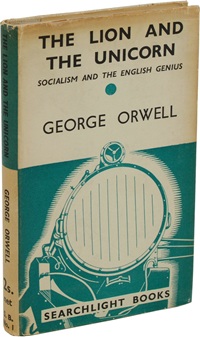
His diagnosis of our nation’s ills, and his vision of a uniquely English socialist revolution, is set out in the first work of his that genuinely caught the popular imagination. The Lion and the Unicorn: Socialism and the English Genius was written during the Blitz in 1940 and published the following year. Famed for its sharp but affectionate descriptions of England’s class-riven character, it also described the necessary collective effort needed to win the war and set out a six-point programme for a uniquely English socialist revolution. This little book did much to inspire and articulate the appetite for change which brought about Clement Attlee’s Labour victory when war was won in 1945.
So it is perfectly understandable and legitimate for any English socialist today to assume Orwell to be a man of the left, and one of their own. If it were not so now, it would have been a sore disappointment to England’s great political visionary. A disappointment, yes, but not something he might not have guessed at. For Orwell was an acute critic of the vices of the left, who foresaw how these might continue into the future that has become our daily present.
For the left today, interpreting Our Eric honestly has become more than a little ‘problematic’ (an ugly term, I know, that would likely have irritated the author who turned political writing into an art). To illustrate a few key errors, I’ll start with a little tiddler of an example, and move on to some whale-sized whoppers.
A Facebook friend of mine recently posted a meme quoting from Nineteen Eighty-Four, intending to suggest that the ignorant folk brainwashed by the media today are like unto the people whose thoughts, words and actions were controlled by Big Brother on Airstrip One. Here is the quote:
So long as they continued to work and breed, their other activities were without importance. Left to themselves, like cattle turned loose upon the plains of Argentina, they had reverted to a style of life that appeared to be natural to them, a sort of ancestral pattern. Heavy physical work, the care of home and children, petty quarrels with neighbours, films, football, beer and above all, gambling filled up the horizon of their minds. To keep them in control was not difficult.
His post was well liked and attracted a few approving comments. I, on the other hand, sighed my weary sigh. Should I say anything? My friend had found comfort in invoking the moral authority of Orwell to back his opinion, but his reading of Orwell was incorrect. The beer-swilling masses of Nineteen Eighty-Four (equivalent to today’s thuggish lower-class ‘gammon’) were NOT controlled by Big Brother. They were the ones left undisturbed by the ruling party, and ‘had stayed human’ (according to hero Winston Smith), living according to their nature. The two-way TV screens, the Thought Police, the propaganda, the Two Minutes Hates – the entire panoply of oppression in Nineteen Eighty-Four was not for these underlings, it was for the administrative middle-class and their ruling elite (the Outer and Inner Party), who were forcibly educated and policed to conform and suppress their normal emotions.
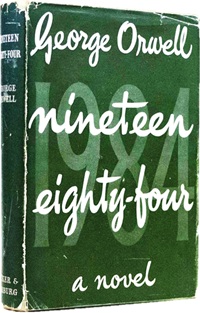
To a gentle correction on my part my friend got back to me with this polite response: ‘Thank you, Alan. But I personally do believe the media (particularly tabloid) hold massive sway over the lower classes in recent history and currently.’ We left it there.
In fairness to my friend’s opinion, it is prevalent and not without credibility, and if he cannot legitimately claim the parallel he desired, it is also true to say that our real, post-Nineteen Eighty-Four world is unlike that of the novel in important respects, with votes for the proles, for one thing, and media access for all. Nevertheless, the idea that the novel describes a world where the minds of the masses are directed and controlled by a remote elite is rather on its head; it is actually about the ruthless maintenance of ruling party fictions unified around a non-existent tyrant. If we are looking for modern day comparisons, Auntie Beeb is surely closer in equivalence to Big Brother, in terms of its power, position and influence, than are the tabloid newspapers of dwindling circulations or GB News.
Such misconceptions are not confined to ordinary bods who perhaps failed to pay attention in class. In fact, I fear to inform you that I have discovered even more wayward misreadings of Orwell among literary people who lay claim to some authority. My principal example of this is painful for me to recount; painful because the main protagonists are kind gentlemen who have been friendly and supportive of me, in times past and times more recent. I can only hope my criticisms here can be taken by them in good sport, and if it turns out that I am as wrong as I claim they have been, I will be happy to have my arse served to me upon a plate, and pass the salt.
Recorded in a mood of deep post-Brexit dejection at the Port Isaac Festival in the same year that that statue went up at the BBC, the Backlisted podcast invited musician, songwriter and Orwell aficionado Billy Bragg to discuss The Lion and The Unicorn. Writer Suzy Feay was also in attendance. A few years after it went out, I listened back with keen interest and mounting amazement.
About eight minutes in, one of the hosts described the trajectory of Orwell’s career, during which he introduced two remarkable claims which went by with laughter and approval from the panel and audience. Here they are:
Claim 1: ‘…after the war he [Orwell] writes a book called Animal Farm, which becomes an international bestseller because Americans don’t understand it. [Laughter] It’s true! They read it as about the Soviet Union. It’s not about the Soviet Union.’
Claim 2: ‘…[Nineteen Eighty-Four] becomes a massive bestseller around the world … because Americans don’t understand it. [More laughter] Because people read it as a prediction of the future. It’s not a prediction of the future, it’s about the here and now, or the there and then.’
Now (pause for breath), we may admit that Animal Farm is not about the Soviet Union, but only in the same way that it is not about animals that can talk. It is a fable where exploited farm animals stage a revolt, take everything into collective ownership, run things for themselves as supposed equals, and it all goes horribly wrong… just like in the Soviet Union! To deny the allegorical reference of Animal Farm to real-life contemporaneous communism is daft. Why do the animals call each other ‘Comrade’, Comrade?
Claim number 2 is similarly frustrating. It’s not a prediction of the future? Well, not exactly: it’s a warning of what the future might hold, much as other dystopian fictions like Brave New World and ‘The Machine Stops’ have imagined, with some prescience, the shape of things to come. It cannot be denied that taken from the author’s 1940s perspective, Airstrip One represented Britain in the near future. The bedroom in Chapter 8 where Winston meets his lover in secret is ‘a pocket of the past’ littered with little relics of the time before Big Brother, including a decorative paperweight (a frivolity banned by the Party) and dog-eared magazines and yellowed newspapers from the 1930s. Outside, in the proles’ junk shops, Winston finds books by Scott, Dickens and Kipling. Nineteen Eighty-Four is set in the future; this is not an interpretation, it is what the title of the book and the story says.
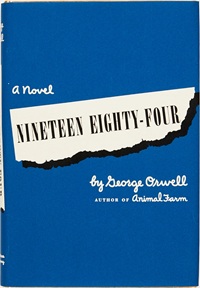
Of course, a story may be much more than what a story literally says, and so Nineteen Eighty-Four may indeed be about the here and now, and the there and then, and all sorts of other things. This is all fair game. Further on in the podcast, Billy Bragg went on to marvel that he appreciated the book differently with each new read, thinking it about ‘fake news’, the last time. Very well, sir. If you say so, sir! But please, podcast people, do not dismiss the most obvious meanings, in your search for more pleasing ones. Orwell, it is also rightly observed in the discussion, wanted his prose to be ‘transparent like a window panel,’ and so it is. That is what is good about his writing. It is clear and easy to understand. Kindly do not muddy his waters, or, to extend Orwell’s own metaphor, frost over the glazing.
Why does such denial of the obvious go on? For want of an alternative, I can only speculate on motivated reasoning. What else can it be? In my first example, it is clear that my friend wanted to recruit Orwell as an authority to locate the origin of right-wing working-class bigotry and ignorance. Similarly with our podcaster friends, they are keen to embrace Orwell as a good leftie like themselves, and want to direct the discussion away from any suggestions that Nineteen Eighty-Four, Animal Farm or any other works by Orwell have anything negative to say about their left-leaning selves.
To be fair to our panel, the left’s snooty disdain for patriotism, then and now, was fairly well noted and discussed. The famous line that an ‘English intellectual would feel more ashamed of standing to attention during “God Save The King” than of stealing from a poor box’ is read out approvingly by progressive patriot Billy Bragg, and ‘some in the audience’ are duly chastened.
But the desire to placate their disillusionment with the British Brexit voter was also strongly present. To achieve the desired effect, Bragg rather shamelessly passed over what Orwell said in The Lion and the Unicorn in favour of this passage from an obscure work called The English People.
The English will never develop into a nation of philosophers, they will always prefer instinct to logic, and character to intelligence. But they must get rid of their downright contempt for cleverness, they cannot afford it any longer. They must grow less tolerant of ugliness, and mentally more adventurous, and they must stop despising foreigners. They are European, and ought to be aware of it.
Cue much relieved cheering and applause. Hurrah for clever people! Hurrah for being European! Orwell belongs to Us!
Unfortunately The English People is obscure because Orwell disowned it. An illustrated book that attempted to see the English through the eyes of a foreign visitor during wartime, it was dismissed by its author as ‘propaganda’ and he refused to have it reprinted. What’s said in The Lion and the Unicorn is far less melodious to the remoaner. For instance:
The insularity of the English, their refusal to take foreigners seriously, is a folly that has to be paid for very heavily from time to time. But it plays its part in the English mystique, and the intellectuals who have tried to break it down have generally done more harm than good.
The attitude of the English to ‘foreigners’ depicted in The Lion and The Unicorn is one of disinterested disdain rather than hostility, which Orwell acknowledged to be ignorant, but which he considered understandable and usually harmless, even charming. It was, after all, an insularity born of life in a country where foreigners were not often encountered or noticed by most people, except by those sent abroad on behalf of King and country. Our soldiers, Orwell recounts, cared little for their French comrades in the First World War, developed no liking for wine or other continental ways, and our working-class chaps consider it effeminate to pronounce foreign words correctly. All this Orwell records as particular quirks of a distinctive national character.
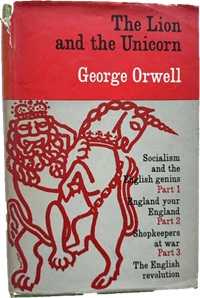
There is no mention of immigration in the essay, though no less than three points of his six-point socialist programme deal with the Empire and how we should redress our imperial legacy in India and elsewhere. Inward immigration was not a prominent part of national life in the 1940s, and Orwell failed to anticipate that it later would become so.
Orwell’s position, iterated over again in this essay and elsewhere, is that the cause for the English socialist revolution that was essential for our national survival was ill-served by an unpatriotic, effete left-wing intelligentsia who lived ‘in a state of chronic discontent with the existing order’. These he contrasted, interestingly, with the ‘Blimps’, the dutiful, narrow-minded patriots who had staffed our empire, armies and institutions, but whose days were now numbered. Antithetical but roughly alongside one other in the British class pyramid, both the Blimps and the unpatriotic lefties (come the post-war revolution) had to go.
The Bloomsbury highbrow, with his mechanical snigger, is as out of date as the cavalry colonel. A modern nation cannot afford either of them. Patriotism and intelligence will have to come together again.
It might have been a happy outcome, but sadly, it is one Orwellian prophecy that proved only half-correct. Indeed, it may be a case where half a loaf has proven to be worse than no bread, for though the Blimp class are now as rare as cockneys living within the sound of Bow Bells, their left-wing opposites are still entirely recognisable in the present day, and have run riot over the class territory once occupied by the slow-witted Blimps.
This is a point of contention, of course, and the left will likely postulate Nigel Farage as a modern-day Blimp. Perhaps, but even if he is, it’s surely all style and no substance, much like Keir Starmer waving a Union Jack. As for the left-wing march through our institutions, this contention is always going to be denied by the left, as opposition to establishment power is built into their very identity. They may claim credit for founding the NHS, but they will deny to the bitter end that they bear responsibility for any of its failures.
And so we come back to the central criticism that Orwell had of the left, which is the baked-in tendency of ideologues to deny uncomfortable truths that contradict the faith. This makes them hostile towards free thought and speech, and prone to a totalitarian mindset.
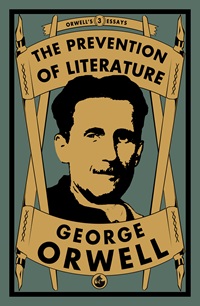
To get what Orwell had to say about this we must go back to ‘The Prevention Of Literature’. Written and published in 1946, it is perfectly positioned to express Orwell’s thinking between the writing of Animal Farm (1945) and Nineteen Eighty-Four (1948).
The essay concerned itself with political liberty and ‘the freedom to criticise and oppose’. Though he acknowledged ‘the press lords, the film magnates and the bureaucrats’ were the main obstacle to free speech in the present, the left were his long term concern: ‘on a long view, the weakening of the desire for liberty among the intellectuals themselves is the most serious symptom of all.’
This weakening was partly due to the prioritisation of collective consciousness over individual conscience:
For it is a peculiarity of our age that the rebels against the existing order, at any rate the most numerous and characteristic of them, are also rebelling against the idea of individual integrity. ‘Daring to stand alone’ is ideologically criminal as well as practically dangerous.
But in practical terms it was mostly because of a willingness, even the necessity, to dissemble and cover over for the greater purpose.
There can be no question about the poisonous effect of the Russian mythos on English intellectual life. Because of it, known facts are suppressed and distorted to such an extent as to make one doubtful whether a true history of our times can ever be written.
Though a champion for English socialism, he utterly rejected the totalitarian tyranny of the Communist Party in the USSR, and was appalled at a prevailing sympathy for Uncle Joe Stalin which radiated its influence into society far beyond a few party faithful. Examples of these suppressed and distorted facts of the pro-Soviet left he duly presented. Maybe his doubts about the possibility of a ‘true history’ are hyperbolic – history is perhaps ever thus, and distortions and lies can come from any side – but what troubled truth-telling Orwell most was not so much the lies as the willingness with which the left accepted their necessity.
The significant thing is not that they [lies] happen, but that, even when they are known about, they provoke no reaction from the left-wing intelligentsia as a whole. The argument that to tell the truth would be ‘inopportune’ or would ‘play into the hands of’ somebody or other is felt unanswerable’.
The kind of talk described here is fully recognisable in the present day, where we are routinely warned by our political masters and the media about the dangers of engaging in harmful ‘toxic debate’, whether it be about trans rights (‘no debate’), climate change (‘settled science’) or immigration and multiculturalism, which is best viewed always as an unmixed economic and social blessing, lest any questioning words of doubt or criticism be used to ‘stoke hate’.
It is for this reason that Billy Bragg surprised a few in 2020 when he said that Orwell’s words next to the BBC’s new statue made him ‘cringe‘ whenever he walked past it. For him, those words are not a defence of liberty but a demand for licence in a ‘war against accountability’ being waged by right-wingers, who have concocted the notion of ‘cancel culture’ to protect their spurious right to consequence free speech.
To whom should these right-wing trouble-makers be held accountable, we might ask? From the point of view of those trouble-makers themselves, the accountability which Billy Bragg speaks of is no longer to the Moscow Central of old, but to an amorphous political unity bound together by a collective faith in the prevailing raft of twentieth-first century progressive beliefs. These they keep afloat through education, media fact-checking, the war against misinformation, online safety and hate-speech legislation and all the rest of these rather Orwellian sounding instruments. According to their opposition, this new inner party of the great and good who run the show is called the Blob. According to the Blob, the Blob does not exist.
Billy Bragg is right that the BBC/Orwell quote is inappropriate for a national broadcaster, but not for the reason he gives. It is inappropriate because the BBC is full of people like him, who visit there often, who share the same political a prioris, and, if given the liberty to do so, will trot out the party line according to their preferences and prejudices whether their viewers and listeners like it or not. Writing according to one’s conscience is possible for the individual, but not for a collective. If the BBC sets itself up to be the conscience and voice of the nation it is bound to fail, because there is no such thing. It is a fiction, just like Animal Farm and Nineteen Eighty-Four.
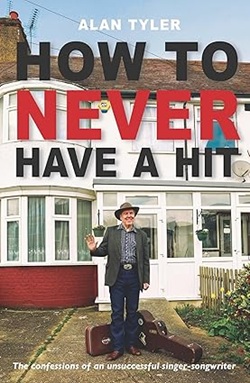
Alan Tyler lives in London and is the author of How To Never Have A Hit: the Confessions of an Unsuccessful Singer Songwriter
see also:
Discover more from Lion & Unicorn
Subscribe to get the latest posts sent to your email.
