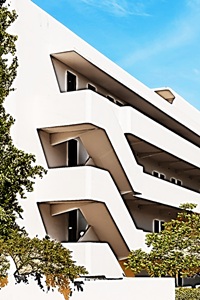
ALAN TYLER on modernism and spies in 1930s Hampstead.
I have a fascination and fondness for all things Hampstead, going back to my 1960s childhood. Visiting my great-grandmother in Holloway and later at her Sally Army old folks home near Kenwood, I remember the family singing ‘Down At The Old Bull and Bush’ whenever Dad drove us past the famous pub on the way, after which I would look longingly at the boys with their toy sailing boats on the pond near Jack Straw’s Castle, and daydream of highwaymen at the Spaniards Inn and of Dick Whittington and his cat looking down at the City from Highgate Hill.
A recent birthday outing took me on a wander about Hampstead once again, taking in a visit to the Isokon Gallery, a small museum located on the ground floor of the Lawn Road Flats, also known as Isokon Flats, the noted white, modernist four-storey block built not far from Belsize Park tube station in the 1930s.
In well laid-out displays, along with reconstructions of apartment interiors and examples of the futuristic furniture that went in them, the museum tells the story of the Isokon’s construction, the ideas which inspired it, the characters who inhabited it and its decline and renovation. It is all very clearly and frankly explained, and is pleasantly free of judgemental notes and ‘decolonising’ disclaimers found in other museums, probably because the building’s protagonists were paragons of progressivism, and thus above such criticism and contempt.
The flats were the fancy of Hampstead property-developers Jack and Molly Pritchard, made real – concrete indeed – through their association with a young Canadian architect, Welles Coates. The three shared a passion for the contemporary designs of Le Corbusier and the Bauhaus, with whom they had cultivated connections and studied.
Their project exemplified a new ideal: small utilitarian units with up-to-date modern appliances (built in fridges, cookers etc), free of Edwardian clutter. In their machine for living, unburdened from excess possessions, the renting tenants could concentrate on the important business of life itself. The majority of the apartments were ‘minimum flats’ where a single living space was separated from kitchen and bathroom by a space-age sliding door. There were a few larger apartments, with the Pritchards (who had bought the land) taking the penthouse with roof terrace when the project was completed. Though built and intended as serviced flats for busy professionals (with cleaning, laundering, cooked meals and even shoe-polishing provided by staff in residence), the Lawn Road Flats’ design anticipated a reinforced concrete future of social housing for the workers under post-Second World War socialism.
The opening of the Isokon building in 1934 coincided with turmoil in mainland Europe, and it soon became a refuge for leading lights of the Bauhaus movement in Germany, variously accused of ‘cultural bolshevism’ and racial impurity by the Nazis. Bauhaus group leader Walter Gropius, Hungarian artist László Moholy-Nagy and furniture designer Marcel Breuer all came to Hampstead under the wing of their friend Jack Pritchard, who made full use of his connections in high places on their behalf, a network which straddled the British establishment and the radical left intelligentsia (two camps not mutually exclusive, even then).
The Pritchards employed Breuer in the design of the Isobar, the elegant ground floor social club and dining space installed a couple of years later. Here and in the Pritchard’s penthouse (where space would allow them) Breuer showed off his reclining Isokon chairs, supreme creations of geometric balance, fashioned from plywood, the like of which I now long to acquire.
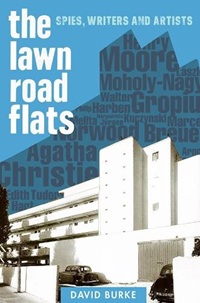
Along with the Bauhaus refugees came many notable residents through the coming years – crime novelist Agatha Christie being the most famous and Soviet spymaster Arnold Deutsch probably the most notorious. Mixed in among the creative intelligentsia, the Isokon was a magnet for communist activists and their fellow travellers in great numbers. David Burke’s The Lawn Road Flats: Spies, Writers and Artists, a book I bought in the Isokon Gallery, provides a fascinating study of these inhabitants, and how it was they came to be there.
Its creators may have had an eye to the mass social-housing provision of the future, but their forward-looking ideas failed to anticipate some that would gain ground later in the century. Principles of equal opportunities and of provision according to housing need were not much thought of (high-status refugee friends perhaps an exception). Rented out at reasonable rates they may have been (starting at £1 and 17 shillings a week), but in practice the flats were not usually for the ordinary Joe or Josephine.
In Flat 1 (to give an extreme example) was Eva Collett Reckitt, the Reckitt & Colman’s mustard heiress, who prospered not only from inherited wealth but also from the success of her bookshops in Charing Cross Road, Manchester and Cardiff. The 1930s saw a great boom in the market for radical books (Penguin paperbacks/The Left Book Club etc), and the Collett’s proprietor put the rest of her progressive energies into practice by assisting her comrades in Moscow when she could. The Isokon was a proto-council block for Hampstead’s intellectual and radical elites, bringing together people of similar status and sympathy.
The presence of Soviet spooks in remarkable numbers is the most eyebrow raising aspect of the Isokon story. Burke enumerates seven confirmed agents between 1934 and 1947, with twenty-five suspected sub-agents in residence or closely connected with it. The Pritchards’ willingness to offer sanctuary to highly educated Jews on the run from the Nazis, many of them committed communists, accounts for this in part, and the serviced, simply furnished flats were suitable for these transient figures who were apt to come and go.
Another factor was a house on the opposite side of the road, 12 Lawn Road, which was (by chance or not) also home to a covert communist cell: Jurgen Kuczynski and his sisters Bridgette and Ursula (codename ‘Sonya’). Photographer Edith Tudor-Hart (née Suschitzky), another Lawn Road luminary whose photos recorded the building’s construction and opening, was a Viennese communist with a fat MI5 file. It was she who introduced Jack Pritchard to Arnold Deutsch, securing him Flat 7, and she is also widely credited with bringing Deutsch and Kim Philby together, rather romantically, on a bench in Regent’s Park. Philby introduced Deutsch to four more of his like-minded Cambridge university chums, and together they did a thorough job of penetrating Britain’s bourgeois institutions and passing secrets to the Soviets on an industrial scale.
As the flats physically embodied so much that was brave and new, they were bound to attract those who put themselves in the vanguard of all that was revolutionary. With its minimalist, machine ethos, and disdain for private possessions, the Isokon was home to many who dreamed of a future liberated from the past. Walter Gropius looked forward to a time ‘where the propertied class has been expropriated and its influence and ideology largely destroyed’, and architect Welles Coates wrote of ‘a Future which must be planned rather than a Past which must be patched up’. ‘This is our century,’ wrote constructivist artist in residence László Moholy-Nagy: ‘technology, machine, socialism.’
What also brought its residents together, in a truly physical sense, was an ideology and appetite for sexual liberation. The Pritchards were enthusiastic practitioners of free love – pioneers in polyamory, you might say. Molly Pritchard had an extra-marital thing with Welles Coates, and husband Jack fathered a child with Beatrix Tudor-Hart (sister-in-law of Edith), a prominent member of the World League for Sexual Reform. Support for sexual health education, contraception, homosexuality and abortion also went with the territory. Nazis scorned such ideas as a threat to Aryan fertility.
At this end of the political spectrum, ideology and design had little thought and left little room for children. The Pritchards had a small annex for their boys, but for the most part this was a place for singletons where the patter of tiny feet was rarely heard; a social experiment which rehearsed the dwindling birth rates of the present day.
Living not far from the Hampstead home of Sigmund Freud, many Lawn Road residents flavoured their dialectical materialism with psychoanalytic theory. Arnold Deutsch (among others) was an admirer of Freud’s old colleague, Wilhelm Reich, and Burke goes to the trouble of summarising Reich’s thought as set out in his best known work, The Function of the Orgasm (1927). Like a few others in the psychoanalytic canon, this is a book I have had in my possession for many a long year without finding the patience to indulge it.
Reich’s studies (according to Burke’s account) suggested that mental illness is the result of pent-up sexual energy which must be relieved by orgasm. The theoretical gist is that release of dammed-up desire is the orgasm’s therapeutic function. Of course, we cannot expect David Burke to do justice to the depth and scope of Reich’s scholarship in just a page or two. His explanation may be simplistic, but it is sufficient for us to get the theory’s basic appeal. Whether a libertine like Casanova would have been better mentally adjusted than the Dalai Lama or the Venerable Bede is, I would say, open to doubt. Whatever its validity, we can certainly say that in Hampstead’s machine for living, some saw regular orgasmic release as the psychic equivalent of good modern plumbing.
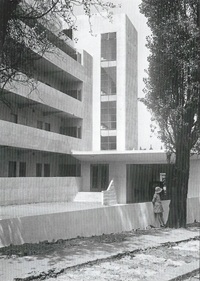
Breuer’s Isobar was one of the most attractive features of life in Lawn Road Flats. Renowned wine expert Tommy Layton was brought in as manager in residence when it opened, with culinary matters overseen by cookery writer and future TV chef Philip Harben, who a little later took on the whole shebang. It was a classy joint; a selection of international newspapers and periodicals were laid on, Viennese café style. ‘Reasonably-priced good wine’ was served, but the Isobar Wine Committee (I am pleased to learn) also saw to it that English beer was supplied on tap. Rowsham Ale from a traditional one-man brewer in Buckinghamshire was one of their refreshing selections – today’s microbreweries prove not to be so new. Special events in aid of popular left-wing causes were common: a ‘bowl of rice’ dinner was one such, with the likes of R. H. Tawney and Harold Laski invited to show solidarity with the Chinese peasantry. On other nights, members luxuriated on oysters and other treats. The onset of war and rationing must have put an end to the culinary highlife.
The Isobar was for members and guests only, with membership initially limited to 250, but the Half Hundred Club, also based at the Isokon, was an even more elite concern. Founded as a club ‘to combine good and imaginative dining with economy’ it had only twenty-five members who were allowed one guest at each event. Members took it in turns to plan and organise the dinners, which took place sometimes in the Pritchard’s penthouse and sometimes at more exotic locations like London Zoo. Members needed not only to be proposed and seconded, but ‘thirded and fourthed’ as well, and club rules also asked that proposing members should ensure candidates ‘possess no religious, political or other taboos or unsocial characteristics which may impede conversation’. The demand seems rather in conflict with the Pritchards’ commitment to ‘vigorous uncensored conversation’ claimed elsewhere in an Isokon Gallery display. Free speech for we but not for thee? The presumption that speech must be carefully cultivated and directed for it to be truly ‘free’ is nothing new.
A certain ‘bourgeois smugness’ was noted about the place by Alexander Foote, a more authentically working class comrade who came to Lawn Road Flats to be recruited by ‘Sonya’, and though some considered the restaurant prices reasonable, the view was not shared by one resident, trade unionist William John Brown, whose cantankerous complaint about the price of bacon and eggs Burke amusingly records in full. With my long background in the business of housing co-op committee meetings, I was further tickled to learn that Brown sat on a tenants’ committee alongside Bridget Lewis (previously Brigette Kuczynski). Both were thanked by Jack Pritchard for taking the time to do so, acknowledging that they had ‘more important things to do’ (i.e. organising strikes and espionage).
In 1946 the flats received (rather unkindly but only semi-seriously) an ‘ugliest building in London’ award. They had been painted a dark chocolate colour during the blitz, during which the Isobar had been used by some as a bomb shelter; the reinforced concrete above making it seem a safer place than most. It was during the war that Agatha Christie arrived, while her husband Max Mallowan was away doing intelligence work for the RAF.
Isokon-based covert activities continued after the war, but things gradually became less and less intriguing as the 1950s and 60s progressed. In 1969 the property was sold to the New Statesman magazine, who briskly sold it on at a considerable profit to Camden Council, dealings which attracted criticism in Private Eye. The on-site services faded away and management was farmed out to local estate agents Knights Frank & Co. Saddest of all, the Isobar was closed to make more flats.
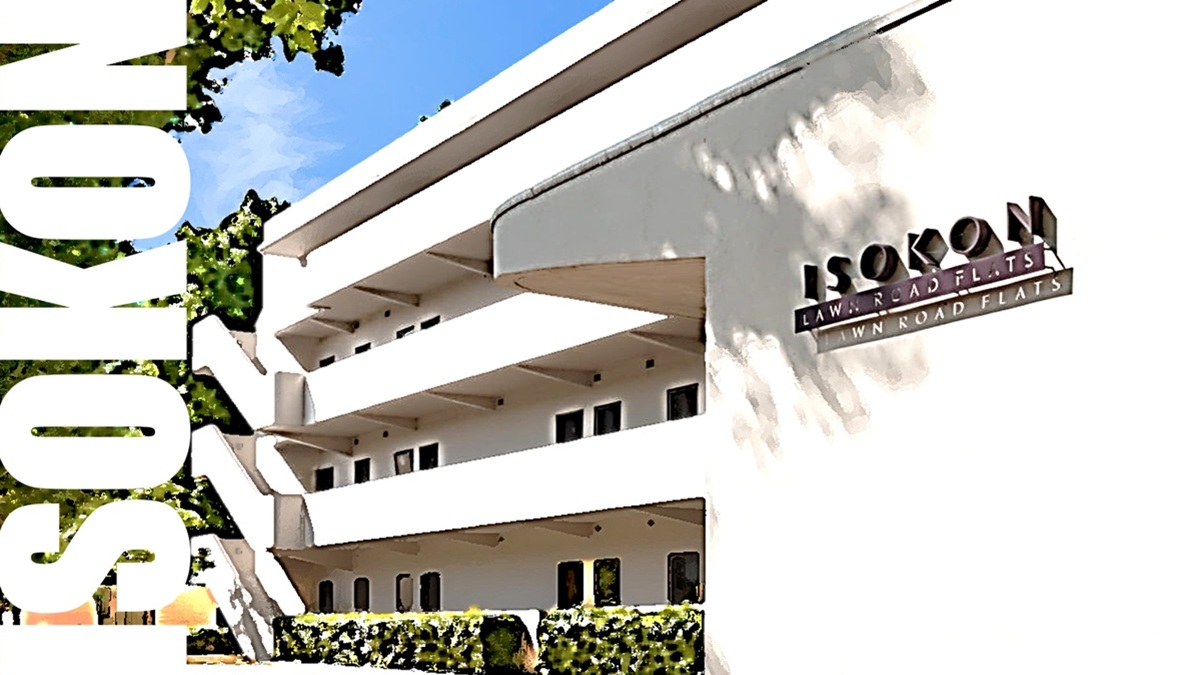
Photographs in the Isokon Gallery show that towards the end of the century the building had fallen into a dreadful state of disrepair (delays and cost cutting when it was built meant it had fallen short of the desired standard even then). The flats were rescued by a sale to Notting Hill Housing Association in 2001, who completely renovated it all and re-let some flats at ‘affordable’ rents to ‘key workers’.
Is there any place of multiple dwellings that can rival the Isokon for the social and historical significance of both its inhabitants and architecture? The Dakota in New York City boasts many more famous people, but does that grand building’s fabric contain and radiate a spirit of the age in the way Welles Coates’ creation has?
Isokon is a TV historical drama series just waiting to be made; a recreation of its modernist interiors, intercut with panoramic scenes of the Heath and Hampstead’s leafy environs, ought to make for a cinematic treat. Behind every door along the concrete balconies might be found a different character and episode. It is pleasing to imagine scenes of Soviet agents fraternising in the Isobar of an evening after a hard day’s espionage, with Agatha Christie playing bridge in the corner with her eccentric Marxist neighbour Vere Gordon Childe. It was never quite so; the different Soviet spy networks were run separately and discreetly, and their agents were not usually known to one another.
I have recounted much from Burke’s book here, but do not go assuming that I have picked out all that is most interesting. It is a study full of so much more remarkable history and anecdote, and it is very informative about the great world events of the day, within which the residents’ lives were so intriguingly set and intertwined. The book draws on a huge list of references and one is left with the impression that its multiple subjects could reward almost endless investigation.
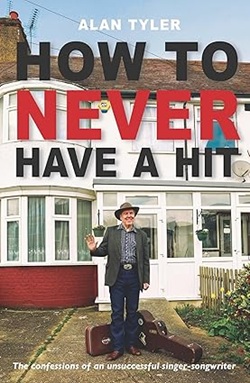
Alan Tyler lives in London and is the author of How To Never Have A Hit: the Confessions of an Unsuccessful Singer Songwriter
Discover more from Lion & Unicorn
Subscribe to get the latest posts sent to your email.
