
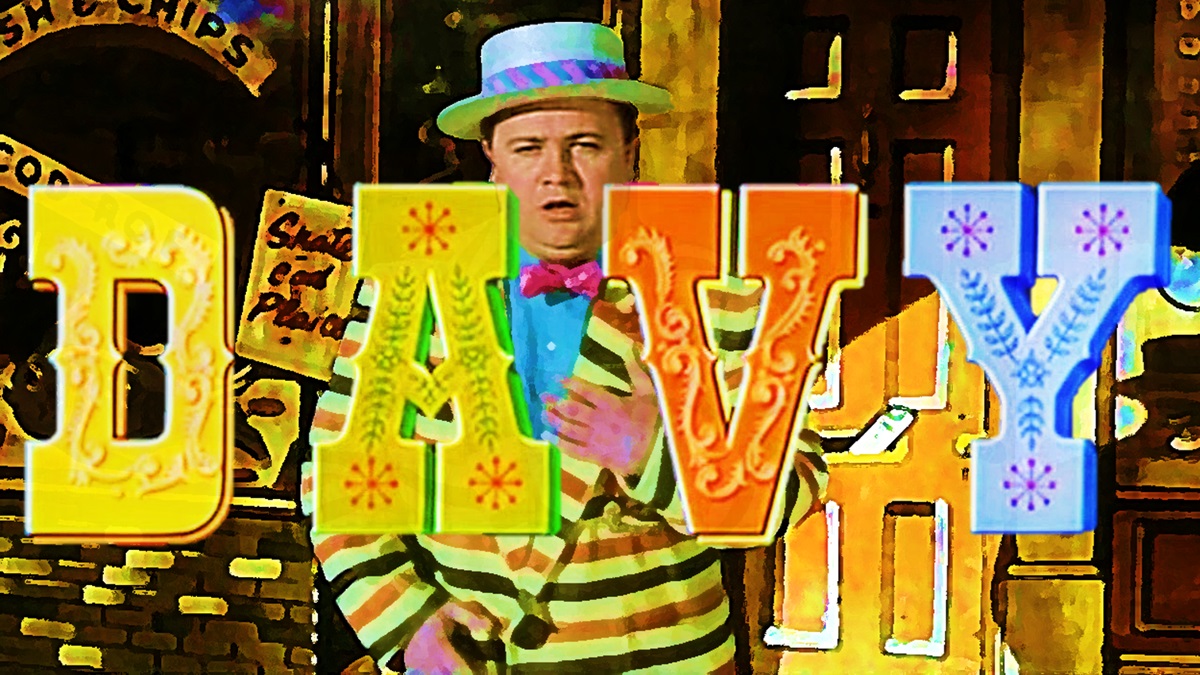
SIMON MATTHEWS watches Michael Relph’s 1958 film Davy.
Think of Ealing Studios and you think of a chunk of English film-making that stretches from the late 1930s to the Coronation of Elizabeth II, bringing together crowd-pleasing vehicles for Gracie Fields, George Formby and Will Hay with patriotic morale-boosting stuff made during the war. Their purple patch began with Hue and Cry (1947) and other sharply observational, satirical comedies like Kind Hearts and Coronets, The Lavender Hill Mob and The Ladykillers. The latter two won an Academy Award and a couple of BAFTA’s respectively, and led eventually to a co-production deal with MGM.
By the mid-50s the big name in British film comedy was Norman Wisdom, and Ealing put some effort into trying to replicate his success. In 1956 they gave Benny Hill a trial run in Who Done It? to very moderate results. About a year later, Michael Relph and Basil Dearden, the same team that made that film, were joined by scriptwriter William Rose, noted for winning a BAFTA for The Ladykillers and an Academy Award nomination for Genevieve (not an Ealing film), in Davy, starring Harry Secombe from the popular radio series The Goon Show.
The involvement of MGM meant shooting in colour, giving what we see on the screen a much less dated feel than most of Ealing’s other work. Which is perhaps a good thing, when the plot centres on something that so clearly belongs to a by-gone era: a five-piece family act (The Mad Morgans) struggling to make ends meet on the declining variety circuit.
Much of the film is shot in the Collins Music Hall, a noted London venue, situated on Islington Green, where packed houses rock with laughter at the antics provided by acrobats, performing animals and a drag act.
The Mad Morgans are led by George Relph, a noted stage actor with credits stretching back to 1909 and, coincidentally, the father of director Michael. He is downtrodden and a heavy drinker, leading Secombe, as Davy, one of his sons, to seek a way out, an opening in a more legitimate (and lucrative) part of the entertainment business.

His ability to sing – signalled early on, he does the film’s title theme ‘My World is Your World’ – provides a possible escape route and he duly lands an audition at the Royal Opera House, Covent Garden. But is he up to this? After almost fluffing his chance due to a bad attack of nerves, he sails through with a capable version of ‘Nessun Dorma’ from Puccini’s Turandot. No surprise really, given that he broke into the nascent UK Top 30 pop charts as early as 1955 with a cover of ‘On with the Motley’ from Pagliacci.
The drama revolves around whether he will accept the contract offered by the Royal Opera House, or stay with the family act, hoping that a TV slot, courtesy of Val Parnell might materialise. Secombe decides that he feels ‘out of place’ at the Royal Opera House. He rejects high culture and stays on the halls, accepting the desperate hand-to-mouth, week-by-week existence of touring variety acts.
Ealing were famous for their comedies, but this isn’t ‘funny’ – more a character study, steeped in a kind of homely melancholy. The milieu it portrays is of considerable archival value, the obvious parallel being Laurence Olivier’s tour de force as Archie Rice in John Osborne’s The Entertainer or even Reg Varney’s pathetic down-at-heel turn in The Best Pair of Legs in the Business (TV play 1968, film 1973). Davy was released in January 1958, but filmed the preceding summer. The timeline suggests that the script may have been written in the knowledge that Osborne and Olivier were about to unveil The Entertainer, the stage debut of which occurred in April 1957.
If that were the case, it didn’t accrue any of that production’s glory. Davy received moderate reviews and lost money. Ealing Studios ceased production a little later, and Secombe, unlike his fellow Goon Peter Sellers, did not enjoy a big film career. In truth, it’s easy to see why: his persona – not unlike that of Ken Dodd, swinging between manic comedy and really straight singing – was too tricky to package. Instead, he became a staple of Saturday-evening TV and Sunday-afternoon religious broadcasts.
Nor did the Collins Music Hall survive. It shut in September 1958 after suffering extensive fire damage. For years afterwards, its shell was used as a timber warehouse, the demands made for home improvements by the gentrification of the surrounding area saving it from complete destruction. Finally, in 1994, Waterstone’s rebuilt it as a bookshop. Davy remains an interesting curio, a study of a way of life that was about to vanish, and a reminder that Islington Green was once a dowdy, down at heel area.
from the maker of:

see also:

Discover more from Lion & Unicorn
Subscribe to get the latest posts sent to your email.
