In a series to mark Lion & Unicorn’s first decade, FINLAY McLAREN presents ten cultural artefacts from the last ten years, telling the story of where we’ve been, where we are, and where we’re going.
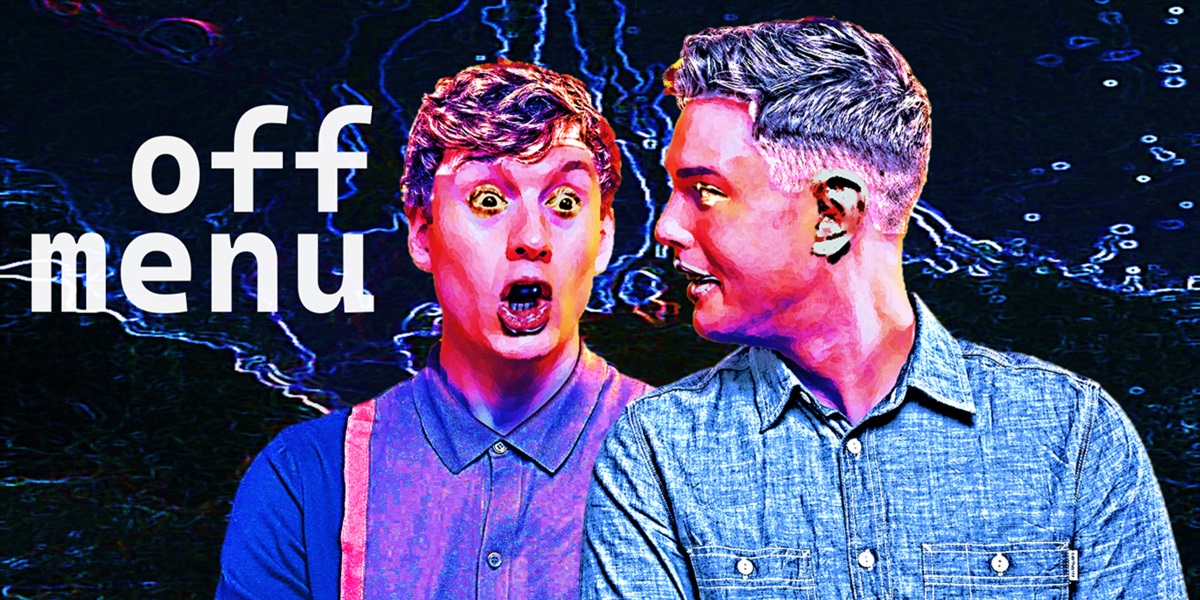
Since its debut in 2018,* Off Menu with Ed Gamble and James Acaster has evolved from a curiosity with a neat conceit into the poster child of Great British podcasting. Recently celebrating its 300th episode, the pod – that’s what the in-crowd call a podcast – consistently tops the charts, and has been downloaded nearly 200 million times.
Success has, inevitably, taken it out of the headphones and into the theatres. Off Menu has had a sell-out UK tour and a West End run at the London Palladium, while its upcoming residency at the Royal Albert Hall has been billed as the ‘biggest ever podcast run’ in the venue’s history. While this promotional tagline might read like a self-congratulatory pat on the back from Gamble and Acaster’s management team – because it is – with three of the five shows already sold out and the other two only added due to demand, it’s hard to argue with the hype.
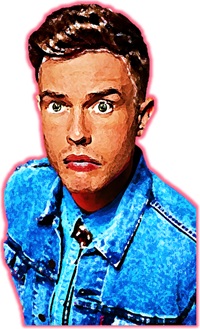
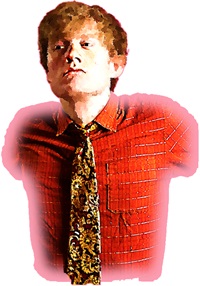
The podcast’s format is simple. Each week, one of the great and the good (or at least the notable and promotable) enters the ‘dream restaurant’ to assemble their dream menu, selecting their ideal starter, main and dessert. Gamble, who carries the vague air of a trendy vicar, presides as maître d’, while the worst girl you know’s favourite comedian, Acaster, acts as genie waiter, naturally.
But the dream restaurant, the dream menu and the genie waiter don’t really matter; Off Menu’s appeal isn’t in what Sara Pascoe wants for a main course (but it’s Wagamama) or Nicola Coughlan’s favourite place to eat in New York (Ivan Ramen, where else?). Instead the podcast centres on the comedy of digression and the warmth of recollection.
The whole thing is a rather flimsy framework for Gamble and Acaster – alongside Hollywood actors, Britpop icons and assorted stand-up pals – to go on tangents, riff, get into arguments and overdose on anecdotes. The result has made them the court jesters of the commuting class; a runaway success that always – in the words of every hack who has written a puff piece about the pod’s success – leaves listeners hungry for more. (Geddit? Coz it’s about food.)
Of course, it would be easy to criticise Off Menu, and indeed that’s what I’m going to do.
First, even the most dedicated fan has to admit that after 300 episodes, the format is looking increasingly frayed. Like a much-loved jumper, it remains cozy and familiar, but time has run its course, moths have nibbled the sleeves, and the fit is no longer quite so flattering. Part of this is due to the fact that the running gags are starting to limp. Acaster’s weekly shout of ‘Poppadoms or bread!’ carries all the same weary inevitability as the opening minutes of Casualty. Similarly, the ‘secret ingredient’ gimmick – wherein a guest is ejected from the dream restaurant if they mention that week’s forbidden item – still staggers on, despite having failed to yield any comic payoff across several hundred outings.
Second, the company of Gamble and Acaster has increasingly gained the air of perpetual houseguests who can’t take the hint. Gamble (whose blood type is ‘boiling’) rants and raves with all the energy of a coked-up stand-up (heaven forfend), which may be ideal for the stage, but is less conducive to finding out if Miriam Margolyes wants ice cream or custard with her sticky toffee pudding. Meanwhile, Acaster clings so tightly to ‘the bit’, that any possibility of insight slips away. This persona works well on his endless panel show appearances – so we’re told – but seems fundamentally ill-suited to long form discussion. Even after all these years the deepest enquiry he can muster is: ‘Cheesy garlic bread: yes or no?’
And yet, for all its arch-knowingness and forced bits, Off Menu manages that rare trick of making listeners feel as though they are at the table too. Gamble’s bluster, when not completely unhinged, steers conversations into unexpectedly funny corners, while Acaster’s style (that of a decade-long surrealist sulk) gives the whole thing a comic rhythm that feels uniquely theirs. At its best, the podcast sounds like Desert Island Discs in the style of anarchic 1990s TV; at its worst, it’s like being sat next to a stag do on an eight-hour flight.
Sadly, for all the hosts’ silliness, the guests rarely surrender to the chaos. Too often they retreat into PR-approved lists, seldom digressing or offering anything interesting to the conversation. This is why Richard Herring with his choice to drink from the Holy Grail, John Robins with his lament for discontinued crisps and Reece Shearsmith, who wanted to have his dream meal while sat in a bird’s nest, remain among the most memorable. They embraced the knockabout spirit of the conceit in a way that others, for all their celebrity, won’t.

Another problem with the guests is that many dine at upscale venues, far removed from the everyday experiences of the ordinary people who tune in. I’m no Bolshevik, but when another millionaire celebrity starts raving about their favourite North London pop-up, or bemoaning how commercialised The Ivy has become, I can’t help feeling like one of the sans-culottes hearing Marie Antoinette rank her favourite cakes.
Not that all this counts for much. The question ‘What has happened to the magic of [insert long running series here]?’ has been with us since Mrs Dale’s Diary relocated to Exton New Town. (No? Anybody? Suit yourselves.) And as the steady stream of talent agency-approved guests who patronise the dream restaurant shows no sign of abating, Gamble and Acaster would be unwise to heed my criticisms. In the end, those two extra nights at the Royal Albert Hall will sell out and soon we’ll be discussing the boys’ 400th episode. When you’re able to rope in guests like Jeff Goldblum, Paul Rudd and Florence Pugh, you’ve become an institution. Like a modern-day Parkinson but with more napkins and fewer sideburns.
Yet now here it is: we’ve come to the inevitable question – though one that all those breathless press profiles have singularly failed to ask. If this is supposed to be ‘new’ media, why all the old faces?
Old media is dying, there can be no doubt about that. Broadcast and print are both in their death throes. Over the last decade, literacy rates, listener numbers and viewing figures have all fallen away, getting smaller and smaller every passing day. Nowadays, the red tops are lucky to get a fish supper slapped on them, the radio is sat in the corner talking to itself, and Auntie Beeb has been put in a home.
But as old media has fallen, so new media has risen! New media is digital, on-demand and interactive. Think socials, streaming and podcasts.
If old media was a boat, it would be a cruise ship. A slow-moving behemoth, costing millions and favoured by OAPs. But new media is a speedboat, a swift, agile thing that moves faster, costs less and makes you look much cooler.
But look closer at this speedboat and you’ll notice that – although it looks different from the old cruise ships – the captain, crew and company are all the same.
In the first golden age of podcasting, the medium belonged to the outliers and obsessives – people with day jobs, dodgy microphones and a passion. But now the second age has arrived and it belongs not to the dreamers but to British entertainment’s already over-promoted and over-earning old guard.
Scroll the podcast charts today and what should have all the rambunctious energy of a drunken freshers’ week or a Peter Blake collage now resembles a Radio 4 schedule, or a drinks reception at the Groucho Club.
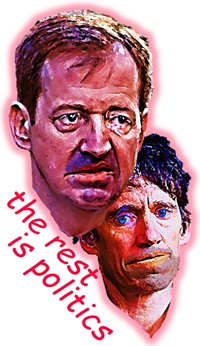
If you need an example, look no further than crisps salesman and pub bore Gary Lineker’s Goalhanger Productions and its ‘Rest Is’ empire, which dominates the charts and hoovers up ad revenue like a Dyson. The Rest is Politics gives you the FBPE Twitter takes of Captain Sensible Rory Stewart and Alastair ‘deployed in 45 minutes’ Campbell. The Rest is History lets Tom Holland and Dominic Sandbrook – both successful authors, constant columnists and occasional TV faces – repackage the same lectures they’ve already monetised a dozen times over. And worst of all: The Rest is Entertainment, where Richard Osman (he of the never-ending television formats and mountainous hardback sales) gossips about all things showbiz with Marina Hyde, patron saint of SW1 dinner parties – because of course the country was crying out for more content from those two (look to camera).
And we mustn’t let TV regular and three-time bestselling writer Acaster, or the BBC’s latest (and loudest) host Gamble off the hook. Off Menu has become just another destination on the celebrity publicity junket, slotting in nicely between the breakfast show on Radio 2 and Graham Norton’s sofa in the evening.

But these people didn’t need podcasts. Ed Gamble and James Acaster didn’t need one. Richard Osman didn’t need one. Alastair Campbell certainly didn’t need one. They already had publishing deals, West End runs, stand-up tours, six-figure speaking gigs, TV panel appearances and more broadcasting slots than they knew what to do with; they didn’t need podcasts because they didn’t need another opportunity to be heard. For the professional chattering class, podcasts are just another revenue stream, another way to keep their names at the top of the algorithm, another way of feathering their retirement nest. It fills the downtime between BAFTA invites.
Meanwhile the smaller pods – the indies, the up-and-comers, the weirdos with a dream – are all drowned out. They’ve got no real chance of competing with the ‘Rest Is’ industrial complex and its glossy PR machine, busy trimming clips for TikTok and YouTube shorts.
It reminds me of when megastar Kylie – with the help of hit-makers Stock, Aitken & Waterman – crashed into the promised land of jangly guitars and scratchy fanzines: the indie charts! But at least then the other nine entries weren’t taken up by Rick Astley and Jason Donovan. The Smiths and Felt still got a look in. But on the podcast charts of today, if you don’t have a management company backing you up or an already inbuilt audience, good luck.
And please spare me the TED Talk about the free market. Yes, these are ‘polished professionals’, and yes, ‘the public likes them’; but of course they do, these ‘podcasters’ are already famous. Therefore, they’ve already won. The indie podcaster, by contrast, is busy trying to work around childcare, day jobs and temperamental laptops just to push out an episode. The playing field isn’t just tilted, at this point it’s practically vertical.
And so, in the end, this isn’t really ‘new’ media at all. It’s the same faces, the same anecdotes, the same cultural chokehold, just on Spotify instead of the BBC. A gerontocracy with AirPods in.
Yes, I know the indie shows keep going. They keep going because they love it and because they actually care. But that faint glimmer of opportunity has been replaced by the flamboyant glare of a marquee sign. A medium that was supposed to be underground has been dug up, embalmed, and wheeled out at the Royal Albert Hall. And that’s not right, it’s not what podcasting promised, and it’s not good enough.
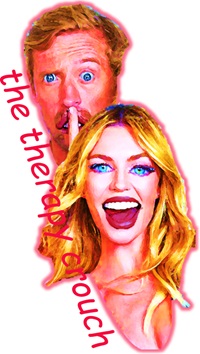
So, by all means, enjoy The Therapy Crouch, where a millionaire footballer and his wife monetise their boring marriage; or The Diary of a CEO and the joys of a CEO explaining why being a CEO is actually very hard (while sitting in a £3,000 chair); or Shagged Married Annoyed which somehow turned bickering into a business model. Go ahead, tell your friends all about The News Agents, and how BBC alumni built a carbon-copy of their old workplace and called it innovation; or Parenting Hell, with its tales of raising children hosted by people who can afford nannies. Then tune into The Louis Theroux Podcast, where Louis Theroux talks to the same celebrities he already talks to on telly; or if not that, maybe David Tennant Does A Podcast With, where a household name, famous since 2005, with a contacts list longer than the Domesday Book, does half-hearted ad reads with his nepo sweetie wife.
But remember: they don’t need your attention, your Patreon fiver, or your subscription. They have TV deals, book tours, arena shows, publicists working full-time to keep their faces on your TV screen, and now – because their management teams have identified ‘audio content’ as a growth area – they’re on your RSS feed too. You’re not listening to the scrappy outsiders – the people who first made the space and who would actually benefit from your support – but to cultural landlords who now own the space.
If this monopoly continues, then when the history of podcasting comes to be written it won’t be about a brave new medium and the people who carved something out of nothing. It’ll be about the people who already had everything and wanted more.

Shame on them.
If you really care about podcasts, then don’t just line Gary Lineker’s pockets. Seek out the people who actually need it. Share them, review them, mention them to your friends. It really makes all the difference.
For Lion & Unicorn readers I can wholeheartedly recommend John Rain’s comedy commentary circuses Smersh Pod, which focuses on Bond (and Bond related-ish) films, and A Wheezing Groaning Sound, where John Rain, Paul Litchfield and Tom Neenan giggle about Doctor Who. Goon Pod, hosted by Tyler Adams and focusing on projects involving any and all of The Goons, is also a joy, as is I am the Eggpod, a now ex-podcast about all things Beatle. Or for those of a more political bent there’s Since Attlee and Churchill, with Lee David Evans and Richard Johnson, which delves into post-war British politics with aplomb. A recent episode with Conservative party historian Dr Mark Garnett about working with Ted Heath was a particular joy.
These are the kinds of creators who built podcasting, who keep it alive, and who’ll vanish unless listeners step up. Otherwise, it’ll be the same old faces and the same old stories. And then the rest really will be history.
As Britain stumbles through its ongoing political and cultural malaise, the story of Off Menu reads like a microcosm of the wider national condition.
Politically, Britain has spent the past decade trapped in a cycle of underperformance and indecision. Policy missteps, Brexit fallout and a chronic inability to invest strategically (or even to invest at all) have eroded living standards, and a general feeling of drift has settled over the nation. Like all those carefully managed celebrity pods filling the charts, the machinery of governance churns away, polished and professional, but largely serving the interests of those already in power, rather than fostering any real progress.
Culturally, younger generations face precarity and limited opportunities; grassroot venues are closing, TV commissions are scarce, and every new space, from podcasts to Substack, is haunted by the ghosts of old media, crowding out innovation and fresh voices. Off Menu exemplifies this perfectly: it is framed, packaged, and marketed by an industry that favours the already successful, leaving the true creative adventurers, struggling to be heard. The result is a culture quietly and persistently stagnating.
If our nation is to escape this slow drift, it will require new ideas, new voices, and even new spaces. James Acaster and Ed Gamble were the future once, now it’s somebody else’s shot. But if we don’t take the leap and start innovating, from the podcast studios to Westminster, we may find ourselves applauding the same old performances while the real potential of Britain quietly withers in the wings.
* Off Menu was first released on 5 December 2018, but ran throughout 2019 and therefore counts as a cultural artefact from that year, coz I say so. Anyway, you’re not even my real Mother!
previously in Decade:
and coming soon…
Discover more from Lion & Unicorn
Subscribe to get the latest posts sent to your email.
