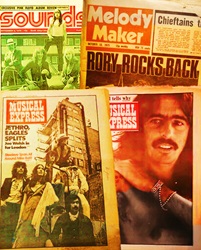
BEN FINLAY guides us through his ten favourite British albums of 1975.
A playlist of selections from these albums is available on YouTube.
For this next top ten, I’ve changed format from genre to looking at an individual year. Neatly, it’s fifty years since 1975, and as there were many landmark albums released then, I thought it interesting to again formulate a personalised list of (some) of the lesser-known titles of the year, rather than the rightly lauded, but familiar favourites. It would feel too ‘easy’ to include them, and more importantly, an opportunity would be missed to highlight a more obscure, but just as worthy choice.
Recently, the music of ’75 has been reconsidered by Dylan Jones, in his book 1975: The Year the World Forgot. Jones’s argument – and one that I largely agree with – is that 1975 was the apotheosis of sophisticated, mature rock music, and a year that was rich with masterpieces; of the British albums he essays, Bowie’s Young Americans and Led Zeppelin’s Physical Graffiti (both in my collection since I was a teenager) are included, alongside The Who by Numbers by The Who, and A Night at the Opera by Queen. All fine titles and huge sellers, but they’ve been written about many times before.
Like Jones, I see ’75 as a highpoint, but not necessarily through the same records. Aside from one massive selling album on this list, perhaps my tastes are (sometimes) less ‘mainstream’ rock, and more on the margins. And maybe some of the choices on offer here are slightly after their individual style had peaked. For instance, although prog had reached its apex around 1973, there was still much to enjoy; its ‘golden age’ may have been drawing to a close, but it went out strong with albums such as The Rotters’ Club and Wish You Were Here.
Similarly, folk rock’s innovation may have been on the wane, but artists such as Richard and Linda Thompson and John Martyn were at a highpoint in their careers. And British jazz, by now long past its 1960s creative apogee, still saw records of the calibre of Citadel 315 being released. The creativity in the music offered here is superb, and if things were on the cusp of change, the need for that shift may not have applied to these acts.
So, the genres covered in my previous top tens – British jazz, folk rock and prog – are all here. The British blues boom, long over by this time, has its legacy represented by the blues-tinged fusion of Jeff Beck’s Blow by Blow, and in David Gilmour’s emotive guitar work on Wish You Were Here. And there is something new that points to the future: ambient music, via Robert Wyatt and Brian Eno.
Musically, there’s always been a sound about ’75 I like. Maybe it’s the sophisticated end of the hippy period; just the right amount of production and sheen, the electric pianos, new synths, better guitar tones through more advanced amps and pedals, and drums dampened as the antithesis to the ridiculously huge 1980s whomp I grew up with. Whatever it is, I still (only half) jokingly refer to 1975 as my musical cut-off point.
Anyway, as ‘they’ say, enough of my yakkin’, let’s travel back fifty years and consider my Lion & Unicorn top ten albums of 1975. Bring along your flares and cheesecloth shirt – it might be your last chance to wear them.
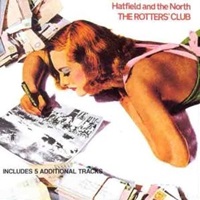
10. Hatfield and the North, The Rotters’ Club
The Rotters’ Club is the second of just two albums by Hatfield and the North, and to my ears, their best work. The band was formed in 1972 by Richard Sinclair (ex-Caravan), Phil Miller (ex-Matching Mole and Delivery), Pip Pyle (ex-Gong and Delivery) and Egg’s keyboard wizard Dave Stewart. They were later joined by the vocal harmonies of Amanda Parsons, Barbara Gaskin and Ann Rosenthal, which provided a highly original sound.
Their debut album is a brilliant rich amalgamation of the individual artists’ talents, but it is The Rotters’ Club where they fully developed their style, the apex of the ‘Canterbury Sound’ and a masterpiece to boot. Side two’s ‘Mumps’ is a glorious twenty-minute piece of instrumental dexterity and appealing melodies, and is eclectic as can be. Furthermore, the whole record is completely British sounding and couldn’t have been produced anywhere else.
Author Jonathan Coe is clearly a fan, the album’s title inspiration for his 2001 novel of the same name, which was later adapted for radio and then a three-part BBC television series. Brilliant.
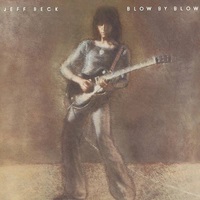
9. Jeff Beck, Blow by Blow
In my top ten British Blues albums I included Beck’s debut album Truth, a ‘whomping chunk of Blues-Rock that draws from all before it and looks to the future’. That may well have been true for a short while, but it didn’t look forward seven years and see this coming.
Blow by Blow was Beck’s fifth album as a leader, his first all-instrumental record, and was light years away from 1968. It also presented a distinct move away from his more previous rock-orientated LP’s, towards a funky, sometimes bluesy jazz fusion style. Produced by George Martin no less, it still sounds wonderful and includes a great cast of musicians featuring keyboard great Max Middleton.
Furthermore, Blow by Blow sees Stevie Wonder contribute ‘Cause We’ve Ended as Lovers’ (which here Beck dedicates to guitarist Roy Buchanan) and ‘Thelonious’, with Wonder on uncredited clavinet. Beck’s playing throughout the record is supple, fluent, sophisticated and has an extraordinary dynamic range. Overall, this is a fine album, which has proved to be influential on the world of instrumental rock and a testament to just how far one former British blues artist came in a few years.
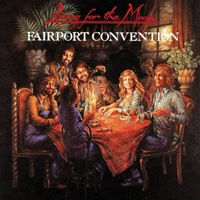
8. Fairport Convention, Rising for the Moon
The first thing that drew me (at the age of thirteen) to Rising for the Moon was the sleeve, its cover suggesting a folksy bonhomie between a bunch of travelling gypsies. Singer Sandy Denny sits dealing cards as the band watch on, backlit by the light of a silvery moon outside beyond the drapes and elegant window.
This was the band’s tenth studio record. The ever-changing line-up now included three Fairport stalwarts, Dave Swarbrick, Dave Pegg and Dave Mattacks, with Sandy Denny (re-joining in 1974, after first leaving in 1970) and two members of Denny’s post-Fairport band, Fotheringay – Denny’s husband Trevor Lucas and guitarist Jerry Donahue. This led the band to jokingly refer to itself as ‘Fotheringport Confusion’.
Rising sounds a little different to the band’s previous records. Produced by the already legendary Glyn Johns, there is a certain rock sheen to the album, without the strings heard on Denny’s solo recordings, and no traditional material. For Sandy’s vocals and Donahue’s excellent guitar playing this sound really works. Indeed, the outro to the gorgeous eight-minute ‘One More Chance’ is superb, Johns pulling a strong performance out of the group as a whole; elsewhere, as on ‘Restless’, they sound more like a West Coast acoustic-based act, the band’s former thundering rough edges smoothed out.
They considered it to be their ‘make or break’ album, but despite positive reviews (‘their best for six years,’ said the Guardian; ‘it ought to re-establish Fairport Convention as a significant British band’), Rising entered the chart on 12 July 1975, and stayed just one week, reaching only 52. Fairport’s hopes were dashed, and Denny was particularly disappointed. Drummer Dave Mattacks had already left during the sessions, to be replaced by Bruce Rowland, and in December 1975, after touring in support of the album, Denny left too, as did Donahue and Lucas.
This brought to the end this brilliant short-lived line-up. Who knows what success may have brought? One cannot be certain. Anyway, there is something ‘un-Fairport-ish’ about big success. Nevertheless, Rising is a fantastic album, with plenty of great songwriting and musicianship. So, I urge you to dust off your copy, wait for sundown and put it on; begin the rising of the moon.
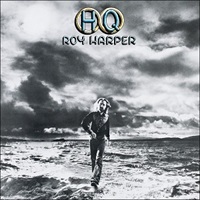
7. Roy Harper, HQ
Harper’s eighth studio album is a powerful offering, including some heavy friends – the Floyd’s David Gilmour on guitar and Zeppelin’s John Paul Jones on bass – guesting on opener ‘The Game’. Gilmour and Jones had appeared on stage with Harper at Hyde Park in 1974, and of course he is linked with both bands (Zeppelin featuring the song ‘Hats Off to Roy Harper’ on their third album, Roy singing the lead vocal on ‘Have a Cigar’ from Wish You Were Here – more on that later). Other notable musicians on HQ include Chris Spedding on guitar and ex-Yes and King Crimson drummer Bill Bruford.
A rockier record than Harper’s previous offerings, HQ could be described as progressive folk, but it still resounds with his wit, originality and skill. ‘When an Old Cricketer Leaves the Crease’, one of Harper’s best-known songs, features the Grimethorpe Colliery Band, and is a hymn to mortality which BBC DJ John Peel insisted should be played in the event of his death. Harper himself considers HQ as ‘a great album, made at one of the best times of my life.’ And he’s right you know, it’s superb.
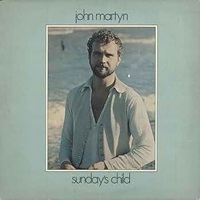
6. John Martyn, Sunday’s Child
Martyn’s follow up to 1973’s trippy Inside Out is a more focused, direct song-based work, as evidenced in titles such as opener ‘One Day Without You’, ‘Spencer the Rover’ and ‘My Baby Girl’ (dedicated respectively to his children Wesley and Mihariri).
The record sees Martyn far from home, apparently missing domesticity, but the truth was that his family life was falling apart; a fact that wife Beverley attested to later. Still, there is some of the jazzy reverie heard on the classic Solid Air, exemplified by the stoned swing of ‘You Can Discover’, a beautiful twilight evocation of the ‘real John’, before closer ‘Call Me Crazy’ reveals the duality of his personality.
If privately life was proving difficult, musically 1975 would be somewhat of a peak for Martyn. The self-released Live at Leeds demonstrated John (accompanied by bassist Danny Thompson and free jazz drummer John Stevens) pushing the envelope far beyond anything imaginable by a ‘folk’ artist. Next, Martyn would spend time with Lee ‘Scratch’ Perry in Jamaica, working up material for the echoplex-laden masterpiece One World, released in 1977. Sunday’s Child is sometimes overlooked in his 70s canon but is a mature and complete work that deserves a reappraisal.
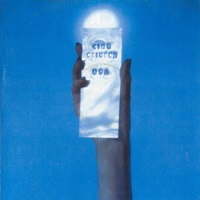
5. King Crimson, USA
If Red (1974) provided a stunning climax to the 70s Crimson studio work, USA is an intense finale to their live performances. Recorded live in Asbury Park, New Jersey (home of Bruce Springsteen, who would ‘break through’ in ‘75 with the massive Born to Run) the album provides a glimpse of the band in all their incandescent glory.
It is a favourite of comedian Vic Reeves, a big prog rock fan, who used to take the record to a pub in Darlington in the late 70s, asking the DJ to play it during a requests evening. Of course, it would get pulled off after about three minutes, Reeves responding ‘but it’s just getting to the good bit!’
The 2002 CD reissue of USA ends with ‘Starless’, its dark live performance dispensing with the studio version’s sheen, the final few minutes threatening to blow up one’s speakers if it peaks any higher. The long applause at the close of the track (and the album) continues the relentless heavy atmosphere even after the band have finished playing. There was simply no one like King Crimson.
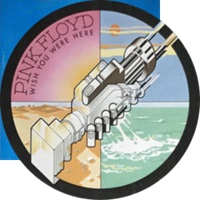
4. Pink Floyd, Wish You Were Here
I’m allowing myself this far more obvious, huge blockbuster on the list because it is superb and as you may know from my prog top ten, I’m just a bit of a Floyd fan. This album, the difficult follow up to Dark Side of the Moon, has of course been hugely reviewed, written about and discussed etc. And while I might not have much more to add to the conversation and legend of the record, I do have some of my own observations to impart.
Firstly, this is the last Floyd album where the band collaborate, before Roger Waters fully takes over and is the finest recorded work of David Gilmour, and particularly of Richard Wright. Secondly, I see it as the definite end of the 60s counterculture – Wright’s refrain of their early hit single ‘See Emily Play’ as ‘Shine on You Crazy Diamond’ fades signalling a goodbye to founder Syd Barrett and the spirit of 1967.
Lastly, the steady 6/8 slow blues groove of ‘Crazy Diamond; sees Gilmour’s guitar have a touch of Peter Green (another fallen 60s acid casualty) about it. The Floyd’s music is losing its psychedelic, experimental edge and harking back to the Brit blues boom just a few years hence. Indeed, in the fabled stories of when the overweight, shaven-headed Barrett visited the band at Abbey Road during a playback of the track, the former frontman was asked what he thought. Barrett replied, ‘it sounds a bit old.’
Syd may have a point; the man who named the band after two obscure Georgia bluesmen, he knew a blues when he heard it. However, Waters lyrics for the track – and indeed throughout the album – are finely crafted and poignant. ‘Have a Cigar’, his savage takedown of clueless record executives (‘by the way, which one’s Pink?’) is delivered with sarcastic relish by the aforementioned Roy Harper.
A massive selling record, that managed to convey absence and loss. The band’s members were so anonymous then that they still could walk unidentified through the crowd from the mixing disc to the stage. One of the few bands that went ‘overground’ whilst still acting ‘underground’, WYWH is a melancholy requiem for what came before.
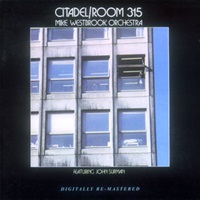
3. Mike Westbrook Orchestra, Citadel/Room 315
In my top ten British jazz albums, I included Metropolis, Westbrook’s ‘ambitious suite, based on his impressions of first visiting London’ that featured ‘a virtual who’s who of the then London jazz scene’. Similarly, Citadel/Room 315 continues in that vein, but is a more tightly focused, sometimes even funky affair that also incorporates some Ellingtonia and lyrical moments, as evidenced in my track choice, ‘Tender Love’, ‘A View From the Drawbridge’ and the haunting ‘Outgoing Song’, which was used as the intro music for BBC Radio 3`s ‘Jazz Today’, presented by Charles Fox. Of note is featured soloist, John Surman, who plays spectacularly throughout, as indeed does the whole nineteen-piece ensemble.
And as with Metropolis, the album is housed in a handsome sleeve, Citadel/Room 315 somewhat reminiscent of the cover of J. G. Ballard’s dystopian novel, High Rise, published the same year. Although it comes near the end of the ‘golden age’ of British jazz, it is a superb record that still sounds fresh and inspiring today. A classic of the genre, and an unsung classic of ‘75.
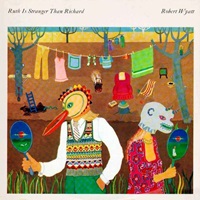
2. Robert Wyatt, Ruth is Stranger Than Richard
Wyatt’s 1974 classic Rock Bottom (produced by Pink Floyd drummer Nick Mason) was embraced by the critics and fans alike. On this album, Wyatt stays with a similar jazz-rock approach, accompanied by a stellar team, but produces a very different record. Noticeably, he includes songs co-written by the Roxy Music’s Phil Manzanera, Soft Machine’s Hugh Hopper and Henry Cow’s Fred Frith, while Pink Floyd’s Nick Mason produces just one of the tracks (Brian Eno also guests).
Where Rock Bottom had a cohesive, dreamlike quality throughout, RISTR is a game of two distinct halves; side one is made up of avant-garde tracks, often with Canterbury-style absurdist humour, while side two is jazzier in tone, culminating with Charlie Haden’s ‘Song for Che’. For me, the best track is the wonderful ambient ‘Solar Flares’. Wyatt is such an individual, creative talent there was no one like him in ‘75 – or any other time for that matter.
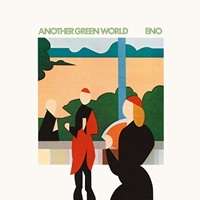
1. Eno, Another Green World
Eno gave us all a bit of paper, and we made lists from one to fifteen. Eno said ‘number two, we all play a G; number seven, we all play a C sharp’ and so on. So, it was like painting by numbers… He used to love me and Percy (Percy Jones, bassist in Brand X); we’d go in and run through our dictionary licks and he’d record them and make a loop of them.
Phil Collins, drums on Another Green World, talking about Eno’s ‘Oblique Strategies’ card system.
This is the album that I came latest to on this list, although I realized that I’d heard the title track since the 1980s as it was the theme for BBC2’s Arena. Another Green World is Eno’s first full foray into artful, ‘ambient’ music, and although it sold poorly at the time, has proved to be hugely influential. Centred on a small group comprising of Robert Fripp (electric guitar), Phil Collins (drums), Percy Jones (fretless bass), and Rod Melvin (piano), the musicians utilize a highly original approach to arrangements and use of technique, inventing a new language and terminology for individual instruments. For example, Fripp describes ‘snake guitar’: ‘the kind of lines I was playing reminded me of the way a snake moves through the brush, a sort of speedy, forceful, liquid quality’. Another example is that of “Leslie piano” – an acoustic piano fed through a Leslie organ speaker.
AGW can also be seen as Eno’s departure from the experimental song/lyric-based rock of previous albums Here Come the Warm Jets and Taking Tiger Mountain, with only five of the fourteen tracks containing vocals. The move towards Eno’s future ambient instrumental work starts here, as does the impressionistic, ‘paintings as music’ approach. Indeed, the whole package exudes artful sophistication, the cover art a detail from British artist Tom Phillips’s After Raphael.
Experimental yet accessible, AGW looks to the future, and is a highly listenable, deeply sensory experience; an album that uses the studio in a completely original way, producing an ambient, truly progressive record that is packed full of emotion and beauty. And, on a personal note, I managed to get Phil Collins (one of the finest British drummers, ever) in at number one. It’s the small victories that count sometimes.
bubbling under:
Van Der Graaf Generator, Godbluff
Henry Cow, In Praise of Learning
Steve Hillage, Fish Rising
Hawkwind, Warrior on the Edge of Time
Graham Collier Music, Midnight Blue
see also:
Discover more from Lion & Unicorn
Subscribe to get the latest posts sent to your email.
