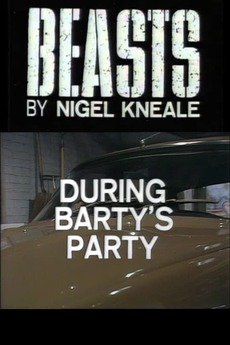
In our series celebrating individual episodes of British television, FINLAY McLAREN stays at home for Nigel Kneale’s ‘During Barty’s Party’ (1976).
There’s a small group of people in the middle of nowhere. Isolated and cut off, with no way out. An atmosphere of tension and dread settles over proceedings as our protagonists realise that they’re not alone. There’s something outside. And it’s trying to get in…
These are some of the traditional trappings of televisual horror; those programmes which seek to scare and shock blood-thirsty teenagers and give courting couples on the settee an excuse to hold hands. Think, the Roald Dahl-fronted anthology series Tales of the Unexpected (1979–88), tea-time folk horror Children of the Stones (1977), or the annual Ghost Story for Christmas (originally 1971–78).
But if you go down to the woods today you’re sure of a big surprise, because these trusty tropes have been traded in for the higher pleasures of sad families sat at dinner tables, thematic depth and, worst of all, pretensions to art. For we live during the rise of ‘elevated horror’.
Elevated horror is the latest trend to grip the genre, imported from Hollywood and typified by such series as: Mike Flanagan’s Netflix hits The Haunting of Hill House (2018) and Midnight Mass (2021), Auntie’s Red Rose (2022) and Shearsmith & Pemberton’s occasional forays into out-and-out horror in their dark comedy anthology series Inside No. 9 (2014–24). These programmes all attempt to raise the standard – and industry standing – of horror TV by shifting focus from the genre’s trad operating procedures to higher production values, a subtler sense of terror, and an emphasis on social commentary.
While this approach has proven successful in terms of critical appraisal and viewing figures, it has a limiting effect on the programmes themselves. Traditional horror presented monsters that could be taken as metaphors for any number of things, but even in a genre not renowned for subtlety, elevated horror is less backwards in coming forwards, consisting instead of films and series that insist they be seen as metaphors for only one particular discontent.
Mike Flanagan’s work deals squarely with the 21st-century pastime of examining one’s own trauma, while Red Rose is explicitly about the digital age, ala Black Mirror (2011–25). Similarly, Inside No. 9 spine-chiller ‘Wise Owl’ offers no room for interpretation: it’s a blatant confrontation with child sexual abuse in the wake of Operation Yewtree.
Compare these to those horror programmes of yesteryear. What deeper thematic meaning could Roald Dahl want us to gather from the blackly comic ‘Lamb to the Slaughter’ (1979)? Is there an improving message nestled somewhere inside Children of the Stones? Does the eponymous Signalman from 1976’s Ghost Story for Christmas have something deeper to tell us about generational trauma? Answers on the back of a postcard.
In adopting this supposedly elevated approach the new breed of horror filmmakers are not only making less interesting works, they also run the risk of cultivating a mindless generation of viewers unable to divine any deeper meaning or artistic intent without explicit aid from the script.
Of course, Nigel Kneale predicted this.
There’s a married couple in the middle of nowhere. Isolated and cut off with no way out. An atmosphere of tension and dread settles over proceedings as Angie and Roger Truscott realise that they’re not alone. There’s something outside. And it’s trying to get in…
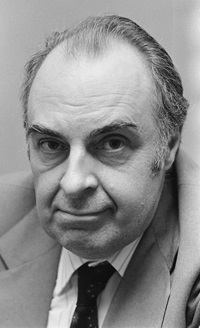
Nigel Kneale was a writer of short stories and scripts, best known for his work in television, the medium that he helped define and which, in turn, defined him, namely for programmes such as The Stone Tape (1972), his adaptation of Susan Hill’s The Woman In Black (1989) and, of course, the Quatermass series (1953, 1954, 1958–59, 1979).
Kneale wasn’t strictly a horror writer, but much of his most successful work either played with the genre or took place entirely within it. His masterpiece in the field is the play ‘During Barty’s Party’, the second episode of his horror anthology series Beasts, which was broadcast by ITV throughout the autumn of 1976.
The overarching theme of the series, and the only thing connecting its six episodes, is the idea of civilisation in conflict with the animal kingdom, and with our own primal, animalistic origins. ‘During Barty’s Party’ sees that conflict writ large in a struggle between the Truscotts, a traditional middle-aged, middle-class, middle-England couple, and an unseen menace from the wild.
We open on an empty sports car, parked on a country lane. Radio on, doors open, skull keyring dangling from the ignition key. And then, the screaming starts…
Cut to: Angela Truscott waking from a bad dream.
Angela, played by Elizabeth Sellars, is a fraught and frightened housewife who, since her husband Roger is out at work all day, and their daughter Kate has long since flown the coop, is left to fend for herself in their large country house. Her only contact with the outside world is their dog Buster, telephone conversations with her mother, and popping round to see their neighbours, the entirely unseen Gibsons. Occasionally Angela turns on the radio and listens to the titular Barty, of Barty’s Party fame. Barty is a smarmy and avuncular disc jockey who hosts a commercial radio show, complete with rockin’ tunes, phone-ins and romantic adverts for holidays far, far away.
When Roger – the only other character we see for the duration of the piece, played by Anthony Bate – comes home, we learn that today has been even more fraught than usual in the lonely and miserable world of Angela Truscott. First, there’s the mystery of that abandoned car, parked in the lane outside, and then there’s the rat problem. There’s a rat, scratching around under the floor. And while Angela can’t see it, she knows it’s there.
Roger, like so many men in 1970s horror television, is an honours graduate of the ‘there, there, dear’ school of comforting women and tries to offer reasonable explanations for his wife’s anxieties. The lane beside their home is often used for passionate liaisons, so the abandoned car has probably been left there by a courting couple, doing more than just holding hands on the settee. As for the unseen rodent, well, simply let Buster deal with it. Except Angela already tried that, and Buster ran for the hills.
Soon, a phone call from Roger’s friend and a news item on the radio confirm Angela’s fears. There have been reports from the outside world of mass rat migrations. Thousands of rats scurrying across country roads. And then, twenty minutes in, the scratching starts. The sound of rats.
BARTY: The guy who runs the program before mine, what is his name, oh forgive me: Oliver. It appears old Ollie turned up something about rats. I gather a couple of his fans phoned in, could you believe fans, to say they’d seen large quantities of these king-sized mices crossing country roads, en famille, so to speak, whole columns of them numbering thousands… It seems the furry folk really are out and about tonight.
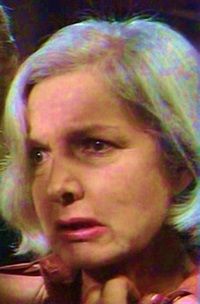
What follows during the next twenty-nine minutes is a masterclass in minimal horror. With only two onscreen characters, a single location, and the persistent, gnawing soundtrack of unseen creatures, Kneale ratchets up the tension, wringing every possible drop of dread from his set up.
As Roger tries ever more desperately to assert his dominance over the rats, the house and his wife, Angela begins to grow in strength, leading to her first attempt to make contact with the outside world, when she phones into Barty’s Party. What was once a lifeline from domestic despond, now becomes her literal lifeline.
While Barty initially treats Angela’s story as lightweight phone-in fare, soon the disc jockey starts to take notice, fearing for her safety. But as she tries to give her name and location so help can be sent, the rats chew through the phone line. Angela’s only means of communication with the outside world has been taken from her. The radio still works however, and the Truscotts listen, powerless to correct him, as Barty promises to spearhead a search across the Hampshire area for a ‘Mrs Angela Prescott’.
With no hope of rescue and the sound of scratching, gnawing rats reaching a cacophony, the Truscotts have no option left but to go outside. Utterly, helplessly terrified of what the rats will do to them, and what presumably they did to the courting couple from the abandoned sports car, Angela swaddles herself and her husband in winter coats and epee masks. Then, at their most desperate moment, there are sounds of life. Their neighbours the Gibsons have returned. And with their arrival, the scratching of the rats stops.
With only minutes left to go, the viewer would be forgiven for believing that the Truscotts are safe, victims only of the overactive imagination of a bored housewife stirred up by media sensationalism. But then the rats resume the attack and we hear the Gibsons screaming.
Now it’s time for the Truscotts. They try to escape upstairs, but it’s too late. As the rats swarm, and the screams of the Truscotts fade away, Barty’s Party comes to an end with this chilling sign off:
BARTY: Now we’re doing all we can but still no positive results. One or two cynics here are even using the word ‘hoax’. Well, that’s happened before. Poor old Barty getting conned and set up ridiculous. But I don’t want to believe it. I’ve got faith in human nature. So before I hand over, I’ll just say this: Angela, sweetie, I hope you really do exist.
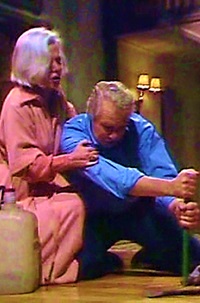
Even at the end of the episode the rats are never shown, always remaining off screen. Thus, the threat they pose to the Truscotts becomes abstract, to the point that – how to put this without sounding too undergraduate? – ‘During Barty’s Party’ isn’t really about rats, is it? The rats are a metaphor for something else. A metaphor for some intangible fear, be it societal, psychological, or existential. Kneale’s script wisely stops short of making the allegory explicit and allows the audience to make up their own minds. So, let’s consider what the rats really are.
As previously noted, the theme that runs through the entirety of Beasts is the conflict between civilised society and the primal, animalistic forces that lurk beneath or beyond it. The rats could be seen to represent those forces; raw and uncontrollable aspects of nature infiltrating and threatening the ordered, domestic world of the Truscotts. Through this lens, we can see how Kneale might be using the rats to explore the fragility of modern life, reflecting a broader anxiety about the thin veneer separating order from chaos. The horror is that no amount of respectability or domesticity can fully insulate humanity from our wild origins.
There is also the ecological issue to consider. The 1970s saw a rise in ecological awareness, in part due to growing concern over pollution and the ever increasing depletion of natural resources. In Britain the trend was personified by the establishment of the Department of the Environment in 1970, the introduction of the Control of Pollution Act 1974, and the foundation of activist groups such as Friends of the Earth (1971) and Greenpeace (1977). It also seeped into the culture of the time, such as do-it-yourself sitcom The Good Life (1975–78), Doctor Who serial ‘The Green Death’ (1973) and the book The Environmental Revolution (1970) by conservationist and founder of the World Wildlife Fund Max Nicholson.
Perhaps the rats symbolise nature’s reaction to mankind’s attempts to take dominion over the Earth. The dialogue makes several mentions of rats’ new-found resistance to the poisons we use against them, speculating that these developments may have resulted in the creatures overcoming their fear of man. We are now, no longer, the enemy that always wins.
ANGELA: Well, they’ve always been afraid of people, we’ve always poisoned them and killed them, and they knew we could… Well, now, our most deadly poison doesn’t work on them anymore… So won’t they know that too?
Speaking of the political background of 1970s Britain, we would be remiss not to linger upon the then contemporary anxiety about urban decay. Throughout the decade British cities were plagued by crumbling infrastructure, extensive demolition, rising unemployment, entrenched poverty and even rat infestations. This was the world that served as inspiration for novelist J.G. Ballard and set dressing for the film Get Carter (1971). From this angle, the Truscotts and their country house could be seen to represent a bastion of middle-class comfort and respectability, with the rats as a pervasive, creeping disorder spreading out from the cities and towards the green and leafy rural spaces.

Of course these are only possible readings, all of which fail to take account of the narrative’s almost absolute focus on Angela Truscott. Angela’s physical and emotional isolation reflects a broader theme of how fragile we are when cut off from community and external support. Her loneliness is not only personal but symbolic of a societal disconnect, particularly for middle-class housewives of the type immortalised by The Jam in their song ‘Private Hell’ released the following year. These women were confined to domestic roles with limited agency or social interaction. It is this isolation that makes Angela so vulnerable to the rats; they turn the metaphorical prison of the house into a very real incarceration. And in her hour of need those whom she’s relied upon to relieve her domestic isolation fail her. Buster runs off, Barty gets her name wrong, and even the refuge of her neighbours is snatched away. The rats leave Angela finally, totally cut off from the outside world.
Alone at 6 o’clock
You drop a cup
You see it smash
Inside you crack
You can’t go on
But you sweep it up
Safe at last inside your
Private Hell
The Jam, ‘Private Hell’ (1977)
What of the role of the media in proceedings? Kneale was often critical of the media in his work. His 1969 television play The Year of the Sex Olympics envisaged a future where the labouring underclasses are squeezed into cities and pushed out of work by automation. To keep these ‘low drives’ docile and unthinking, the elite feeds them a constant diet of mindless, dumbed-down slop straight from the evergreen content pipeline.
They’re watching my show now see. See all their faces. Put ’em off food, put ’em off sex, most of ’em got no work to do. All auto-ed for ’em. Just sit. Dead by 35.
Nigel Kneale, The Year of the Sex Olympics (1969)
In ‘During Barty’s Party’ we find him mocking the commodification of human stories and warning against the haze of artificial frivolity that not only obscures real crises but leaves us impotent to confront them. Angela’s plea to Barty is treated as filler between songs, and despite his eventual concern for her, the media is still no help. Barty misidentifies her and soon begins to think that she isn’t even real. The end of the episode highlights the superficiality of broadcasting as a tool for genuine connection or salvation, years before the rise of parasocial relationships and out-right celebrity worship.
Or maybe, the play really is just about a horde of rats.

My first viewing of ‘During Barty’s Party’ was in 2020, and I can’t see it as being about anything other than the COVID-19 lockdowns. Think of the Truscotts, alone in their house, the world outside almost totally denied to them, save for shouting out the window to their neighbours and listening to news reports on the radio. When they finally do summon up the courage to venture outside, they have to don masks to protect themselves from the unseen threat. The UK rat population is estimated to have increased by approximately 25 per cent during 2020, as a result of delayed bin collections and increased household waste, as well as all those empty buildings.
Of course, for all Kneale’s skills as a sort-of Manx Cassandra, ‘During Barty’s Party’ probably isn’t about lockdown.
But it’s an important point. In its refusal to present an explicit allegory, this unelevated horror grants the viewer more agency. We are left to make up our own minds, should we wish to, about what the rats could be. My rats will be different from your rats. We each have our own version of ‘During Barty’s Party’. By declining to give the rats a definitive meaning, the piece becomes timeless, not tied to any larger cultural moment, or soon-to-be unfashionable artistic mores.
In the end Kneale’s approach is more powerful than the so-called elevated horrors of today. As much as they trumpet their own intellectualism, what the makers of this new horror don’t realise is that we think more when we’re told less.
Kneale was a master of firing up the viewer’s imagination. The production values of pre-CGI television could be a powerful creative constraint for a writer who refused to always give easy answers, and who relished provoking the audience’s thoughts and fears.
For example, the godlike aliens in Quatermass (1979), who come down to Earth and start harvesting people for their grand banquet, are presented as a blinding white light. They have no form, no personality. They just are. And we are invited to struggle to imagine and understand them.
Consider also Beasts stablemate ‘Baby’, in which a newly married couple find the mummified infantile remains of some strange creature hidden in the walls of their new home. One of the builders observes of the corpse: ‘a thing like that, it’ll have been suckled’. It’s a line that sends the viewer’s mind racing to imagine what kind of monster could have borne such a child. And on this occasion, Kneale is only too glad to answer.
In the age of elevated horror, we’re in danger of losing our imaginations to TV, no longer creating meaning for ourselves and instead merely consuming. Chances are we’ll end up like the low drives of The Year of the Sex Olympics. So let us savour and remember while we still can the genius of Nigel Kneale. Because pretty soon we might all be listening to Barty’s Party.
‘During Barty’s Party’ is available on YouTube and on DVD.
see also:


Discover more from Lion & Unicorn
Subscribe to get the latest posts sent to your email.
