JONATHAN CALDER on Joan Temple’s No Room at the Inn and the child-abuse case that lay behind the play and film.
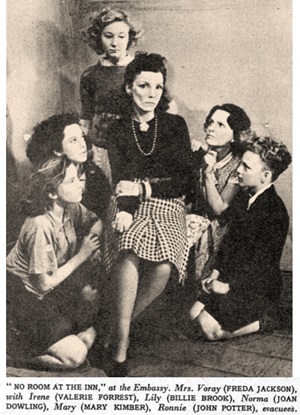
When Joan Temple’s play No Room at the Inn opened in the West End in 1945, its leading actor Freda Jackson needed a police guard. ‘There were always women at the stage door wanting to kill her,’ her son Julian Bird remembers.
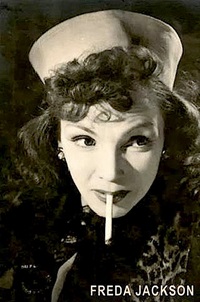
It’s no surprise that an actor as good as Jackson, who had just played Mistress Quickly in Laurence Olivier’s Henry V and was soon to play Mrs Joe in David Lean’s Great Expectations, had a triumph with a part like Agatha Voray. A monster built from cruelty, waning sex appeal and malapropisms, she takes in evacuees and orphans for the money, and then neglects and abuses them. Such was the power of her performance, a newspaper profile reports, that audiences stood and cheered when she finally got what was coming to her.
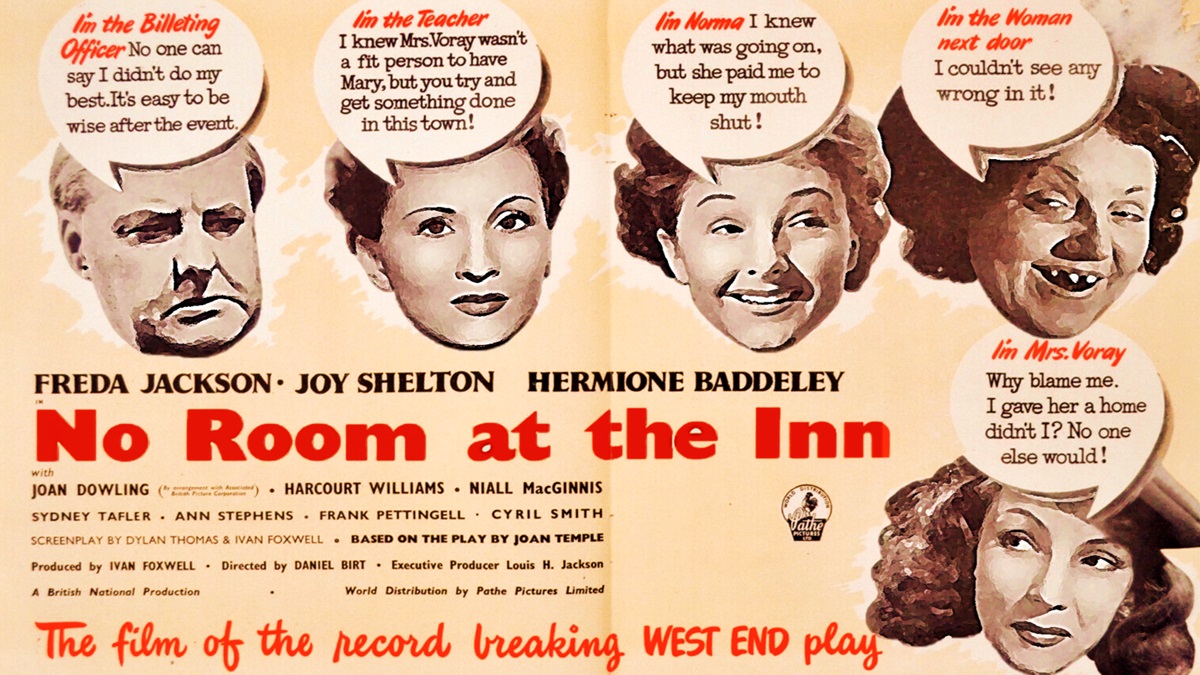
Freda Jackson reprised the role in the 1948 film of No Room at the Inn, which was directed by Daniel Birt and adapted by Ivan Foxwell and the poet Dylan Thomas.
We first see Mrs Voray’s dilapidated house through the arch of a railway bridge, and this Gothic mood is maintained throughout the film. She is already hosting three girls and a boy in her verminous Udolpho, and is prevailed upon to accept a fourth girl, Mary O’Raine, whose mother has died and whose father is away in the Merchant Navy.
Voray immediately takes against Mary’s middle-class ways – the next time we see Mary’s warm coat is in the window of a pawn shop. When Mary’s father arrives on leave and she tells him about her life in the house, he says he will sort Voray out ‘with a look’. But Voray seduces him and afterwards wears as a trophy the watch that Mary’s mother had meant for her.
Mary comes to bond with the traumatised Ronnie, the only survivor of the bombing of his family home. But the dominant figure among the children is the urchin, almost goblin, figure of Norma, played by the remarkable Joan Dowling. She is the only child who dares go toe-to-toe with Voray, timing her requests for money or sweet coupons at moments when the monster has a visitor she wishes to impress.
A sympathetic teacher, Judith Drave (played by Joy Shelton), manages to get Mary the offer of a better home, but Mary refuses to leave unless there is room for Ronnie too. And so she is condemned to stay.
Judith Drove then devotes herself to exposing Mrs Voray. As Meredith Taylor writes in an essay on the film:
A powerfully written and acted moment occurs when Miss Drave, who has complained about Mrs Voray’s behaviour, is asked to give evidence at a town councillors’ meeting. They dislike Miss Drave’s assertive manner. When Mrs Voray has her right to reply she adopts the manner of a humble woman struggling to do her best during wartime restrictions.
The schoolteacher sees right through her performance. But the council members (half of whom have flirted with Voray) believe her account of things over the teacher’s. I love Dylan Thomas’s writing here. His social concern is angrily targeted at bureaucratic corruption and ineptitude.
Voray hits the town to celebrate her victory, though the rain prevents her wearing the new hat that she sees as key to keeping up her wavering sex appeal. She arrives at a bar, only for the young Dora Bryan, in one of her first films, to steal her date and the scene. While Voray takes solace in drink, back at the house the children are dressing up in her clothes, and the feather in her new hat gets broken.
She staggers home, and when she finds the hat damaged, blames Ronnie and locks him in the outside coal bunker. Mary and Norma fear for his life on such a cold night, so when Voray falls asleep, the girls get the keys off her and go to let the boy out. Voray wakes up, rushes after them and falls to her death when the rickety banister on the staircase gives way.
The film ends, as it begins, with the respectable, adult Mary working in a department store. She returns to her post to find a shoplifter has been detained, and that the shoplifter is Norma. Mary swears to herself that she will help Norma, because she could so easily have become a thief herself.
Whatever the fate we feared for Mary in that house, it was something far worse than being a shoplifter. I am reminded of G. K. Chesterton’s observation on Dickens and his characters: ‘When the book closes we do not know their real secret. They soothed the optimistic Dickens with something less terrible than the truth.’
Except we do know the truth that lay behind the film of No Room at the Inn. First there was the stronger meat of the play, where Voray is smothered in her drunken stupor – you can debate how accidentally – by Mary and Norma as they search her for the keys, but the film censors were never going to allow that on screen.
And behind the play there lay a real child abuse tragedy that scandalised the nation even as the Allied armies closed on Berlin. ‘A strong parallel is drawn to a recent case,’ as the advance publicity in The Stage said.
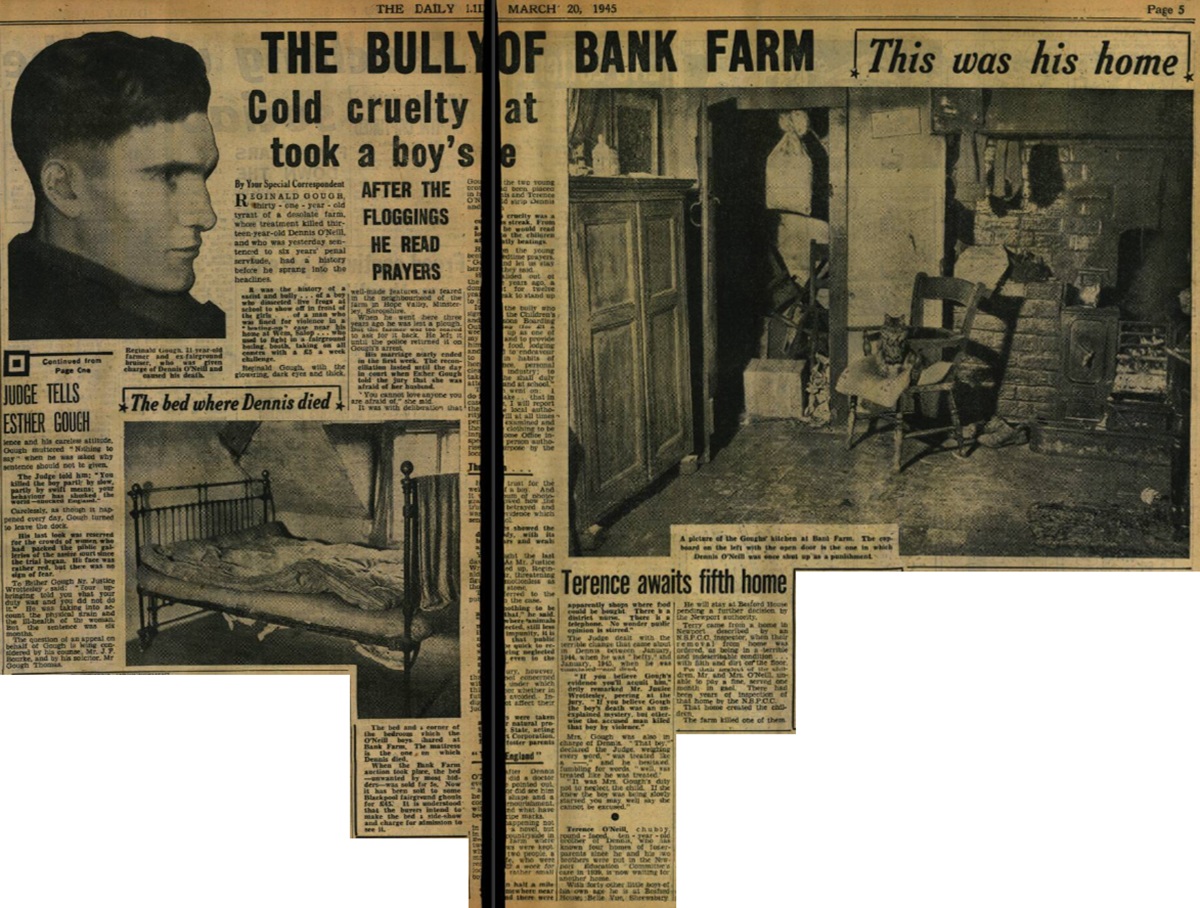
That case was the death of Dennis O’Neill at Bank Farm, Minsterley, on 9 January 1945.
Two brothers – Dennis and Terence O’Neill, aged 12 and 9 – who had long been in the care of Newport Borough Council in South Wales, were boarded out at the farm, which lay in the shadow of the Stiperstones in Shropshire, to be looked after by Reginald and Esther Gough.
There was confusion, even ill feeling, between the authorities in Newport and Shropshire over who was responsible for ensuring the boys’ welfare, and a general shortage of staff because of the war. The result was that a doctor did not see the brothers until 9 January 1945, by which time Dennis was dead.
He died a martyr to the chilblains and chapped legs that were the enemy of all children in that harsh wartime winter, to nightly beatings and to underfeeding: the O’Neill brothers lived chiefly on bread and butter.
Barbara Cartland, then a notably sensible voice in wartime welfare work, wrote in her memoirs:
I shall never, in all my life, forget the horror I felt on reading of how that little boy had suffered before he died – his hunger, his terror, his maltreatment haunted me, and like thousands of other women in Great Britain I could not sleep for thinking of him.
And there was plenty to read, as the newspapers reported the inquest and committal hearing at the tiny Pontesbury Magistrates Court, then the trial of the Goughs in Stafford – it was moved from Shrewsbury because feeling was running so high in Shropshire – and finally the official inquiry chaired by Sir Walter Monckton.
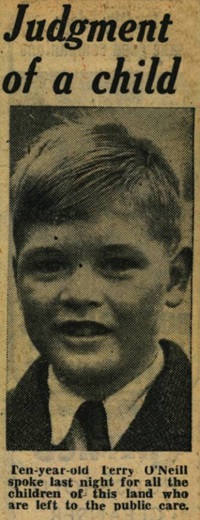
The chief prosecution witness was the 10-year-old Terry O’Neill. Fair-haired and too small to see over the witness box, he sat at the front of the court and told the story of his and his brother’s abuse. The public sent gifts of money, toys and sweets for him to the Shrewsbury children’s home where he now lived.
Despite the defence’s attempts to blacken the boys’ characters, the jury took just 20 minutes to find Reginald Gough guilty of manslaughter and his wife guilty of neglect. They received sentences of six years and of six months respectively.
Sir Walter Monckton’s inquiry found what every such inquiry has found since: a need for different services to work together more effectively.
Public anger was concentrated, not on the Goughs, but on Newport’s education committee, which had taken the O’Neill brothers into care in the first place and then failed to ensure their safety. On the few visits that officialdom paid to Bank Farm, the boys were never spoken to without the Goughs being present. That anger surely inspired the scene set in the council chamber in No Room at the Inn.
Barbara Cartland was not the only grande dame moved by the story of Bank Farm. Asked by the BBC in 1947 to contribute a short radio play to an evening celebrating Queen Mary’s 80th birthday, Agatha Christie came up with Three Blind Mice. This was a murder mystery centred on the avenging of the death of a child who had been cruelly treated after being boarded out on a farm.
This element survived the transition to a full-length stage play, with the result that Terry O’Neill (or the sister Christie gave him and Dennis to widen the pool of suspects – no spoilers here) has been avenging his brother’s death in the West End since 1952. The play that Three Blind Mice became was The Mousetrap.
Whether this is how Terry, who died in 2023, deserves to be remembered is another matter. His courage as a child secured the conviction of his brother’s killers, and the book he published in 2010, Someone to Love Us, has ensured that his story is better known than it used to be.
No Room at the Inn had its own tragedies: Joan Dowling was to take her own life in 1954 at the age of twenty-six; Freda Jackson became a player of literal monsters, because the British cinema of the 1950s struggled to accommodate such a powerful female presence. But, dark as No Room at the Inn is, the deeper story the film hints at is darker still.

Visit Jonathan Calder’s excellent blog Liberal England.
see also:
Discover more from Lion & Unicorn
Subscribe to get the latest posts sent to your email.
