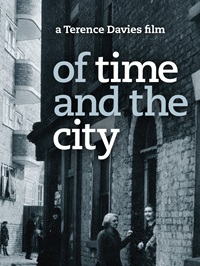
SIMON MATTHEWS on Terence Davies’s film Of Time and the City (2008)
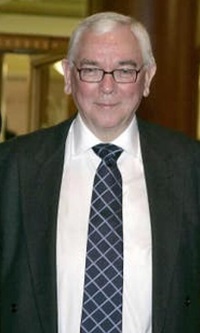
Rather like his contemporaries Mike Leigh and Ken Loach, the films of Terence Davies were much feted abroad, whilst being distinctly at variance with the free-market politics that dominated the UK after 1979.
From Liverpool, he went to drama school in 1971 as a mature student without any qualifications, and quickly gravitated toward filmmaking. A small, discreet body of work followed, much of it funded by the British Film Institute and Channel 4. Eventually, in 1988, Distant Voices, Still Lives, a terrific recreation of Liverpool in the 1940s and ’50s, wowed everyone.
Four years later, he explored similar terrain in The Long Day Closes, and was nominated for the Palme D’Or at Cannes. Hollywood called and an adaptation of John Kennedy Toole’s ‘unfilmable’ The Neon Bible (1995) followed. It didn’t set the world alight commercially, but, as would be the case with all his work, was praised for its ‘stunning photography and poetic approach.’
Over the next 26 years he made five more feature films. Which may seem a rather limited output, except that when one factors in unmade projects, his decision not to work in television and the usual, endemic, funding issues that beset UK directors, was probably to be expected. It was during the gap between two period dramas – Edith Wharton’s The House of Mirth (2000) and Terence Rattigan’s The Deep Blue Sea (2011, something he was surely put on Earth to adapt) – that the BBC and Liverpool Culture Company came knocking.
They did so once Liverpool’s bid to become European Capital of Culture in 2008 had been successful, and the City Council had set up the Culture Company as a wholly owned subsidiary to deliver a programme of events ‘up to and beyond 2008.’ Part of this included making a film that would celebrate the city and obtain a wide cinematic release. Davies was an obvious, indeed probably the only, choice for such a commission, and Of Time and the City was his response.
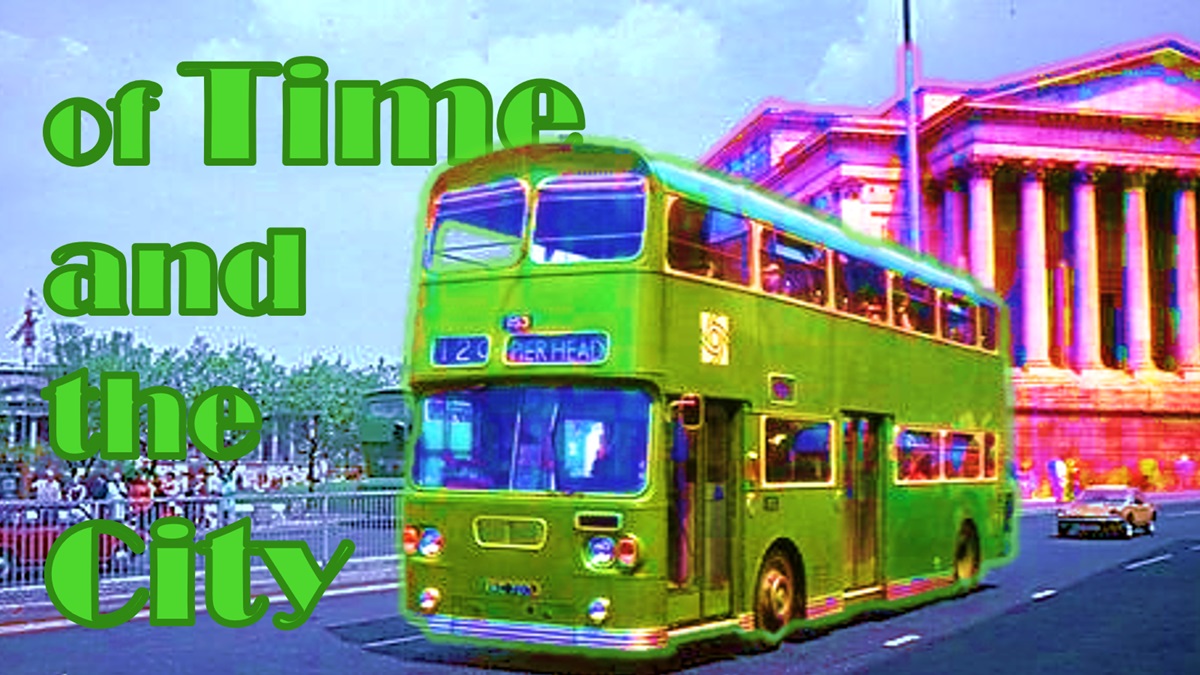
It unfolds via a plethora of historic images, culled from newsreels, documentaries, even home movies. There are shots of the massive, and now vanished New Brighton Lido. Football matches (of course), audio clips from Round the Horne, presumably to recreate the living-room ambience of the pre-TV era, and footage of long forgotten film premieres, with glamorous stars in attendance locally. Much of this is in black and white, though some colour does intrude.
There are so many shots of the Liverpool Overhead Railway that one might assume Davies was a closet train-spotter. Which is not to say that the LOR (or ‘Dockers Umbrella’ as it was known) wasn’t worth celebrating. A brilliant piece of inner-city engineering, it was never part of the British Rail system and remained in private ownership until the cost of renewing some of its infrastructure, for a ridiculously small amount of money by today’s standards, caused it to close in 1956.
An abundance of poetry and music accompanies the beautiful images. The pitch is firmly retrospective throughout, and rooted in Davies’s own childhood. Soldiers march away to the Korean war, an Orange parade passes by, Ewan MacColl sings ‘Dirty Old Town’ whilst slum clearance happens and new estates are built. In a nod to his teenage years, we hear the Hollies (from Manchester, like MacColl) and glimpse the Beatles in their pomp. As an exercise in editing, this is unsurpassed, with much of it only possible because of the use of new digital technology that allows zooming in, enhancement and colourisation.
Not content with deploying his cutting-room (or laptop) skills, Davies is also the uncredited narrator, albeit in a film where everyone is uncredited. He uses this to muse about his sexuality, quotes liberally from Joyce, Engels and many others whilst expressing his religious (Roman Catholic) doubts, and his anti-Royal and anti-Empire opinions. The film concludes with ruins; the death of the old city. It is a remarkable fugue and rumination, Proustian in its scope.
Liverpool Culture Company, rebranded Culture Liverpool still exists, operating out of the Cunard building. Sadly, they haven’t made a film since 2010, when austerity kicked in. How could they? As part of a mercilessly cash-strapped council, the money isn’t there, and with the UK exiting the EU, matching funding from that quarter is no longer possible.
When looked at today, and accepting that any comment or criticism about a work of this quality seems superfluous, Davies’s film, although magnificent in its execution, seems overly nostalgic, and very much at odds with how the city would have presented itself in the 1960s and ’70s. Back then, documentaries about local authority areas and regions were optimistic, forward-looking; they stressed – sometimes rather absurdly – modernism, and how best to meet the challenges of a jet age/space age future.
By contrast, so retro is Davies’s vision that it isn’t clear what direction he envisages the city might take. His account is merely about how it reached a certain point in its evolution. It would have been interesting to know a bit more about his views in this area, but after a final period drama (Benediction, 2021, about Siegfried Sassoon), he died in 2023.
Of Time and the City is a fine example of his work and one that might, in a better country, have led to similar documentaries celebrating other major cities.
see also:


Discover more from Lion & Unicorn
Subscribe to get the latest posts sent to your email.
